

What This Sprint Delivers
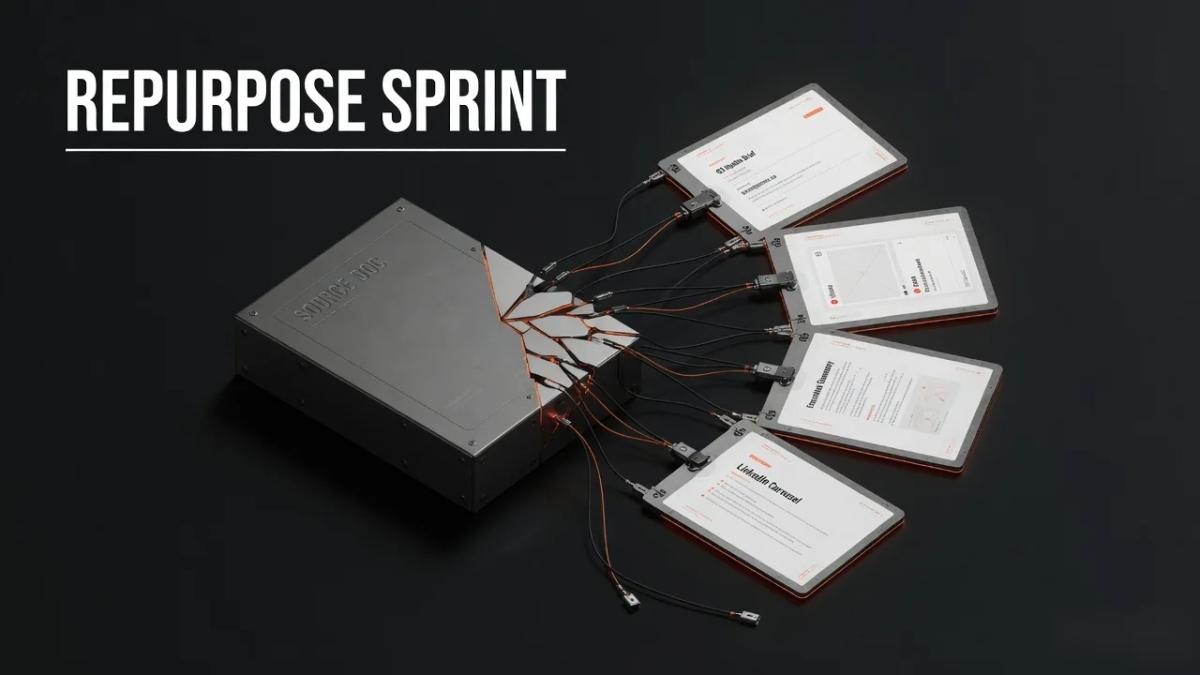
Ten business days. One approved pillar asset. Four derivatives built for four different jobs — a newsletter edition, two to three LinkedIn cuts, a sales one-pager, and an FAQ/SEO extract — plus the distribution brief that explains why each exists, who it reaches, and how you will know it worked.
You leave with a distribution system, not a content dump: an asset on the site, channel-specific slices, named owners, and a 30-day measurement note. If the pillar is already live, the sprint starts at day two.
Why Distribution Is the Bottleneck in 2026
Production has never been cheaper or more crowded. In CMI’s B2B Content and Marketing Trends: Insights for 2026 report (1,015 B2B marketers, conducted with MarketingProfs), 95% of organizations use AI-powered applications and 89% use AI for content creation. The results are expected: 87% report improved productivity and 80% improved operational efficiency. The deeper numbers fall off a cliff — only 58% say content quality improved, only 39% say content performance improved, and 12% say quality went down.
HubSpot’s 2026 State of Marketing agrees: 61% of marketers call AI the biggest disruption to marketing in 20 years, and 80% already use it for content creation. Kieran Flanagan, HubSpot’s SVP of marketing, AI, and GTM, draws the consequence: more content is now generated by AI than by humans, most of it average, and consumers tune out brand and AI-generated content — moving to gated spaces AI has not overrun, like newsletters, podcasts, and YouTube.
Search has flipped the same way. Robert Rose at CMI argues we have moved from a world of “be found” to a world of “be cited”: only 12% of URLs cited by ChatGPT, Perplexity, and Copilot rank in Google’s top 10 for the corresponding query, and more than a quarter of ChatGPT’s most-cited pages have zero organic visibility. Rankings no longer predict whether you appear in the answer your buyer reads. And buyers are listening to people, not pages: LinkedIn’s 2026 Global B2B Marketing Outlook (YouGov, 1,299 marketers in the US, UK, France, Germany, and India) finds 83% of B2B marketers say credibility matters more than traditional brand messaging and 70% say buyers rely more on peer voices and experts than brand-produced content; 56% of buyers depend on creator input in the final stage of the buying process.
Put those four findings together and the job is clear: producing more is the wrong response. The teams that win take one strong asset and distribute it deliberately — deciding which slice of its value goes where, and who else can carry it. That is what this sprint forces.
Prerequisites
You need the hard part already done: an approved pillar with a direct answer — every derivative is an argument cut from the same cloth. Before day 1, name one owner per channel plus a distribution owner who carries the brief and the calendar. CMI’s research shows 39% of B2B marketers cite resource constraints as a top challenge; unnamed ownership is how that constraint wins.
The Distribution Brief
Rose’s July 2026 argument on CMI is the foundation: distribution is not promotion, it is audience development. Promotion pushes a finished asset at strangers and prays for a click; audience development decides which slice of the idea’s value goes where so a relationship can start. The working artifact is a distribution brief with three decisions — the slice, the ask, and the signal.
| Decision | Question it answers | 2026 evidence for the answer |
|---|---|---|
| The slice | Which part of the idea’s value goes to which surface? | Owned surfaces (newsletter, site) earn the depth — Flanagan’s point that content is moving to gated spaces like newsletters. Rented surfaces (LinkedIn) earn the provocation — 76% of B2B marketers rate LinkedIn their most effective thought-leadership channel (CMI). |
| The ask | What do you invite people to do on each surface? | Rented: almost nothing, a follow at most. Owned: subscribe, reply, show up. Mailchimp’s Art of the Opt-In research: 56% of subscribers stay for content that adds value, 40% for frequency that does not feel like spam. |
| The signal | How will you know it worked? | Rented: alignment — did the argument travel? Owned: trust and advocacy. For AI search: presence in the right conversations, share of voice, and accurate representation (Rose, July 2026). |
Use the content brief template to lock the pillar’s thesis, then add the distribution brief as its second page. The brief is the contract for days 5 through 7.
The 10-Day Plan
| Days | Work | Deliverable |
|---|---|---|
| 1–2 | Lock the pillar’s direct answer; extract the value inventory: claims, data points, definitions, frameworks, and the objections it answers. | Value inventory |
| 3 | Write the distribution brief with the slice, ask, and signal per channel. | Distribution brief |
| 4 | Publish the pillar, structured for AI search: clear definitions, citable claims, and a Q&A block. | Live pillar |
| 5 | Draft the newsletter edition. | Email draft |
| 6 | Draft two to three LinkedIn cuts from the pillar’s sharpest tensions. | LinkedIn drafts |
| 7 | Build the sales one-pager and the FAQ/SEO extract page. | Sales + SEO assets |
| 8 | Ship on a calendar; add internal links; set up tracking. | Live derivatives |
| 9 | Brief sales; compile the shortlist of employees, customers, and creators who could carry the argument. | Enablement + amplification list |
| 10 | Log experiments and write the 30-day measurement note. | Measurement note |
Days 1–2: Lock the pillar and build the value inventory
Treat the pillar like a buffet, as Lightcast’s JP Lespinasse describes research-based content in CMI’s August 2026 piece: put everything on the table — claims, stats, definitions, frameworks, objections — and let each audience take what it needs. If a claim cannot be quoted cleanly or traced to a source, fix it now; every derivative inherits it.
Day 3: Write the distribution brief
Fill in the table above, including one decision most teams skip: what you will not repurpose. An idea supports four or five good derivatives, not twelve. CMI’s research found the top challenge for 40% of B2B marketers is creating content that prompts a desired action — the brief fixes this by stating the ask before the asset exists.
Day 4: Publish the pillar for AI search
Structure the page with definitions, a direct answer up top, named frameworks, and a Q&A block. Rose’s July 2026 analysis is the evidence: AI answer engines are synthesis systems, not retrieval systems. They decompose a question into variations (“query fan-out”), retrieve from many sources, and compose an answer. Your page earns a citation by being the clean, citable version of the argument.
Day 5: Draft the newsletter edition
The edition is not the article re-sent. It is the pillar’s argument compressed to its value: the direct answer, the framework, the one or two numbers that changed your mind. Mailchimp’s Art of the Opt-In report (6,000+ consumers and 2,000+ marketers, fielded by Ascend2 in late 2025) is blunt about retention: 56% of subscribers stay for content that adds value, 40% for frequency that does not feel like spam. CMI’s Ann Gynn adds the warning from the same data: 74% of consumers do not want more than two messages a week, yet 21% of marketers send several in the first 30 days. One value-dense edition beats three thin ones; if you run a recurring newsletter, this edition slots into your cadence — see the newsletter growth system for the retention mechanics around it.
Day 6: Draft the LinkedIn cuts
CMI’s research ranks LinkedIn the most effective thought-leadership channel at 76%, ahead of email newsletters (54%) and speaking events (52%). The winning format is the provocation: the sharpest tension in the pillar, the argument only you would make — not a summary with a link. One cut per tension, written to be quoted. That matters because the LinkedIn outlook data says the audience for your argument is other people who will carry it: 82% of B2B marketers say creators increase credibility with decision-makers, and 56% of buyers use creator input to validate final decisions. Give employees and category voices something quotable to post. For finding those voices, CMI’s August 2026 expert roundup is the practical playbook: skip follower counts, read the comments, and start with customers and employees who already talk about your category.
Day 7: Build the sales one-pager and FAQ/SEO extract
Salespeople are not asking for awareness brochures. CMI’s August 2026 interviews with sales professionals are specific: deals are won in the follow-up conversations and the trust built over time, not in the pitch, and what sales needs is “ammunition” that fits real customer discussions — objections, industry changes, emerging risks, and the questions buyers ask when deciding. Build the one-pager for that job: the framework in three steps, the two or three numbers that hold up in a call, and a block of objection answers. Connect it to your GTM messaging architecture so it says the same thing the rest of the business says — CMI’s research shows alignment with sales is cited by 45% of effective B2B marketers as a driver of results.
The FAQ/SEO extract is the flip side of the same inventory: five to ten questions buyers actually ask, each answered in two to three sentences on its own page. These pages are the raw material AI search citations are built from, and each unanswered conversation gap is a content brief in waiting.
Day 8: Ship on a calendar
Ship on a calendar, not a dump day. Stagger the newsletter, the LinkedIn posts, and the FAQ pages so each surface carries the argument at its own pace. Wire internal links between the pillar, the FAQ pages, and related hubs — the distribution system should also be a navigation system. The content distribution checklist covers the pre-launch details (tracking, images, alt text, social cards) that collapse at the end of a sprint.
Day 9: Brief sales and build the amplification list
Thirty minutes with the sales team: where the one-pager lives, what each section is for, and which objection block fits which deal stage. Then write the amplification list — five employees, three customers, two category creators — with the specific slice each could credibly post. The LinkedIn data says peer voices outsell brand voices; the list is how you make that structural.
Day 10: Log experiments and set measurement
Log what you tested: subject line, hooks, posting times, which slices traveled. Then write the 30-day measurement note — what you will watch, what number triggers a change, and who owns the review. A third of B2B marketers (33%) say measuring content effectiveness is a top challenge; the note is the cheap fix.
AI-Assisted Repurposing: What the Data Says to Automate and Decide
CMI’s 2026 numbers draw a clean line. AI reliably improves the mechanics — 87% report better productivity, 80% better operational efficiency — and not the judgment: 58% report better content quality and only 39% better content performance, while 12% report worse quality. HubSpot’s report makes the same point, and Flanagan’s warning is that the teams who outsource the craft itself produce the average content people tune out.
Automate the drafts, not the decisions:
- Automate: first-draft social posts from value-inventory claims, email subject-line variants, metadata and alt text, transcription cuts, summary paragraphs.
- Decide by hand: which insights deserve a derivative, which surface each slice belongs on, the tone, the argument’s edge, and whether the claim is true and citable.
The second-order trend is worth watching: 28% of B2B marketers say they experiment with AI agents, rising to 43% among pacesetters. Agents will eventually schedule, repackage, and distribute on their own — which makes the brief discipline more important, not less. Someone has to decide what the system is for before the system runs itself.
Measurement
CMI’s thought-leadership data shows most marketers measure the wrong layer: 80% track audience engagement (views, downloads, shares) while 63% track business impact. Impressions tell you whether the post went out, not whether the system worked. Set one signal per surface from the brief:
- Newsletter: open and click-through against your baseline, reply rate, and new subscribers attributed to the edition.
- LinkedIn: comments and shares that quote or challenge the argument — engagement quality, not reach. Check whether the employees and customers on your list actually posted.
- Sales: one-pager usage in deals (ask sales), objections answered in conversation, and any deal it appeared in.
- Search: for the FAQ pages, track which questions appear in AI answers over 90 days. Rose’s framework is the standard: presence in the conversations that matter, share of voice, and accurate representation — being named as “the expensive option” is a mention, not a win.
One number triggers a change; one owner reviews at day 30. That is the whole measurement system.
Anti-Patterns
- Resizing instead of slicing. Four versions of the same asset with different word counts is not repurposing; it is recycling.
- Newsletter as headline dump. Sending the pillar’s link with no added value violates the two rules subscribers cite for staying: value and frequency (Mailchimp, 2026).
- One-pager as brochure. Sales asked for ammunition for the follow-up conversation, not an awareness asset (CMI, August 2026).
- Measuring impressions. It tells you nothing about whether trust or pipeline moved, and CMI’s data shows it is the default.
- Treating creators as a campaign. CMI’s expert roundup is consistent: creator relationships fail as one-off spend rather than an owned function. Name the owner before the first outreach.
- Repurposing with no distribution owner. If nobody owns the calendar, the sprint ends and the system stops.
Sources
- Robert Rose, Content Marketing Institute. “9 Takeaways and Insights From the 2026 B2B Content and Marketing Trends Report.” October 8, 2025. https://contentmarketinginstitute.com/b2b-research/b2b-content-marketing-trends-research
- HubSpot. “The 2026 State of Marketing Report.” https://www.hubspot.com/state-of-marketing
- LinkedIn. “How B2B Brands Can Drive Impact with Creators and Stronger Creative on LinkedIn.” June 10, 2026. https://news.linkedin.com/2026/how-b2b-brands-can-drive-impact-with-creators-and-stronger-creat
- Robert Rose, Content Marketing Institute. “Why Your Distribution Strategy Is Stunting Your Audience Growth.” July 14, 2026. https://contentmarketinginstitute.com/strategy-planning/distribution-strategy-audience-growth
- Robert Rose, Content Marketing Institute. “Why AI Search Is a Conversation, Not a Keyword.” July 27, 2026. https://contentmarketinginstitute.com/content-optimization/ai-search-conversation
- Intuit Mailchimp. “New Intuit Mailchimp Report Reveals What Marketers Overlook at the Opt-In Moment and Why It Matters.” February 4, 2026. https://mailchimp.com/newsroom/art-of-the-opt-in/
- Ann Gynn, Content Marketing Institute. “Does Your Email Program Violate the No. 1 Rule in Content Marketing?” July 23, 2026. https://contentmarketinginstitute.com/content-distribution-promotion/email-program-content-marketing
- Mike Carrozzo, Content Marketing Institute. “What Your B2B Sales Team Wishes You Knew.” August 5, 2026. https://contentmarketinginstitute.com/demand-generation/b2b-sales-team-buyers-journey
- Content Marketing Institute Team. “How To Turn Original Research Into a Content Marketing Superpower.” August 6, 2026. https://contentmarketinginstitute.com/strategy-planning/original-research-marketing-superpower
- Ann Gynn, Content Marketing Institute. “12 Expert Ideas For Finding B2B Creators Who Drive Results.” August 12, 2026. https://contentmarketinginstitute.com/content-distribution-promotion/finding-b2b-creators