

Direct answer
A GTM messaging architecture is the structured map from your positioning down to the exact claims, proof points, and language every channel draws from — website, outbound, sales, product marketing, and increasingly, what AI answer engines say about you. It exists to solve one problem: buyers encounter your company in many places, and every encounter must leave them with the same true story.
In 2026 that problem got harder and more valuable at the same time. G2’s “The Answer Economy” research found 51% of B2B software buyers now begin their purchase process in an AI chatbot rather than a search engine, 69% chose a different vendor than they initially planned based on AI guidance, and 85% think more highly of a vendor when an AI chatbot mentions them in a recommendation. Meanwhile Wynter’s 2026 survey of 101 B2B SaaS CMOs found 80% arrive at sales calls at least moderately familiar with the vendor — 48% “very familiar,” up from 22% a year earlier. Discovery is over before most marketing teams get a chance to touch the buyer. The question isn’t whether you can control the narrative. It’s whether you have a coherent one to control.
The economics reward coherence. Revenue Memo’s 2026 alignment analysis reports that companies with strong sales-marketing alignment grow at 20% annually while misaligned companies decline 4% — and that misalignment costs US businesses an estimated $1 trillion a year, with only 8% of companies reporting strong alignment. A messaging architecture is the cheapest alignment mechanism that exists: it forces sales and marketing to agree on what is true before anything ships.
Why this changed in 2026
Three shifts made messaging architecture a revenue system rather than a brand exercise.
AI answers are now a channel with a shortlist. G2’s March 2026 survey of 1,076 buyers found a third purchased from a vendor they had never heard of before, and 4 in 5 said AI chatbots accelerated their decision. The LinkedIn B2B Institute and Ehrenberg-Bass found the same dynamic in their GenAI mindshare research: GenAI buyers consider only 2.4 brands on average. When your positioning is vague, AI summarization makes you interchangeable; when it is clear and consistent, it is the thing an LLM can quote. Your messaging architecture now has an audience it was never designed for.
Buyers arrive educated — calls are for validation, not discovery. Wynter’s CMO data shows 68% of CMOs start searches with AI tools before traditional search engines and LLM recommendations rank #4 among consideration factors, ahead of Google research and supplier content. Peer communities rank #1 — 42% of CMOs rank word of mouth first, and 65% start vendor searches in private communities; cold outreach ranks dead last at 2%. In that world, the pre-call narrative decides the meeting’s outcome. Gartner’s 2026 finding that 67% of B2B buyers prefer a rep-free experience is the same signal: the message does the selling before any human is involved.
Trust is scarce and consistency is how you earn it. The 2026 Edelman Trust Barometer (33,938 respondents across 28 countries) found 7 in 10 people are unwilling or hesitant to trust someone with different values, facts, or approaches — an “insular” mindset. Buyers increasingly trust their own circles: peers, communities, and now AI tools that synthesize opinions for them. Contradictory claims across your channels are exactly the kind of dissonance that gets you excluded from those circles. Employers were also rated the most trusted institution to broker trust — which is why B2B brands that speak with one consistent voice keep winning the benefit of the doubt.
Positioning first: the foundation that can’t be copied
Messaging architecture sits on top of positioning, and it’s worth being precise about the difference. As April Dunford puts it in her quickstart guide to positioning: positioning is not messaging, and it is not a tagline. Positioning is “how your product is a leader at delivering something that a well-defined set of customers cares a lot about.”
Her five components — competitive alternatives, differentiated capabilities, value for customers, target segment, and market category — form a decision chain, and the order matters. Start with competitive alternatives (“what would the buyer do if you didn’t exist?” — often the status quo; Dunford notes enterprise sellers typically lose about 25% of deals to “no decision”), then find what you have that alternatives lack, then translate those capabilities into value (“so what?”), then identify who cares most, then choose the category that makes that value obvious.
The architectural consequence: your messaging hierarchy is downstream of these choices, never upstream. If the category is wrong, no amount of copy polish fixes the foundation. The good news is the hierarchy then does the heavy lifting of consistency.
The message hierarchy: value prop → pillars → proof → channel adaptations
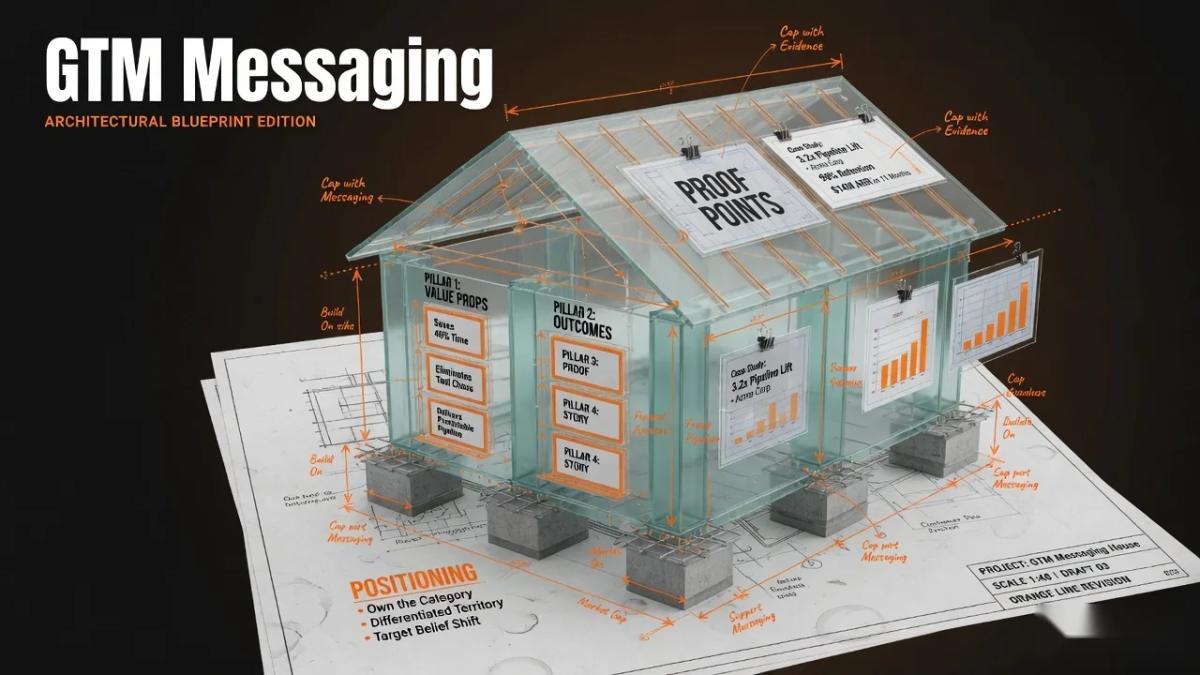
A messaging hierarchy is a language system: a set of claims grouped and ordered so any team member can adapt messaging to an audience without drifting from the core. In practice, four layers do the work:
Layer 1 — Positioning statement and value proposition. The single sentence that states what you do, for whom, and the transformation delivered. This is the layer LLMs will quote, so it must pass what you might call the paraphrase test: if an AI answer summarized your category in three sentences, would your claim survive?
Layer 2 — Value pillars (3–5 durable claims). The functional buckets that support the core narrative. Express each as a customer outcome, not a feature: “eliminate manual data silos,” not “automated cloud reporting.” Pillars change quarterly at most; they are the stability your channel owners build on.
Layer 3 — Proof inventory. The evidence behind each claim: customer testimonials (36% of sales professionals say they’re the most effective enablement content for winning deals), market research (35%), reviews (30%), and demos — per Sopro’s 2026 alignment data. Without proof, messaging is aspiration. Revenue Memo reports 60–70% of B2B content goes unused; most often because the topic never attaches to a claim a seller can defend. The rule: no claim ships without a linked proof point.
Layer 4 — Channel adaptations. The same claim expressed at different densities: website long-form storytelling, outbound three-sentence hooks with one metric, sales decks proof-heavy, social hook-driven, product pages spec-heavy. Adaptation is architecture; contradiction is chaos. If the website promises “quarterly time-to-value” and outbound says “30 days,” no hierarchy can save you.
The most common 2026 failure is skipping straight to Layer 4. Teams generate per-channel copy because it feels faster, then discover buyers comparing notes across communities and AI summaries. Demand Gen Report’s 2026 B2B trends research found 96% of B2B marketers now use AI in their roles, and 23% use it specifically to hone messaging and personalize campaigns. More production velocity without a shared source of truth just scales the inconsistency.
The operating artifacts
Two artifacts turn the hierarchy into an operating system.
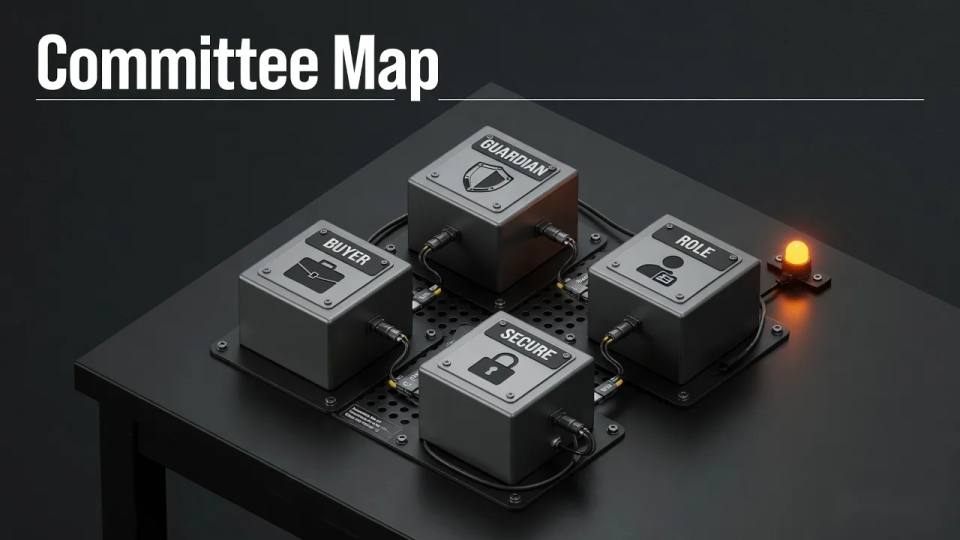
The messaging matrix. A persona × problem × claim × proof table. For each buying-committee role — and the buying group matters more than ever (map the full committee, not just the champion) — define the specific problem, the value claim, the proof point, the likely objection, and the response. A CTO’s integration risk gets different claims than a CFO’s cost predictability; the pillars underneath stay identical. This is the document that fixes the “broken handoff” — 53% of companies have handoffs where sales follows up on fewer than 35% of marketing-engaged prospects, often because sales never saw a claim it believed.
The single source of narrative truth. One versioned, dated document containing the positioning statement, pillar definitions with proof links, persona-level messaging, objection responses, and campaign-angle templates. It lives where both teams actually work, with a change log that explains why claims changed — because churn in claims is the second-most common failure mode. This connects directly to the operating rhythms of a demand-generation system: the architecture is content governance, and the operating system is the cadence that keeps it alive.
Governance: who can change what
Architectures die from either rigor or rigor mortis. The fix is ownership tiers matched to change speed:
- Category POV — CEO + CMO. Changes in years; should survive a CEO transition.
- Value pillars — product marketing + sales leadership. Quarterly review.
- Proof inventory — product marketing + customer success. Continuously updated; dead proof is worse than no proof.
- Campaign angles — demand gen or content owner. Weekly, single owner, but every angle must trace back to a pillar.
- Channel dialects — channel owners. Per-campaign adaptation within guardrails.
The governance question that predicts survival: can a new SDR and a senior AE describe your value proposition identically after reading the doc? If not, the architecture exists but isn’t operational. This is also where entity clarity matters — define the category, product, and outcome terms precisely, because AI systems and buyers both rely on stable naming.
Testing: the 2026 upgrade
The biggest upgrade to messaging practice this year is that testing is now cheap, fast, and part of the default workflow. Message testing against real ICP audiences — the practice Wynter built its product around — uses a layered evaluation derived from thousands of tests: clarity, relevance, value, differentiation. In one public test, 58.06% of panelists preferred Klue’s homepage copy over Crayon’s on exactly those layers, mostly on clarity. The lesson generalizes: most B2B messages fail on clarity before anything else, and clarity is testable in days, not quarters.
Test at three points: positioning statements and value props before launch (against your ICP, not your team), campaign angles before they hit channels, and the channel adaptations against each other — outbound hooks in particular, since cold outreach has become the lowest-trust channel in B2B. And keep creative effectiveness in scope: the B2B Institute’s “Cashing in on Creativity” research with System1 shows 5-star creative can generate 10–20x more sales, driven by emotion, fluent brand devices, and commitment over time. Architecture doesn’t mean boring; it means your best creative is repeatably on-strategy.
Common failure modes
1. “AI-powered everything.” When every competitor’s AI answer sounds alike, the LLM has nothing to quote. Differentiate on specific pain and specific outcome.
2. Feature-led pillars. Pillars must be outcomes. This is the single most common rewrite we see in messaging matrices.
3. Sales ignoring marketing content. 57% of sellers say marketing content feels generic, and 43% say they need higher-quality leads. Fix it with the matrix — claims written from real objections, backed by proof sales will actually use.
4. The one-time doc. A messaging doc launched and forgotten is stale in a quarter. Schedule monthly review against win/loss data; if nobody can say what changed after the last launch cycle, the architecture is dead.
5. Rigid consistency. Claim consistency is not identical phrasing everywhere. Outbound that reads like a homepage gets ignored; a sales deck with no proof loses. The hierarchy defines what must not change (claims, proof) and what must adapt (format, density, tone).
Measuring the architecture
Measure at three levels. Coherence: run a quarterly consistency audit across website, outbound sequences, sales decks, and AI-answer summaries of your category — flag any claim that doesn’t trace to a pillar. Adoption: what percentage of marketing assets carry a proof link, and what percentage of sales conversations reference the matrix? Alignment stats suggest the prize: organizations that collaborate across the buyer journey see 2.3x conversion rates and are 1.6x more likely to exceed revenue goals. Outcome: pipeline conversion per channel and win rate movement over 90-day windows — the same cadence you use for landing page conversion architecture and outbound ICP systems.
Key takeaways
- AI answers decide shortlists now. 51% of buyers start research in chatbots, 85% favor vendors AI mentions, and shortlists average ~2.4 brands. Your positioning is what LLMs quote — make it quotable.
- Buyers arrive educated. 80% of CMOs reach calls already familiar with the vendor. The pre-call narrative wins; the call validates.
- Hierarchy over output. Value prop → pillars → proof → channel adaptations. Claims are durable; campaign angles are temporary; every angle traces to a pillar.
- Every claim needs a proof point. Unproven claims are why 60–70% of content goes unused.
- Test before you broadcast. Layered message testing (clarity, relevance, value, differentiation) against your ICP beats team opinion, and 5-star creative compounds 10–20x.
- Govern by change speed. Category POV in years, pillars quarterly, proof continuously, angles weekly — with one versioned source of truth.
Citations
Sources & references
- How To Win Mindshare In The GenAI RaceLinkedIn B2B Institute & Ehrenberg-Bass Institute
- Cashing in on CreativityLinkedIn B2B Institute & System1
- 2026 Edelman Trust BarometerEdelman Trust Institute
- A Quickstart Guide to PositioningApril Dunford
- Demand Gen Report's 2026 B2B Trends Research ReportDemand Gen Report