
Why the brief exists
Three verified numbers explain why a cornerstone brief is not paperwork:
- Most B2B content underperforms by the people who make it. Only 12% of B2B marketers say their content marketing was “highly effective” over the past year, and 40% name “creating content that prompts a desired action” as their top challenge (CMI, 2026). Roughly half (56%) also report difficulty attributing ROI to content (CMI, 2025). The pattern is a diagnosis problem, not a writing problem: the decision about audience, intent, and call to action was never made before drafting.
- AI made the draft cheap and the differentiation expensive. 96% of B2B marketers now use AI in their roles (Demand Gen Report, 2026) and 80% use AI for content creation (HubSpot, 2026) — yet 49% of U.S. consumers say generative AI has made content quality worse (Gartner, 2026), and only 17% of B2B marketers rate AI-generated content quality as excellent or very good (CMI, 2025). Average, generated, undifferentiated content now outcompetes nothing. The brief is where you decide what AI cannot decide: the claim, the proof, the position.
- Freshness is a ranking factor for the machines too. Roughly half of the most-cited content in AI search answers is under 13 weeks old (Profound, 2025), and WordPress VIP’s content team now reserves 30% of capacity for refresh work — up from 20% before AI (CMI, 2026). A brief without a refresh plan produces content that dies on a schedule.
The Rule
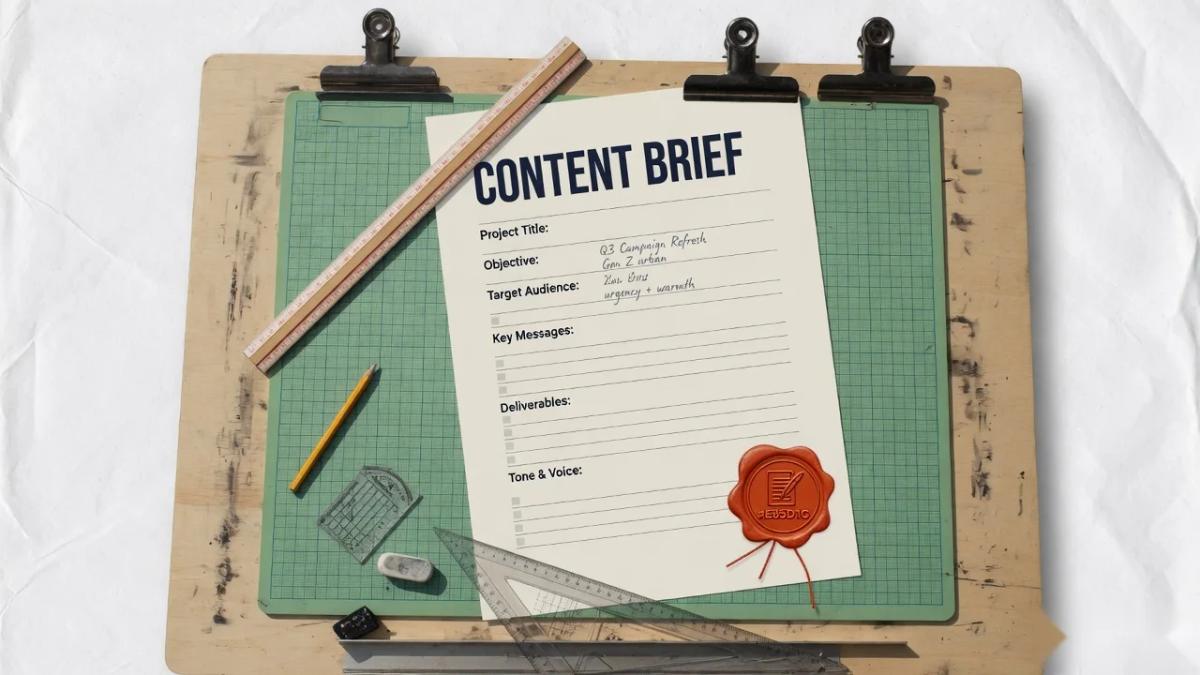
No draft starts until fields 3, 9, 13, and 15 are complete — the funnel job, the proof & sources list, the distribution plan, and the intent-matched CTA. These four are the business decisions. If a writer can draft without them, the brief has no gate, and the gate is the entire point.
Template fields
Group A — Strategy & audience
Field 1 — Working title & one-line promise What the asset is called and the single sentence it must deliver. The promise is the contract with the reader and with the search engine: it determines the H1 and the title tag. If the promise is a feature list, rewrite it until it is an outcome.
Field 2 — Audience segment & job-to-be-done Who, exactly, and what they are trying to accomplish at the moment they land. Name the segment (title, company size band, industry) and the trigger that sends them searching. A brief for “marketing leaders” produces content for no one; a brief for “heads of marketing ops at 200–1,000-employee companies evaluating attribution” produces something a person recognizes as theirs.
Field 3 — Funnel job (gate field) Choose one: create (demand where none existed), capture (existing demand, lower funnel), convert (comparison/decision support), or enable (sales, partners, customer success). The funnel job dictates length, depth, and CTA. CMI’s 2026 research shows the top challenge is content that prompts action — most assets fail because this field was skipped, not because the prose was weak.
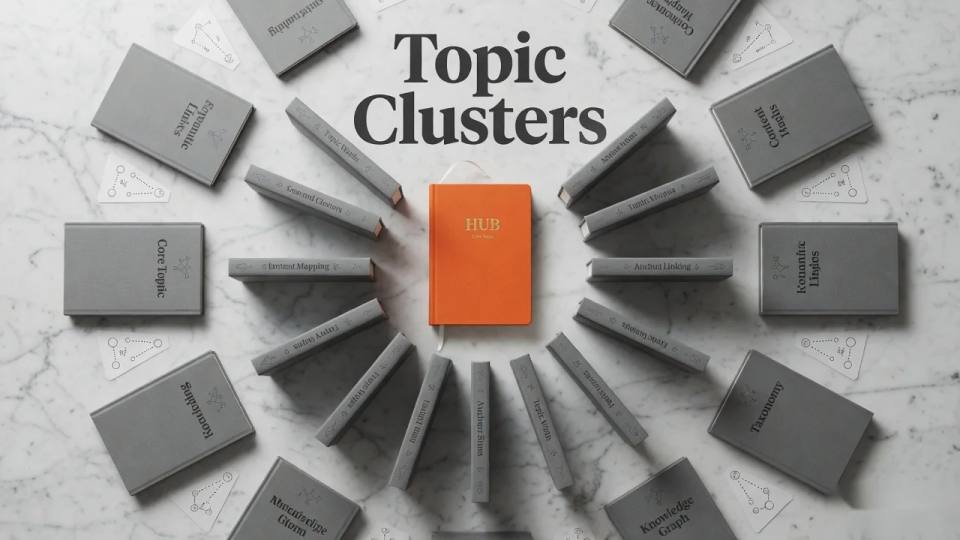
Field 4 — Primary query cluster & keyword map The pillar query plus the supporting queries the asset must answer. Map each query to a section heading and to an intent (see Field 5). If the cluster needs more than 8–12 supporting queries, the topic is too big for one asset — split it, or consolidate via a topic cluster build playbook.
SAMPLE (fictional: a mid-market marketing analytics vendor):
- Pillar query: “marketing attribution software” (commercial)
- Section queries: “marketing attribution vs media mix modeling”, “marketing attribution models explained”, “how to pick an attribution vendor”, “marketing attribution ROI benchmarks”
- Each section heading in the brief maps 1:1 to a query above; the draft is not allowed to invent new headings.
Group B — Intent & AI-citation requirements
Field 5 — Search intent per cluster query Tag each query in Field 4: informational, commercial, transactional, or navigational. Semrush’s 200,000-keyword study found ~80% of AI Overviews trigger on informational intent and under 3% on transactional — so an informational query earns an answer section, and a commercial query earns a comparison table. One page can serve both, but only if the brief says which section serves which.
Field 6 — Direct answer (2–4 sentences) The liftable answer: the block a search engine or AI answer engine can quote verbatim. It must state the claim, the condition, and — where it matters — the date. Google’s own guidance is that AI features rely on the same index and quality systems as core Search, so the direct answer is not a trick; it is the clearest expression of the page’s thesis. Write it in the brief, before the draft. If the writer cannot write 3 sentences now, the topic is not understood yet.
SAMPLE (continuing the fictional example): “Marketing attribution software connects revenue events to the campaigns, channels, and content that influenced them. Unlike media mix modeling, which estimates at the channel level, attribution models assign credit at the interaction level — useful for mid-market teams with concrete campaign data. Choose a model (first-touch, last-touch, multi-touch) based on your sales cycle and data quality, not on vendor marketing.”
Field 7 — AI-citation requirement What the asset must contain to be citable, not just readable: a named entity, a dated claim, an original framework, or a primary source. In Profound’s 250-million-response analysis, conventional SEO metrics explained only 4–7% of AI citation variance — the rest is content quality, expertise, and freshness. In plain terms: if this page has no reason to be cited, do not publish it as a cornerstone.
Field 8 — Key takeaways (3–5) The three to five operational things a reader can act on. These double as the summary block, the social card, and the newsletter excerpt. If the takeaways are generic (“learn best practices”), the proof field below is empty and the draft is not ready.
Group C — Proof & sources
Field 9 — Proof & sources required (gate field) List the minimum evidence the asset must carry: primary data (with date and methodology), a named framework, a customer quote, a subject-matter expert byline, or a documented process. E-E-A-T in practice: every claim that ages gets a date, every statistic gets a source, every opinion gets a named owner. No invented numbers — a fabricated stat in a cornerstone is a liability that compounds every time the page is cited.
Field 10 — Author & subject-matter reviewer Who writes and who validates. CMI’s 2026 research shows the strongest driver of content strategy improvement is strategy refinement and team capability — not tools. An unstaffed reviewer slot is the most common way a brief gets faked.
Field 11 — Claims that age List every date-sensitive claim in the draft (pricing, benchmarks, vendor features, headcount stats) with the date it was verified. This list is the raw material for Field 17. CMI’s 2026 analysis of content debt is blunt: an outdated page no longer decays quietly on page nine — AI will cite a retired pricing page next to the current one and the reader cannot tell which you stand behind.
Group D — Links
Field 12 — Internal links (hub, cluster, contextual) Three link jobs: (1) the hub/pillar this asset links up to, (2) the cluster siblings it links across to, (3) 3–5 contextual links inside the body. Google’s John Mueller calls internal linking “super critical” — it is how you tell search engines what matters (Ahrefs, 2026). Assign anchors in the brief, with descriptive anchor text, and add links to newer pages whenever the asset is refreshed.
Group E — Distribution & launch
Field 13 — Distribution plan (gate field) Name the channels, the owner, and the dates — owned (newsletter, LinkedIn, product email), amplify (paid, syndication, PR), and outbound (SDR sequences, sales enablement). Grounds for taking this field seriously: paid media is now 31.4% of total marketing budgets (Gartner, 2026), and AI Overviews cut position-1 click-through by 58% on informational queries (Ahrefs, 2026) — organic alone is no longer a launch plan. B2B marketers rate LinkedIn (76%), email newsletters (54%), and webinars/speaking (52%) as their most effective thought-leadership channels (CMI, 2026); pick at least two.
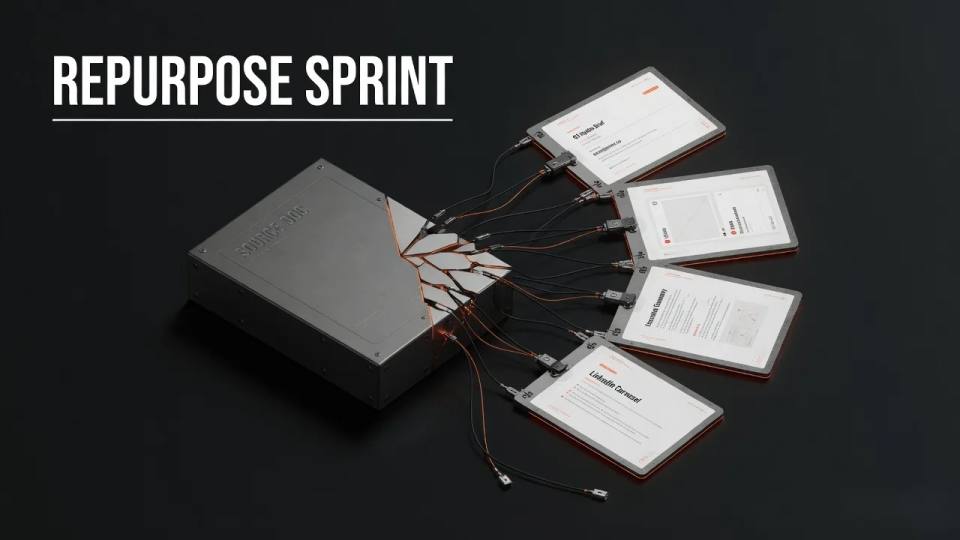
Field 14 — Repurposing slices & launch cadence The 2–4 derivative assets the cornerstone feeds (newsletter edition, LinkedIn series, slide deck, comparison sheet) and the publish cadence after launch. If a slice “isn’t a different cut of value, don’t make it” — route the slices through the content repurposing sprint so the pillar pays for itself beyond search.
Field 15 — CTA matched to intent (gate field) The single call to action, matched to the funnel job: create → subscribe or download; capture → demo-qualifying asset; convert → pricing or consultation; enable → resource library for sellers. CMI 2026: the top content challenge is prompting a desired action — the CTA is where that is decided, and it is decided here, not by the writer’s mood.
Group F — Measurement & refresh
Field 16 — Success metrics & review date The 3–5 metrics that define success, set at briefing time: organic impressions for the cluster, AI citations (via Search Console’s generative AI report or manual audits), engagement, and pipeline influence. If the metric is “traffic,” add the metric that answers “so what.” Set the first review date at 90 days post-launch.
Field 17 — Refresh trigger Set the cadence at briefing time. For cornerstone assets: full review at 12–18 months or when any metric declines for two consecutive months — whichever comes first. Rationale: ~50% of top-cited AI content is under 13 weeks old (Profound, 2025), so pages you want cited need freshness passes — re-date, re-stat, re-link, add new proof — roughly every 6 months, and deep refreshes (rewrite the direct answer, add sources) on the 12–18-month cycle. Triggers: any claim in Field 11 expires; the SERP intent shifts; a competitor publishes a superior answer; your own newer content supersedes this page. Run the AI visibility audit sprint quarterly to catch citation losses before they become rank losses.
Field 18 — Owner & ship date One owner, one ship date, one place where status lives. A brief with three owners and no date is a discussion document, not a production gate.
Rule enforcement
- Fields 3, 9, 13, and 15 must be complete and signed off before drafting.
- Fields 11 and 17 must be complete before publishing; if they are blank at publish time, the asset ships without a maintenance plan and will enter the refresh queue unplanned.
- Every field is one to three lines. If a field needs an essay, the field is wrong, not the template.
Citations
Sources & references
- 9 Takeaways and Insights From the 2026 B2B Content and Marketing Trends ReportContent Marketing Institute
- B2B Content Marketing Benchmarks, Budgets, and Trends: Outlook for 2025Content Marketing Institute
- Your Outdated Content Lives Forever in AI Search: Here's How To Manage ItContent Marketing Institute
- Demand Gen Report's 2026 B2B Trends Research Report is LiveDemand Gen Report
- We Analyzed 250 Million AI Search Results: Here's What I FoundProfound (Josh Blyskal, TechSEO Connect)