


What a Cluster Actually Delivers
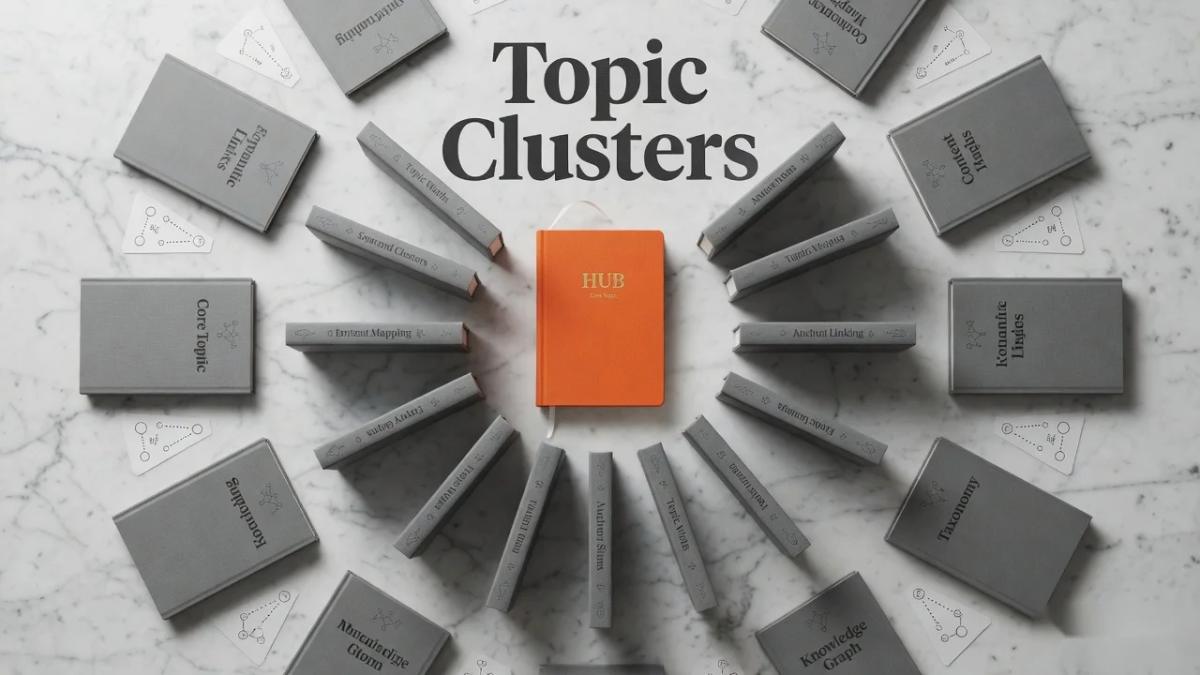
A topic cluster is a group of interlinked pages that lets a site be recognized as the authoritative source on one subject: a pillar page that owns the broad term, supporting pages that answer the specific questions beneath it, and internal links that make the relationships explicit. Done well, it produces two compounding returns. In classic search, the pages rank for more queries than they were individually optimized for. In AI search, the network as a whole earns citations across a wider set of generated answers.
That second return is no longer a nice-to-have. HubSpot’s State of AEO 2026 report, which analyzed citations from ChatGPT, Gemini, Perplexity, and Google AI Overviews between December 2025 and March 2026, found that 58% of marketers are already optimizing content for answer engines, and 44% have made a business purchase based on a brand they discovered through one. HubSpot’s own brand citation improvement from doubling down on AEO: 433%. (HubSpot) Clusters are the structural play that makes that optimization sustainable, because they force comprehensive coverage instead of scattered posts.
Why Clusters Matter More in 2026
Three mechanics changed the value of the cluster model in the last two years.
Query fan-out multiplies your chances
Google’s own documentation explains that AI Overviews and AI Mode “may use a ‘query fan-out’ technique — issuing multiple related searches across subtopics and data sources — to develop a response,” which surfaces “a wider and more diverse set of helpful links” than classic web search. (Google Search Central) One user question becomes several sub-queries, and every subtopic your cluster covers is another chance to appear in the answer. A single page can’t cover that surface; a 20-page cluster can.
AI citations follow E-E-A-T signals
The same report found that pages with outbound links, statistics, author bios, and a visible “last updated” date earn more citations — with AI Overviews, Gemini, and Perplexity the engines most responsive to those signals. (HubSpot) Each of those elements is expensive to add to every page, which is precisely why a cluster earns them efficiently: the pillar carries the authoritative overview and the supports each carry their own data, named author, and sources.
Site focus and site radius made focus measurable
The 2024 Google API leak exposed the internal signals behind topical authority: site focus score (how concentrated a site’s content is around a core subject) and site radius (how far individual pages stray from that core). Shaun Anderson’s analysis of the leaked Content Warehouse API documentation, published June 24, 2026, walks through the underlying site2vecEmbeddingEncoded attribute and the “solar system” model: every off-topic page is a planet in a wide orbit that drags the whole system’s focus score down. (Hobo Web) The practical consequence: publishing outside your cluster topic doesn’t merely fail to help, it measurably dilutes the signal that makes everything else rank.
The compounding evidence is real and current. Ahrefs’ June 2026 topical authority guide documents Healthline’s single page on magnesium glycinate appearing for 2,500 keywords on Google, 473 queries in AI Overviews, 279 prompts on ChatGPT, 200 on Perplexity, 28 on Gemini, and 86 on Copilot — all from one page inside a topical network. The same guide shows Bicycle Motor Works, a specialist e-bike retailer with a Domain Rating of 15, outranking Amazon (DR 96) for competitive e-bike keywords because it owns the topic more completely. (Ahrefs)
The Architecture: Hub, Pillar, Supports
Three layers, each with a distinct job:
- Hub page. The curated entry point. It states who the cluster is for, what “done” looks like for a reader, and where to start based on need. It is not a list of links.
- Pillar page. The broad, definitive guide to the head topic. It covers breadth at a framework level, answers the literal “what is X?” question in the first paragraph, and links out to every support.
- Supporting pages. One subtopic each, targeting one primary keyword, going deep where the pillar can’t, and linking back to the pillar.
The hub-curation test
Apply this before shipping a hub: would a first-time visitor who knows nothing about your site understand exactly what it covers, who it serves, and which page to open next? If the hub fails that test, it is a tag archive. Leslie Ye, who rebuilt much of HubSpot’s content into clusters, defines the pillar boundary the same way: if a page is being aimed at a long-tail keyword, it is not a pillar; if it explores one narrow topic in depth, it is not a pillar; if it touches many aspects of a broad topic, it probably is. (HubSpot)
Plan for 20–30 supporting pages per pillar as the working range; Ahrefs suggests 10–20 subtopics as the practical minimum for a pillar topic to be worth building. (Ahrefs) Topics that can’t support that depth belong inside another cluster, not on their own pillar.
The 2026 Build, Step by Step
Step 1: Choose the topic from ICP demand, not volume
Start with five to ten core problems your buyer persona actually has, gathered from interviews, support conversations, and community research. Map each problem to a broad topic area, then validate with keyword tools. Volume alone is a trap: Nathan Gotch, an AI SEO practitioner cited by Semrush, recommends new sites build authority around a single topic or service line first — one cluster, done properly, before the next. (Semrush) Validation criteria: informational or commercial intent, real traffic potential, 20–30 supportable subtopics, and a credible reason for your brand to own the territory.
Step 2: Research and map the subtopics
Expand your seed term into the full question set. People Also Ask boxes, People Also Search For suggestions, and the source lists inside AI Overviews all reveal which subtopics the answer engines treat as related. Ahrefs’ Keywords Explorer clusters up to 10,000 keywords by parent topic and shows each cluster’s total search volume. (Ahrefs) Semrush’s AI-powered Keyword Strategy Builder generates pillar and subpage ideas directly. (Semrush) Google’s own Search Console Insights now groups queries by intent through Query groups, launched October 2025 — a free, first-party way to see the clusters your site is already being asked about. (Google Search Central Blog)
Before locking the map, run every candidate subtopic through three filters: does it have meaningful demand, is it relevant to your business, and does it stay inside your topical focus? Anything that fails the third one is a site radius problem in waiting.
Step 3: Write the hub page first
Ship the hub early, even if some supports are placeholders on the editorial roadmap — but never ship it thin. The hub should name the audience, define done, and organize the cluster by reader need rather than publication date. This is also where the cluster gets its owner: a named editor responsible for coverage, links, and refresh decisions. Clusters without owners decay faster than they grow.
Step 4: Draft the pillar page
The pillar answers the head term completely at a framework level. Finalize your subtopic list before writing it so the H2s reflect the cluster’s actual themes and give you natural places to link to each support as it’s introduced. Match the pillar format to what already ranks for the topic — guide, definition, or step-by-step — and keep it a portal, not a 10,000-word everything page. (Ahrefs)
Step 5: Build the supporting content
Each support targets one primary keyword and one intent: how-to guides for procedural queries, comparisons for evaluation queries, definitions for informational ones, case studies for buyer-research queries. Depth matters more than length — a focused article on a narrow subtopic beats a long one that skims several. If two subtopics are too close to each justify a page, combine them; thin pages drag the cluster’s quality signal. For B2B, prioritize formats that meet buying-stage objections, and use the content brief template to keep every support aligned to the same cluster standard.
Step 6: Write the internal-link rules before the pages
Internal linking is what makes this a cluster instead of an archive. John Mueller has called internal linking “super critical” — the biggest lever a site has for guiding Google and visitors to the pages that matter. (Ahrefs) Three rules:
- Every support links to the pillar with clear, descriptive anchor text.
- The pillar links to every important support where its subtopic is introduced.
- Supports cross-link only where the reference genuinely helps a reader continue.
Keep it intentional: 3–5 contextual links per article is the working range, placed in the body where readers actually click, not in the footer. Vary the anchor text across the cluster. And treat link placement as authority management: the leaked onsiteProminence signal shows Google simulates traffic flow internally, so pages buried with no incoming links stay “cold.” Orphaned pages are a cluster failure — the pillar-to-support graph is what prevents them by design.
Step 7: Set refresh triggers before publishing
Ahrefs’ refresh triggers, updated June 2026: organic traffic drops noticeably from its peak, a key stat or study is superseded, a referenced tool or product changes, a competitor publishes a substantially updated version of a page targeting the same keyword, or you drop out of an AI Overview you previously appeared in. (Ahrefs) The leak adds one nuance: Google’s freshness clock only resets on a significant update, and it can read dates semantically — so re-dating a page without changing it is pointless. Real revisions, new data, fixed links: that is what refresh means.
AI-Search Specifics for Every Cluster Page
Answer engines don’t need special markup to cite you, and Google is explicit that there are no additional technical requirements for AI Overviews or AI Mode. (Google Search Central) What they reward is page-level evidence of credibility:
- A visible “Last updated” date. Google’s byline date documentation recommends a prominent user-visible date plus
datePublished/dateModifiedin Article or BlogPosting structured data. (Google Search Central) - Author bios and real bylines. Named experts beat anonymous corporates in citation studies.
- Outbound links to primary sources. Cite the research, don’t just summarize it.
- Statistics with dates. Every number gets a date, so a model can decide whether it’s current.
- Structured, scannable answers. Clear definitions up front, because AI experiences field longer, more specific questions and follow-ups. (Google Search Central Blog)
Our AI search visibility playbook covers the citation mechanics in full, and the AI visibility checklist turns them into a per-page gate.
Tools That Fit the Job
| Tool | Cluster job | Notes |
|---|---|---|
| Ahrefs Keywords Explorer | Subtopics and clustering | Clusters by Parent Topic, traffic potential; up to 10,000 keywords (Ahrefs) |
| Ahrefs Site Audit | Link audit | Orphan detection, internal-link opportunities, broken links (Ahrefs) |
| Ahrefs Brand Radar | AI visibility | Topic-level AI Share of Voice, brand-topic association (Ahrefs) |
| Semrush Keyword Strategy Builder | Pillar/support planning | AI-generated pillar and subpage ideas (Semrush) |
| Semrush Position Tracking | Dual ranking | Google rankings and ChatGPT positions, keyword tags for cluster grouping (Semrush) |
| Google Search Console | First-party measurement | Query groups, plus the June 2026 Search Generative AI performance reports covering AI Overviews and AI Mode impressions (Google Search Central Blog) |
| HubSpot AEO | Citation tracking | Brand visibility across ChatGPT, Perplexity, Gemini (HubSpot) |
Measure the Portfolio, Not the Page
Cluster-level measurement has five legs, and the fifth is new in 2026:
- Rankings. Average position for pillar and supports on the head term and long-tail variants.
- Traffic. Organic clicks from Search Console, segmented pillar versus supports.
- Engagement. Pages per session from any cluster URL, and movement between cluster pages.
- Conversions. Assisted and direct conversions attributable to cluster URLs, separated from non-cluster organic traffic.
- AI impressions and citations. In June 2026 Google launched dedicated Search Generative AI performance reports in Search Console, with impressions in AI Overviews and AI Mode for Search and Discover. (Google Search Central Blog) That gives you a first-party baseline, and tools like HubSpot AEO and Ahrefs Brand Radar extend it to ChatGPT, Perplexity, and Gemini.
Google also notes that clicks from pages with AI Overviews are higher quality — users spend more time and arrive with more context — so weight engagement and conversions at least as heavily as raw click volume. (Google Search Central)
Time to results
Expect 6–12 months before significant movement: months 1–3 establish coverage, months 4–6 produce initial ranking gains, and months 6–12 deliver the compounding effect as internal links accumulate and the search engines’ model of your site firms up. (Ahrefs) Run the AI visibility audit sprint quarterly to catch citation losses before they become rank losses, feed the output back into the refresh queue, and route every refreshed page through your content distribution system so the cluster keeps earning beyond search.
Failure Modes
- A hub with no point of view. Tag archives don’t earn trust, they earn crawl budget.
- Volume before focus. Twenty shallow posts dilute the focus signal; one strong cluster beats them.
- Orphans. Every page needs an incoming link; the pillar-to-support graph is the guarantee.
- Off-topic drift. Chasing volume outside the cluster is now a measurable site-radius problem, not a harmless experiment.
- Fake freshness. Re-dating without revising is detected and ignored.
- Page-level measurement. The cluster is the unit of analysis; if you report per page, you’ll cut the wrong things.
- No owner. Clusters without an accountable editor accumulate gaps and broken links until the whole thing collapses.
Sources
- HubSpot. “The State of AEO in 2026.” Accessed August 3, 2026. https://offers.hubspot.com/state-of-aeo
- HubSpot. “Topic clusters: The next evolution of SEO.” Updated June 17, 2026. https://blog.hubspot.com/marketing/topic-clusters-seo
- Ahrefs. “Topical Authority: What It Is, How Google Measures It, and How to Build It.” June 1, 2026. https://ahrefs.com/blog/topical-authority/
- Ahrefs. “Content Pillars: What They Are & How to Build Them for SEO & AI Visibility.” Updated January 6, 2026. https://ahrefs.com/blog/content-pillars/
- Ahrefs. “Internal Links for SEO: An Actionable Guide.” Updated March 10, 2026. https://ahrefs.com/blog/internal-links-for-seo/
- Semrush. “Topic Clusters for SEO: What They Are & How to Create Them.” October 29, 2025. https://www.semrush.com/blog/topic-clusters/
- Hobo Web (Shaun Anderson). “Topical Authority: Site Radius & Site Focus Score from the Google Leak.” June 24, 2026. https://www.hobo-web.co.uk/topical-authority/
- Google Search Central. “AI features and your website.” Last updated December 10, 2025. https://developers.google.com/search/docs/appearance/ai-features
- Google Search Central. “Influence your byline dates in Google Search.” Last updated December 10, 2025. https://developers.google.com/search/docs/appearance/publication-dates
- Google Search Central Blog. “Introducing Query groups in Search Console Insights.” October 2025. https://developers.google.com/search/blog/2025/10/search-console-query-groups
- Google Search Central Blog. “Introducing Search Generative AI performance reports in Search Console.” June 2026. https://developers.google.com/search/blog/2026/06/gen-ai-performance-reports
- Google Search Central Blog. “Top ways to ensure your content performs well in Google’s AI experiences on Search.” May 2025. https://developers.google.com/search/blog/2025/05/succeeding-in-ai-search