

What the SLA Actually Buys You
The sales–marketing SLA is a written contract with four commitments: marketing delivers a defined volume of records that clear an agreed quality bar; sales works them inside an agreed response window; every rejection carries a reason code instead of silent deletion; and both sides review the numbers on a fixed cadence. Write that down, wire it into the CRM, and the handoff stops being a weekly renegotiation.
The baseline problem is well documented. Only 8% of companies describe their sales–marketing alignment as strong, even as 82% of C-level executives believe their teams are already in sync (Forrester 2024, cited in Revenue Memo 2026). Most teams never even get to the contract: just 43% of organizations have any formal SLA in place, and only 11% manage one jointly (Digital Applied 2026). The gap is expensive — misalignment costs B2B companies 10% or more of revenue per year (Revenue Memo 2026) — and the upside is real: aligned organizations generate up to 208% more marketing-sourced revenue, grow about 20% a year while misaligned peers shrink 4%, and log 24% faster three-year revenue growth (Revenue Memo 2026).
That is the pitch. The rest of this playbook is the work.
Why the Handoff Breaks
The dysfunction is structural, not personal. Three failure modes repeat across every dataset.
Incentives. Marketing is measured on lead volume; sales is measured on closed revenue. With no shared contract between those incentives, marketing optimizes for more records and sales quietly ignores the ones it does not trust. Gartner’s survey of 412 senior marketing and sales leaders found the functions collaborate on only 3 of 15 commercial activities, 80% of key activities are missing contributions from one side, and 90% of executives report conflicting functional priorities (Gartner 2024).
Definitions. Nobody has signed the same glossary. About 49% of chief sales officers say their organization’s definition of a qualified lead differs greatly from marketing’s (Revenue Memo 2026). And 61% of B2B marketers send all leads directly to sales — but only 27% of those leads are actually qualified (Revenue Memo 2026). When “lead” means something different to each team, every handoff is a renegotiation.
Measurement. With no committed targets, nothing gets audited. Over half of companies (53%) experience broken hand-offs where sales follows up on fewer than 35% of marketing-engaged prospects (Sopro 2026); 79% of marketing leads never convert into sales at all (Revenue Memo 2026); 57% of sellers ignore marketing content because it feels generic (Sopro 2026); and 43% of sales professionals say they need higher-quality leads from marketing, while only 59% say the leads they receive are high quality (Sopro 2026).
An SLA fixes all three at once, because it replaces vibes with fields, timestamps, and reason codes.
Draft Sequence
Five steps, two weeks, one page.
1. Inventory your stages and find the zombies. Map every stage and status in the CRM. Statuses that records enter but never leave are undefined process — each one is a place where a lead is dying silently.
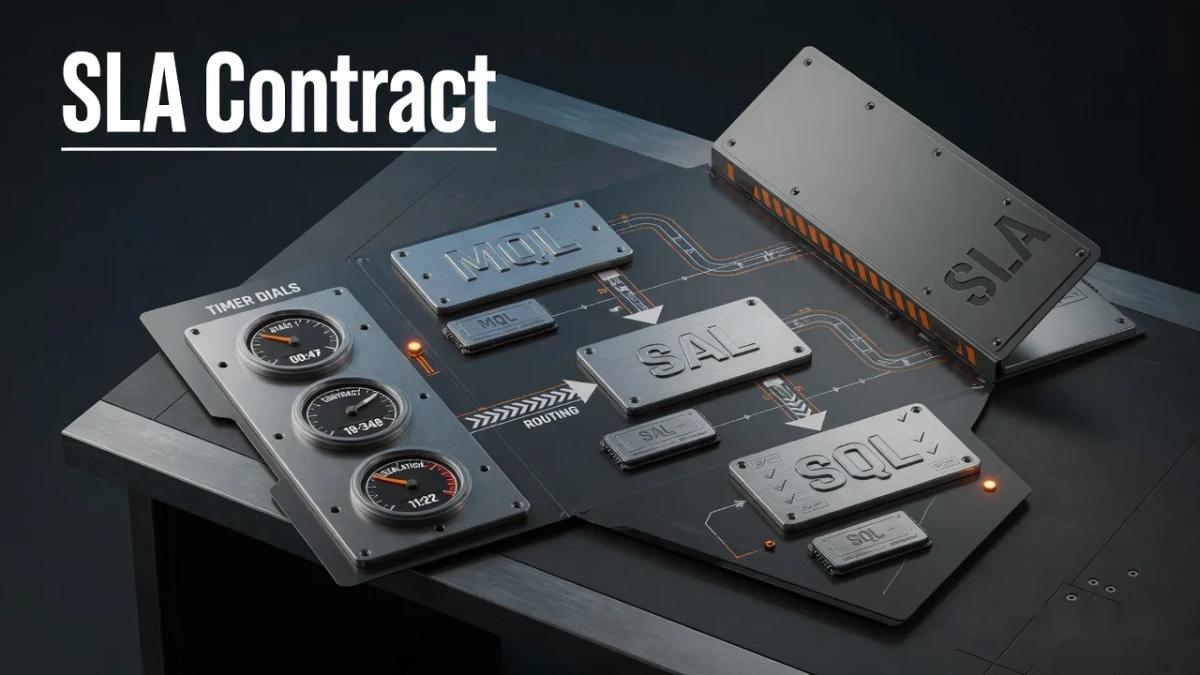
2. Write entry/exit criteria for each stage. Use the demand-waterfall vocabulary (MQL → SAL → SQL, introduced by SiriusDecisions and carried into Forrester’s revenue waterfall) or your own labels — the labels do not matter, the criteria do. A record is only an MQL if it clears the agreed score threshold and required-data bar; it is only “sales’ problem” once sales accepts it.
3. Set tiered timers (below). Speed is the clause that moves revenue fastest.
4. Agree the disposition matrix (below). Every rejection gets a code and, where appropriate, a re-entry path.
5. Pilot for two weeks, then adjust. Review acceptance rates, response times, and reason codes against real volume, then calibrate thresholds and windows before scaling.
The One-Page SLA: Stage Table
| Stage | Entry criteria | Exit criteria | Owner |
|---|---|---|---|
| Lead | Inbound or purchased record with valid contact data | Meets score and data bar | Marketing |
| MQL | Score threshold (commonly 60–75 points) combining fit and behavior signals | Sales accepts or rejects with a reason code | Marketing |
| SAL | Sales formally accepts the MQL | Verified as a working opportunity | Sales |
| SQL | Sales has worked the record and confirmed genuine interest, fit, and budget | Opportunity created | Sales |
Directional benchmarks: MQL-to-SQL conversion runs about 13% cross-industry, 18–22% in B2B SaaS, and 25–35% among top performers (Review42 2026). Treat those as calibration ranges, not quotas; conversion benchmarks belong in your pipeline metrics that matter review.
One 2026 caveat: Forrester now argues the MQL itself is part of the problem. Its “GTM Singularity” research calls out “marketing-qualified lead obsession,” gated content, and siloed teams as outdated practices that AI-enabled buying has made untenable (Forrester, via Demand Gen Report 2026). The revenue waterfall has shifted from lead-centric to opportunity-centric, tracking buying groups rather than individual contacts. Define your stages tightly, but measure quality at the account and buying-group level — not just per form fill.
Response-Time Targets
The speed-to-lead evidence is the oldest, most replicated data in this field — and teams still ignore it. The foundational numbers come from the MIT/InsideSales.com Lead Response Management Study, published in HBR’s 2011 article “The Short Life of Online Sales Leads”:
- Responding within 5 minutes makes you roughly 21x more likely to qualify a lead than waiting 30 minutes, and about 100x more likely to connect (HBR 2011; CaseyResponse 2026; LeadResponse 2026)
- Responding within one hour versus two makes you 7x more likely to qualify (HBR 2011)
- 78% of customers buy from the first business to respond (Lead Connect, cited in CaseyResponse 2026; Chili Piper 2025)
And the 2026 reality:
- Average B2B lead response time is still roughly 42–47 hours (Drift, cited in CaseyResponse 2026; Digital Applied 2026)
- 58% of companies never respond to a web lead at all (Drift, cited in LeadResponse 2026)
- About 74% of 573 benchmarked businesses still miss the five-minute window (LeanData/Blazeo 2026, cited in Digital Applied 2026)
- B2B leads wait about 1 hour 22 minutes on average, while 79% of buyers expect a reply within 5 minutes — only 58% get one (Worldmetrics 2026)
- 60% of leads are lost if not responded to within 5 minutes (HubSpot study, cited in Worldmetrics 2026)
The SLA demonstrably moves this: companies with a defined SLA respond within 15 minutes 54.9% of the time versus 29.5% for those without one — a 25.4-point swing (LeanData/Blazeo 2026, cited in Digital Applied 2026). Companies with formal SLAs also report the strategy works: 85% of marketers with an SLA call their marketing strategy effective versus 60% without one (Review42 2026).
Tier the windows by intent. A single “respond fast” promise is unenforceable. Sales will commit to five minutes for the leads that warrant it — demo requests, pricing page conversions, live chat, “contact sales” forms — not for every newsletter download.
| Tier | Trigger | First-touch target | Enforcement |
|---|---|---|---|
| T1 — high intent | Demo, pricing, chat, contact-sales | ≤5 minutes | Alert and auto-assign; first activity timestamped |
| T2 — standard | Content download with ICP fit and engagement | ≤4 hours, same business day | Same-day review; next-day escalation |
| T3 — low intent | Engagement without strong fit | 24 hours or recycle | Nurture re-entry with lower score |
Review42’s SLA guidance points the same way: about 1 hour for inbound leads, 4 hours for nurture leads (Review42 2026). Routing is what makes the timers achievable — if assignment is manual, the window is already gone. The mechanics of ownership and assignment are covered in our marketing ops routing guide.
The Disposition Matrix: No Silent Deaths
The clause that separates a real SLA from a polite agreement is what happens when sales says no. Publish the taxonomy with re-entry paths, and make the status change mandatory in the CRM:
| Disposition | Criteria | Re-entry | CRM status |
|---|---|---|---|
| Accept — SQL | ICP fit confirmed, active interest, valid contact | None; owned by sales | SAL → SQL |
| Recycle — bad timing | Right account, no budget or active project yet | Date-based nurture re-entry | Returned to marketing |
| Recycle — no response | Fit correct, never engaged | Re-engagement sequence, lower score | Returned to marketing |
| Recycle — stakeholder change | Contact left or changed role | Re-route to new contact in account | Re-mapped |
| Disqualify — not ICP | Wrong segment, size, geography | Suppressed from demand programs | Disqualified, coded |
| Disqualify — invalid | Bad email, fake details, bot, competitor | Removed from rotation | Disqualified, coded |
The principle: a rejected MQL is the fastest feedback loop marketing has. Capture it as structured data and scoring improves within weeks; delete it and the same bad lead gets re-bought next quarter. (Matrix adapted from Digital Applied 2026.)
Metrics That Belong on the SLA
Seven numbers, each with an owner, a target, and a CRM enforcement point:
| Metric | Target | Enforced by |
|---|---|---|
| Time to first touch | T1 ≤5 min, T2 ≤4 h | Timestamp: first activity vs assignment |
| MQL data completeness | 100% of required fields | Validation rule on create |
| Accept rate | Calibrate; 70%+ is a common starting bar | Reason code on every disposition |
| MQL → SQL conversion | 13–22% band depending on segment | Closed-loop reporting |
| Recycle rate by reason | Reviewed weekly | Reason-code field |
| Leads never contacted | Industry average ~51% — treat as an alarm, not a goal (Digital Applied 2026) | Activity check vs assignment |
| Disputed dispositions | Zero unresolved at month end | Monthly review agenda |
For a deeper read on which pipeline numbers deserve your attention, see pipeline metrics that matter.
CRM Enforcement: Where the Contract Lives
A clause that exists only in a slide deck is aspirational; a clause attached to a required field, workflow gate, or timestamp comparison is enforceable. The minimum wiring:
- Required-field validation on MQL creation (data completeness)
- Score field plus workflow gate at the MQL threshold
- Mandatory reason-code field on any SAL → rejected status change
- Assignment timestamp vs first-activity timestamp (the response SLA)
- Escalation workflow when a T1 lead ages past 5 minutes
- Closed-loop reporting: accepted, rejected, recycled, re-entered
This is where most programs fail. A Bain & Company survey found 70% of companies struggle to integrate their structured sales plays into CRM and revenue technologies — with only about 20% realizing full commercial value (Bain 2025, cited in Sopro 2026). Meanwhile, 78% of sales leaders say the CRM effectively improves sales–marketing alignment (Sopro 2026). The operational side of assignment and ownership lives in our lead routing SOP.
Governance: The Cadence That Keeps It Honest
A signed SLA that nobody revisits decays within a quarter. Run three distinct cadences, in the same spirit as a pipeline review operating cadence:
| Cadence | What happens | Owner |
|---|---|---|
| Weekly — operational inspection | Live numbers: response times vs windows, data completeness, reason-code hygiene, T1 escalations. Early warning, not debate | RevOps / marketing ops |
| Monthly — sales–marketing review | Accepted vs rejected vs recycled volumes, conversion trends, disputed dispositions resolved to zero | Both teams |
| Quarterly — executive reset | Re-ratify definitions, volume commitments, and windows against next quarter’s pipeline goals. Version the document; keep old versions | Leadership |
Alignment is habit-forming: 87% of teams with strong alignment meet weekly (Revenue Memo 2026).
The 2026 Context: Buying Groups, RevOps, AI Agents
Three shifts change what the SLA must cover.
Buying groups, not leads. Gartner’s March 2026 survey of 646 B2B buyers found 67% prefer a rep-free experience, and 45% used AI during a recent purchase (Gartner 2026). When most of the journey happens without a seller, the moments buyers do raise their hands are worth more — which is exactly why the response window is the highest-leverage clause you can write. It also means “qualified” should reflect account-level and buying-group signals, not one person’s form fills (Forrester, via Demand Gen Report 2026).
RevOps owns the contract. About 48% of companies now have a RevOps function, up 15% from the prior year, and Gartner predicts 75% of the highest-growth companies will run one (Revenue Memo 2026). RevOps is the natural owner of the SLA: it is the team paid to care about enforcement points, closed-loop reporting, and the cadence above.
AI agents enforce and erode in equal measure. Nine in 10 sales teams already use AI agents or expect to within two years (Salesforce State of Sales 2026), and 80% of marketers use AI in content workflows (HubSpot State of Marketing 2026). On the enforcement side, instant routing and scheduling collapse speed-to-lead from hours to seconds — Chili Piper reports that dropping response from hours to minutes improves pipeline conversion by up to 8x (Chili Piper 2025), and AI-powered routing is credited with roughly 50% response-time reductions (Salesforce, cited in Worldmetrics 2026). On the erosion side, buyer-side AI agents are now members of the buying network, so gated content and MQL theater die faster than ever (Forrester ARC, via Demand Gen Report 2026). The SLA that survives 2026 has auditable stages and a first touch measured in seconds, not meetings. Our B2B demand generation operating system ties this into the wider GTM architecture.
Sources
- Gartner. “Gartner Survey Reveals Marketing and Sales Functions Collaborate on Only Three Out of 15 Commercial Activities.” Press release, June 4, 2024. https://www.gartner.com/en/newsroom/press-releases/2024-06-03-gartner-survey-reveals-marketing-and-sales-functions-collaborate-on-only-three-out-of-15-commercial-activities
- Gartner. “Gartner Sales Survey Finds 67% of B2B Buyers Prefer a Rep-Free Experience.” Press release, March 9, 2026. https://www.gartner.com/en/newsroom/press-releases/2026-03-09-gartner-sales-survey-finds-67-percent-of-b2b-buyers-prefer-a-rep-free-experience
- Oldroyd, J., McElheran, K., & Elkington, D. “The Short Life of Online Sales Leads.” Harvard Business Review, March 2011. https://hbr.org/2011/03/the-short-life-of-online-sales-leads
- HubSpot. “2026 State of Marketing Report.” https://www.hubspot.com/state-of-marketing
- Salesforce. “State of Sales Report 2026.” https://www.salesforce.com/resources/research-reports/state-of-sales/
- Revenue Memo. “Sales and Marketing Alignment Statistics for 2026: A Comprehensive Analysis.” February 16, 2026. https://www.revenuememo.com/p/sales-and-marketing-alignment-statistics
- Review42. “Sales & Marketing Alignment Stats (2026).” Updated June 16, 2026. https://resources.review42.com/sales-and-marketing-alignment-stats/
- Sopro. “52 Sales and Marketing Alignment Statistics for 2026.” March 6, 2026. https://sopro.io/resources/blog/sales-marketing-alignment-statistics/
- Digital Applied. “Sales & Marketing SLA: The 2026 Alignment Framework.” June 13, 2026. https://www.digitalapplied.com/blog/sales-marketing-sla-alignment-framework-2026-smarketing-playbook
- Worldmetrics. “Lead Response Time Statistics 2026.” February 12, 2026; last verified July 4, 2026. https://worldmetrics.org/lead-response-time-statistics/
- CaseyResponse. “Lead Response Time Statistics (2026): The 5-Minute Rule.” January 30, 2026. https://caseyresponse.com/blog/lead-response-time-statistics
- LeadResponse. “Speed-to-Lead Statistics 2026: 17 Data Points.” March 9, 2026. https://leadresponse.co/blog/speed-to-lead-statistics
- Chili Piper. “What Is Speed to Lead and Why It Still Matters.” September 24, 2025. https://www.chilipiper.com/resources/blog/speed-to-lead
- Demand Gen Report. “Forrester Report Calls for New GTM Approach by B2B Leaders.” May 2026. https://www.demandgenreport.com/industry-news/news-brief/forrester-report-calls-for-new-gtm-approach-by-b2b-leaders/52797/
- Demand Gen Report. “Gartner: 67% of B2B Buyers Prefer a Rep-Free Experience.” March 2026. https://www.demandgenreport.com/industry-news/news-brief/gartner-67-of-b2b-buyers-prefer-a-rep-free-experience/52142/