

A weekly and monthly pipeline review rhythm does one job: it tells you, in time to act, whether demand is being created, captured, and converted. Most teams run one ritual — the forecast scrub — and call that pipeline management. The scrub tells you what might close this quarter. It does not tell you why the pipeline is thin in 90 days, why leads die between form fill and demo, or why deals stall in the same stage every week. That is the gap this cadence fills.
Why the review changed in 2026
The pressure on forecast accuracy is worse than the averages suggest. HubSpot’s 2026 Sales Trends Report found only 27% of reps consistently hit quota, and its sales data puts the average win rate at 21% (HubSpot, updated February 24, 2026). Meanwhile 54% of sales professionals say selling has gotten harder (HubSpot, 2026). A review meeting built around “who’s going to sign” cannot keep up with that.
Two things make the review different this year. First, the buyer arrives pre-informed. Gong Labs Trends data shows a 250% increase in AI-driven vendor discovery and a 280% increase in buyers using AI as a buying advisor since early 2024, and Forrester’s 2026 research puts AI usage in the purchase process at 94%, up from 89% in 2025 (Gong, July 29, 2026). Gartner’s 2026 research adds the twist: 69% of B2B buyers still turn to sales reps to validate what their AI told them (reported by Gong, July 2026). The review is now where you check whether reps are having the validation conversation, not the education conversation.
Second, the tools now do the inspection. Clari Labs’ benchmark report — 10 million opportunities across 121 enterprises — found the top 10% of reps drive 65% of all revenue, and that companies using AI-assisted selling close new logo deals 20% faster than two years ago (Clari Labs, 2025). Revenue intelligence platforms have become the pre-read: Gong’s research describes the shift from AI as a productivity tool to AI as an operating model, where insights stop living in dashboards and become next-best actions in the pipeline (Gong, April 27, 2026). Clari’s Revenue AI Agents now handle deal inspection and pipeline analysis directly (Clari, 2026), and Gartner’s first Magic Quadrant for Revenue Action Orchestration, published December 15, 2025, treats this as a defined category. If your review still relies on reps narrating their deals from memory, you are running the 2019 meeting.
Design principles
Keep the whole system honest with four rules.
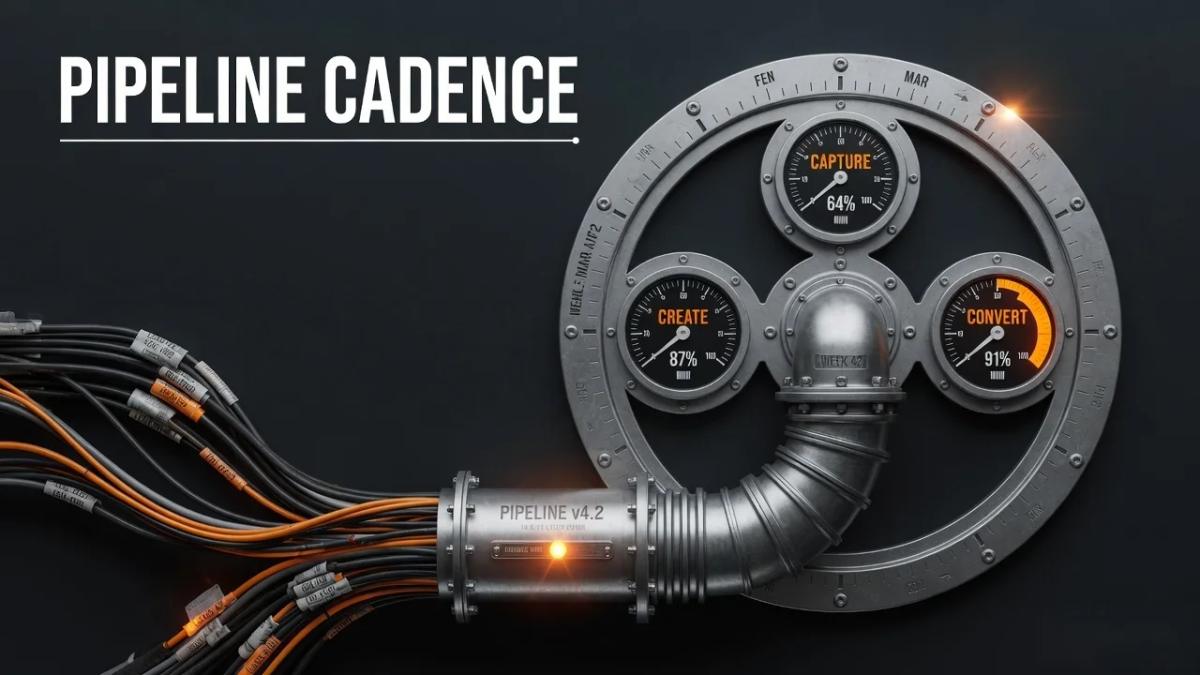
Separate creation, capture, and conversion. A single pipeline number hides the failure. Creation is new qualified opportunities entering the funnel; capture is how leads and MQLs survive the handoff into active pipeline; conversion is stage movement and close. One weekly ritual can’t diagnose all three, so the weekly review rotates through them explicitly rather than letting the loudest deal win. For the system-level view of the creation side, our B2B demand generation operating system covers how the machine should be wired before you review it.
Review the future, not the history. Gong’s guidance for world-class pipeline reviews is blunt: focus on deal momentum and what should happen next, not on the backstory of every deal (Gong, updated March 4, 2026). Reps who “rattle off a list of deals” are an information dump, not a review.
One deal per rep, and it better be the stuck one. Gong’s recommendation stands: each rep brings their single most pressing deal, and the room collaborates on it (Gong, updated March 4, 2026). That is peer coaching, and it converts the meeting into the highest-leverage hour of the week.
Laptops closed. Gong makes this a non-negotiable: no distractions, because the meeting is team strategy, not a status round (Gong, updated March 4, 2026). If you are not willing to enforce that, do not start this cadence.
The weekly review (45 minutes)
The weekly review is the operational meeting. It assumes every number on the screen was delivered as a pre-read the morning before — anyone who needs to talk at a chart instead of about a chart is wasting the room. This agenda is adapted from Gong’s six-part pipeline review framework, rebalanced for the three-part health split (Gong, updated March 4, 2026; Gain.io, March 31, 2026). A printable version is available in our pipeline review agenda.
| Block | Minutes | What gets decided |
|---|---|---|
| Creation: new pipeline vs. plan | 8 | Which sources produced qualified opportunities; what to accelerate or kill this week |
| Capture: leads to qualified pipeline | 8 | Where lead-to-pipeline conversion dropped; SLA breaches; automation failures (mechanics in landing page conversion architecture) |
| Conversion: stage movement vs. baseline | 8 | Deals stuck past expected stage duration; stage-conversion deltas vs. prior 4 weeks |
| Deal inspection: AI risk flags + one deal per rep | 16 | At-risk deals, forecast-category moves, and one collaborative strategy per rep |
| Decisions and owners | 5 | Every item exits with an owner and a deadline; the forecast number is locked |
Time discipline matters more than content discipline. If the first three blocks routinely run over, the pre-read is weak, not the agenda.
The monthly deep dive (90 minutes)
The monthly session is structural. It asks what the weekly rhythm cannot: is the machine shaped right? It should include RevOps, marketing, and finance — not just sales leadership. Agenda, informed by Gain.io’s forecasting guidance and Clari’s benchmark findings (Gain.io, March 31, 2026; Clari Labs, 2025):
- Pipeline coverage health (20 min). Total pipeline value vs. remaining target, by segment and by rep. Gain.io’s 2026 guide cites 3x coverage as the common benchmark, with teams at strong coverage levels showing up to 28% higher sales performance — but treat 3x as a starting hypothesis, not a law; it depends on cycle length and stage distribution (Gain.io, March 31, 2026).
- Forecast accuracy post-mortem (20 min). Actual vs. forecast by category, last 90 days. Compute bias by rep and stage so the correction is structural, not personal. Teams that update forecasts weekly see up to 10–15% accuracy improvements; combining weighted, historical, and stage-based methods is what high performers do — around 70% of high-performing teams blend methods (Gain.io, March 31, 2026).
- Stage conversion and cycle length (20 min). The conversion table from the last four weekly reviews, plus sales cycle length trend. Gain.io’s research links shorter cycles to win-rate gains of up to 18% (Gain.io, March 31, 2026). Longer cycles with flat conversion is a product-fit problem, not a sales problem.
- Program and channel portfolio (15 min). Kill or fix programs producing pipeline that never converts; reallocate budget to sources with verified stage movement. This is the meeting that protects next quarter — and our 90-day demand generation audit is the structured version of this block if you need a starting framework.
- Data quality and tool audit (10 min). Closed/lost reasons recorded, deal values current, stage hygiene. Clari Labs found 98% of companies fail to track closed/lost reasons consistently — the single cheapest fix available to most teams (Clari Labs, 2025).
- Decisions and owners (5 min). Same rule as the weekly: named owner, deadline, logged.
Metrics that belong in the review
Only metrics that produce a decision belong in the room. Everything else goes in the pre-read. These six carry the load, and full definitions and formulas live in pipeline metrics that matter (Gain.io, March 31, 2026; HubSpot, updated February 24, 2026):
| Metric | Definition | 2026 reference point |
|---|---|---|
| Pipeline coverage ratio | Total pipeline value ÷ remaining quota | 3x is the common benchmark; range 2.5–4x by cycle length (Gain.io) |
| Stage conversion rate | % moving stage-to-stage, 4-week window | Monitor vs. baseline; weak stages are where pipeline silently dies (Gain.io) |
| Pipeline velocity | Deals × win rate × deal size ÷ cycle length | Watch trend, not a single number; velocity drop precedes revenue drop (Gain.io) |
| Forecast accuracy | Actual revenue ÷ forecast, by category and rep | High performers blend weighted + historical methods (Gain.io) |
| Win rate | Closed-won ÷ total closed | Average is 21%; high performers sustain 25–30%+ (HubSpot; Gain.io) |
| Cycle length | Days from first touch to close | Optimized cycles show up to 18% higher win rates (Gain.io) |
Two metrics deserve special attention because they are leading indicators, not outcomes: coverage and stage conversion. A coverage shortfall in month two is a revenue shortfall in month five. A conversion dip at one stage is usually the same problem repeating every week — and it is the cheapest thing in this list to fix once you measure it weekly.
What AI deal inspection changes
The honest summary: AI did not make the meeting smarter, it made the pre-read honest. Here is what the current generation of revenue platforms actually does in a review context (Gong, April 27, 2026; Clari, 2026; Salesforce, 2026):
| Capability | What changes in the review | Source |
|---|---|---|
| Conversation signal analysis | Deal risk flags based on calls and emails — email velocity is Gong’s strongest closing signal; risk flags arrive before the meeting, not during it | Gong, updated March 4, 2026 |
| AI deal inspection agents | Pipeline analysis, risk scoring, and next-best actions generated before humans meet | Clari, 2026 |
| Orchestration of insight into workflows | Winning patterns become playbooks, forecast signals, and next-best actions instead of dashboard decorations | Gong, April 27, 2026 |
| Agent-led sales workflows | Nine in ten sales teams already use agents or expect to within two years — the review must assume them | Salesforce State of Sales, 2026 |
The practical shift for the meeting itself: instead of asking reps “what’s happening with the deal?”, you ask “the model flags the deal as stalled on legal review and the buyer is single-threaded — what’s the play?” Gong Labs data makes the stakes concrete: multi-threading lifts win rates by 130% in deals over $50K, and single-threaded deals over that threshold are an immediate red flag (Gong Labs via HubSpot, updated February 24, 2026). That is inspectable, coachable, and it is exactly what a review should spend its minutes on.
Decision rights
A review is a decision forum, and decisions need owners with authority. Otherwise it drifts back into a forecast call. Define these before the first meeting:
- Forecast category moves — the sales leader owns the number; reps can argue, but the leader decides and the platform records the override.
- Deal removal — RevOps can remove stale deals against a written policy (no activity in X days, no response in Y); escalation to sales leadership only.
- Program pause and budget shift — marketing owns the channel plan; the monthly deep dive is the only place it changes mid-quarter, which keeps the weekly meeting out of budget politics.
- Data corrections — RevOps owns stage and value integrity; reps own the input, and the review tracks compliance, not blame.
One accountability mechanism closes the loop: every decision gets logged with an owner and a due date, and the next week’s review opens with the previous week’s log. If an item shows up twice, it is either a broken owner or a broken decision — both are visible to the whole room. That is what separates the strategy session from the information dump (Gong, updated March 4, 2026).
Failure modes
The cadence fails in predictable ways. The weekly review becomes a forecast scrub because someone skipped the pre-read. The room gets too big — pipeline review is a small group of owners, not a town hall. The monthly review dies first, because the urgent weekly always crowds out the structural. Closed/lost reasons stay unlogged, and then no one can explain why win rate moved (98% of companies never track them consistently, per Clari Labs, 2025). And the oldest failure of all: the meeting produces discussion, not decisions, and the agenda is identical six weeks running.
Run the weekly for four weeks before judging it. Run the monthly for two cycles before redesigning it. If both survive a quarter, you will stop discovering demand problems late — which is the entire point.
Sources
- Gong — “For Sales Leaders: How to Conduct Pipeline Reviews for Growth” (last modified March 4, 2026). https://www.gong.io/blog/pipeline-review/
- Gong — “How to Accurately Forecast Your Sales in 6 Steps” (last modified March 4, 2026). https://www.gong.io/blog/sales-forecast/
- Gong — “Driving predictable growth with AI: What actually moves the needle for GTM teams” (April 27, 2026). https://www.gong.io/blog/driving-predictable-growth-with-ai-gtm-teams
- Gong — “94% of buyers use AI before they talk to you. Here’s what that changes.” (July 29, 2026). https://www.gong.io/blog/94-of-buyers-use-ai-before-they-talk-to-you
- Gong — “The State of Revenue AI 2026” report page. https://www.gong.io/resources/guides/state-of-revenue-ai-2026-report
- Clari Labs — “The State of Enterprise Revenue 2025: Insights from 10 Million Opportunities.” https://www.clari.com/downloads/state-of-enterprise-revenue-clari-labs-benchmark-report-2025/
- Clari — “Clari Named a Leader in the Gartner Magic Quadrant for Revenue Action Orchestration” (Gartner, December 15, 2025). https://www.clari.com/downloads/clari-named-leader-in-the-gartner-magic-quadrant-for-revenue-action-orchestration/
- Clari — “Why Clari” (Revenue AI Agents for deal inspection). https://www.clari.com/why-clari/
- Salesforce — “State of Sales Report” 2026. https://www.salesforce.com/resources/research-reports/state-of-sales/
- HubSpot — “97 key sales statistics to help you sell smarter in 2025” (updated February 24, 2026). https://blog.hubspot.com/sales/sales-statistics
- HubSpot — “I Mastered Sales Forecasting, Here Are My Top Tips” (updated May 1, 2025). https://blog.hubspot.com/sales/sales-forecasting
- Gain.io — “Pipeline Forecasting Guide in 2026 for Accurate Revenue” (March 31, 2026). https://gain.io/blog/pipeline-forecasting/