

Quick verdict
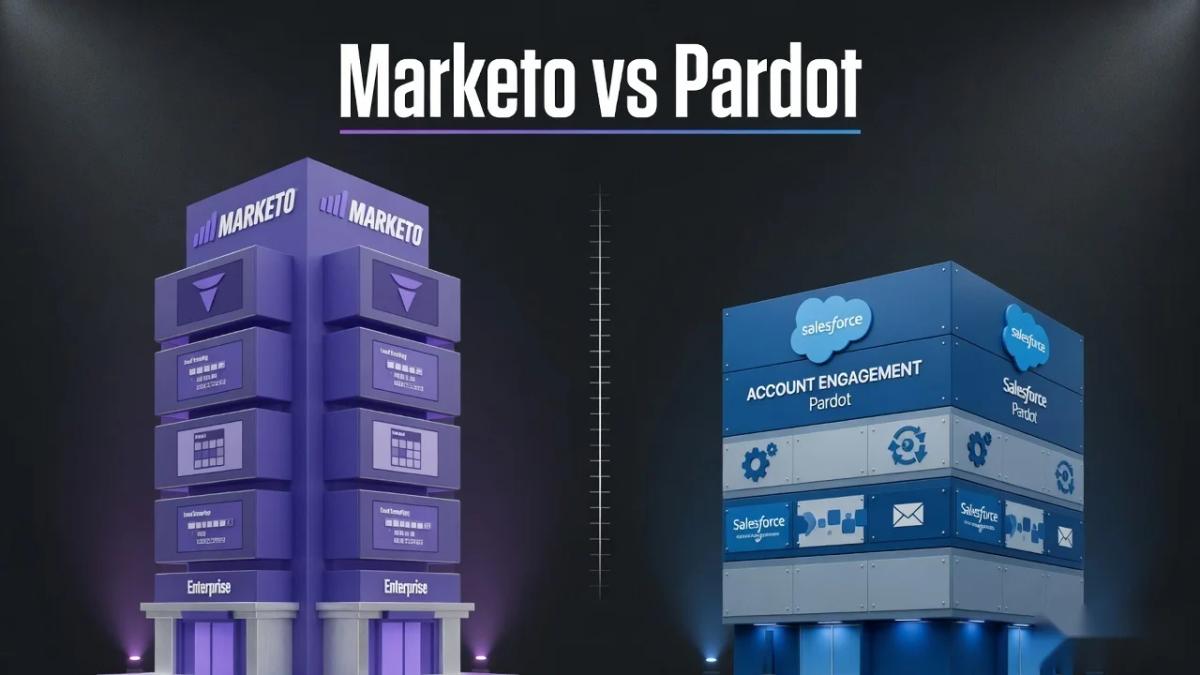
Pick Marketo Engage if you run a dedicated marketing ops team, need deep automation logic and CRM flexibility, want ABM tooling included at Prime and Ultimate tiers, or are investing in the Adobe Experience Cloud (Real-Time CDP, Journey Optimizer B2B Edition, Analytics).
Pick Account Engagement (Pardot) if Salesforce is your CRM of record and you want marketing activity living natively on the same platform, with published, predictable pricing and a fast path into Salesforce’s agentic marketing (Agentforce) without ripping anything out.
Pick neither if you’re below roughly 10,000 contacts, have no ops talent, or want a single platform that also covers CMS, social, and sales — HubSpot or a lighter tool is the honest recommendation until you outgrow it.
The 2026 difference between these two is no longer just features. Salesforce has rebuilt its B2B pitch around an “agency of agents” and now publishes tier pricing. Adobe is repositioning Marketo as the automation core of an AI-powered Experience Cloud, with generative AI content and an agentic interface. Your selection is partly a bet on which AI direction you want to live inside.
What each platform is in 2026
Adobe Marketo Engage
Marketo was founded in 2006 and acquired by Adobe for $4.75 billion in 2018 (announced September 2018), after a $1.79 billion Vista Equity Partners deal took it private in 2017. In August 2026 it sits in Adobe’s customer-experience orchestration portfolio alongside Journey Optimizer, Real-Time CDP, and Adobe Analytics.
Adobe’s current product page describes Marketo Engage as “an industry leading, AI-powered marketing automation platform,” and the marketing in 2026 leans hard on three things:
- An agentic user interface for planning, executing, and measuring omnichannel campaigns — Adobe says even complex multi-step campaigns can be run from it.
- Generative AI content generation — Adobe’s own summary of its 2025 Gartner Magic Quadrant recognition credits “generative AI and AI agents” as the innovation driving its leadership.
- Native extensibility, including a Marketo Engage MCP server announced in 2026, which connects Marketo to AI applications and LLMs of your choice.
Core strengths remain what they have been for a decade: lead management and lifecycle tracking, engagement programs for multi-stream nurture, revenue cycle analytics, predictive audiences, and account-level ABM via Target Account Management. CRM support is broader than Salesforce’s — Adobe lists native integration with Salesforce, Microsoft Dynamics, and Veeva.
Salesforce Marketing Cloud Account Engagement
Salesforce is honest about the naming situation: “Pardot was part of ExactTarget, which was acquired by Salesforce in 2013, and is the legacy product name for Marketing Cloud Account Engagement. They are the same product.” The product now lives under the Agentforce Marketing umbrella, which also includes Marketing Cloud Next (the next-generation agentic platform) and Piper, the AI SDR agent from the Qualified acquisition.
The 2026 positioning has three pillars:
- Always-on pipeline from agents. The pitch is no longer “marketing automation” — it’s an “agency of agents” that captures, qualifies, nurtures, and hands off leads around the clock, with marketing kept in the loop.
- Native Salesforce platform. Engagement history, campaigns, leads, contacts, and opportunities live in the same data model as Sales and Service. No middleware.
- A no-migration upgrade path. Every Account Engagement customer automatically gets Agentforce Marketing features through Account Engagement+ — Salesforce says explicitly that “no migration required” applies.
One nuance worth knowing: Piper does not run on the Agentforce platform. Salesforce’s own FAQ says Piper (Qualified) and the Agentforce SDR Agent are two distinct products — Piper handles inbound website-first pipeline, the Agentforce SDR Agent handles outbound. And Piper works natively alongside Marketo, HubSpot, Oracle Eloqua, and Marketing Cloud, so it is not a forcing function to switch.
Pricing: published tiers vs quote-based
This is where the 2026 story changed most. Salesforce now publishes list prices for Account Engagement; Adobe still does not for Marketo.
Salesforce Account Engagement+ (published, August 2026)
All prices are per org per month, billed annually, from Salesforce’s official Account Engagement pricing page:
| Tier | Monthly price | What’s included |
|---|---|---|
| Growth+ | $1,250 | Includes Marketing Cloud Next Growth Edition; Agentforce Campaign Creation; lead nurturing and scoring; 10,000 contacts; 50 forms, form handlers, and landing pages; 5 engagement history dashboard licenses |
| Plus+ | $2,750 | Includes Marketing Cloud Next Advanced Edition; AI-powered scoring; B2B Marketing Analytics; 10,000 contacts; 100 automation rules |
| Advanced+ | $4,400 | Includes Marketing Cloud Next Advanced Edition; business units; dedicated IP; 10,000 contacts; 20 SSL vanity domains; 2 developer sandboxes |
| Premium+ | $15,000 | Includes Marketing Cloud Next Advanced Edition; Premier Success; all capabilities; 75,000 contacts; 5 business units; B2B Marketing Analytics Plus licenses |
Key mechanics worth knowing:
- Contacts are capped, not unlimited. Growth+, Plus+, and Advanced+ include 10,000 contacts; Premium+ includes 75,000. Additional contacts cost $100 per 10,000 per month. This is a change from the old “flat pricing” story — contact volume now has a price tag.
- SMS and WhatsApp are add-ons at every tier (credits from $10 per 1,000), as is Advanced Dynamic Content ($400/month) and custom object integration ($400/month).
- Sales Emails and Alerts for sales teams runs $50/user/month; B2B Marketing Analytics Plus is $3,000/user/month.
- The tier stack now bundles Marketing Cloud Next. Growth+ includes the $1,500/org/month Growth edition; Plus+/Advanced+/Premium+ include the $3,250/org/month Advanced edition. Next-gen capabilities (Agentforce Campaign Creation, path experimentation, SMS/WhatsApp conversations) are inside the bundle, not a separate line item.
For context, standalone Marketing Cloud Next editions list at $1,500 (Growth) and $3,250 (Advanced) per org per month. Related add-ons include Salesforce Personalization ($8,000/org/month), Marketing Intelligence ($10,000), Engagement+ ($2,000), Intelligence+ ($11,000), and Personalization+ ($15,000). Business Units cost $2,500/month each.
Adobe Marketo Engage (quote-based, August 2026)
Adobe publishes no list prices. Its official pricing page offers four plans — Growth (“core marketing email, segmentation, automation and measurement”), Select (“essential marketing automation”), Prime (“lead- and account-based marketing with journey analytics and AI personalization”), and Ultimate (“the most powerful marketing automation with premium attribution”) — and routes every price question to a consultation form. TrustRadius records the plans as “pricing based on database size.”
The published feature table is useful anyway, because it shows where the tiers split:
- Users: 10 on Growth, 25 on Select, Prime, and Ultimate.
- API calls: 20K/day on Growth, 50K/day on the rest.
- Target Account Management and Predictive Audiences: paid add-ons on Growth and Select; included on Prime and Ultimate.
- Marketo Measure (attribution): included only on Ultimate.
- Dynamic Chat: add-on on Growth, included from Select.
- Advanced Journey Analytics, Sandbox, Workspaces & Partitions: add-ons below the top tier.
- Native CRM integration: Salesforce, Microsoft Dynamics, and Veeva on all tiers.
Budget guidance has to stay honest: because Adobe doesn’t publish numbers and quotes vary with database size, tier, and contract, treat any specific dollar figure you see elsewhere as an estimate. Plan for a quote process, an annual contract, and implementation services on top. Buyers at Prime/Ultimate scale should expect the conversation to be about six figures a year before services.
Price comparison at scale: Salesforce wins on transparency and predictability ($1,250 to $15,000 per org per month, contacts beyond 10K at $100 per 10K). Adobe wins on packaging depth — ABM, predictive audiences, and journey analytics are bundled at Prime/Ultimate — but you can’t budget from a public page. If procurement needs line-item pricing for a board deck, Account Engagement is far easier to model today.
Capability deep-dive
Email and automation
Marketo remains the depth benchmark: engagement programs with multi-stream nurture, exclusion lists, fatigue management, and per-stream engagement scoring; time-zone-aware sends; dynamic content on any field; and A/B/n testing with automatic winner selection. The email editor is functional but dated — TrustRadius reviewers consistently call the UI “dated and unintuitive” (27% of reviewers in TrustRadius’s August 2026 insight summary cited it), and 2026 reviews still say the platform “feels stuck in time” while praising what it does under the hood.
Account Engagement ships a cleaner, more modern builder with rule-based dynamic content, A/B testing, and a visual Engagement Studio for nurture with branching logic, pauses, and triggers. It’s less configurable than Marketo’s engine — reviewers note testing dynamic content and role-based approvals are weaker areas on TrustRadius — but far faster to stand up. Einstein/Agentforce content creation drafts email and landing-page copy, and Agentforce Campaign Creation builds segments, sequences, and content from natural-language prompts.
Verdict: Marketo for automation depth and program architecture; Account Engagement for modern UX and speed to launch.
Lead scoring and qualification
Marketo gives you fully customizable behavioral scoring, multiple scoring models, score decay, and threshold triggers, with predictive audiences and AI-assisted scoring at Prime and Ultimate. This is the platform’s historical core competence.
Account Engagement separates scoring (behavioral) from grading (fit), supports multiple scoring categories, adds rule-based account scoring, and — from Plus+ — AI-powered scoring. The separation of score and grade is conceptually cleaner for handing off to sales.
Verdict: Marketo for granular control; Account Engagement for conceptual clarity and native Salesforce visibility.
B2B analytics and attribution
Marketo offers revenue cycle analytics, attribution and ROI dashboards from Select up, and Marketo Measure (multi-touch attribution) at Ultimate. Integration with Adobe Analytics is there if you’re in the Adobe stack.
Account Engagement delivers ROI reporting, engagement history dashboards (5 licenses at Growth+, 10 at Plus+, 20 at Advanced+/Premium+), multi-touch attribution models, and B2B Marketing Analytics at Plus+ and above, all inside Salesforce reporting. Marketing Intelligence (formerly Datorama) is the cross-channel analytics add-on at $10,000/org/month, plus Intelligence+ at $11,000.
Verdict: Marketo for deep, configurable reporting; Account Engagement for out-of-the-box CRM-aligned reporting that sales actually sees.
CRM sync
The starkest difference, still.
Marketo connects to Salesforce, Microsoft Dynamics, and Veeva natively. The integration is powerful but it is a middleware problem: field mapping, sync rules, and ongoing maintenance are real work, and the Marketo-Salesforce connector is the most common source of data-quality headaches in practice. That said, if your CRM is not Salesforce, Marketo is one of very few enterprise-grade options — and it handles Dynamics far better than anything Salesforce offers.
Account Engagement is built on the Salesforce platform. Engagement history appears on the lead, contact, and account records reps already live in; campaign influence models run on the shared data model. For Salesforce shops this is decisive. For non-Salesforce shops it’s a non-starter — this product does not meaningfully integrate elsewhere.
ABM
Marketo includes Target Account Management and Predictive Audiences at Prime and Ultimate, and Adobe pairs it with Journey Optimizer B2B Edition for buying-group and account management — the combination Adobe cites in its 2025 Gartner Magic Quadrant recognition.
Account Engagement runs account-level programs with agents engaging multiple stakeholders across email, SMS, web, and WhatsApp, plus business units and rule-based account scoring. Its ABM strength is the account view inside Salesforce; its limit is the platform’s lead-centric history.
Verdict: Marketo for orchestration depth; Account Engagement for account visibility where sales already works.
AI in 2026: Agentforce vs Adobe GenAI
This is the section buyers should spend the most time on, because it’s where the two roadmaps diverge.
Salesforce / Agentforce Marketing is the most aggressive agentic marketing program in the enterprise segment, and the June 3, 2026 Connections announcements show the pace:
- Piper (Qualified’s AI SDR agent) is generally available: #1 on G2 in AI SDR Agents, 4.9/5 from 1,500+ reviews, live in 30–45 days with no SI required, engaging inbound visitors via chat, voice, and video and booking meetings.
- Hunter, a new prospecting agent for outbound, is generally available.
- Campaign management in Slack via MCP went GA in June 2026 — Agentforce Marketing exposes campaign capabilities as MCP tools so marketers can build audiences and launch campaigns from Slack.
- Agentforce Content Agent and the Marketing Goals Agent (define goals, budgets, guardrails; agents build and optimize campaigns) were in pilot as of June 2026.
- Salesforce also signed a definitive agreement to acquire Contentful (June 2026) to add a headless content layer — an explicit bet that agents need a content system to create against.
- Customer-reported results, per Salesforce: Rawlings reports 75% faster campaign creation; Emplifi cut lead-qualifying reps ~20% while increasing opportunity creation >22%; Indeed consolidated martech by 40% after moving to Marketing Cloud Next.
The caveat: much of this is new, several headline agents were still pilots in June 2026, and the “agency of agents” model depends on Data 360 profile data, which is priced separately.
Adobe / Marketo is more conservative but increasingly generative:
- The 2026 Marketo product page leads with an agentic user interface and AI-powered workflows, and Adobe says generative AI content generation is a core plank (cited in its Gartner Leader positioning).
- The Marketo Engage MCP server (2026) lets you connect Marketo to your preferred AI applications and LLMs — a pragmatic, model-agnostic approach compared to Salesforce’s bundled agents.
- Adobe’s AI story is centered on Sensei/GenAI features embedded across Experience Cloud (content generation, predictive audiences, personalization), plus Firefly for brand-safe creative.
- TrustRadius reviewers in 2026 are less impressed: “AI feels tacked on” and “desire for more advanced AI and automation features” appear in both individual reviews and TrustRadius’s aggregate insight summary.
Verdict: Account Engagement has the bolder, faster agentic roadmap — with launch-date risk attached. Marketo’s AI is narrower but proven, and the MCP approach keeps model choice open. If your 2027 plan says “AI agents run campaigns,” Salesforce is the safer bet. If it says “our ops team runs automation and we’ll adopt AI where it’s proven,” Marketo remains defensible.
Implementation and talent
Marketo is the more demanding platform to operate. It rewards — and requires — dedicated ops talent: programs, smart lists, smart campaigns, tokens, and workspace discipline all have to be learned, and the interface is consistently called dated. TrustRadius reviewers in 2026 describe it as “a full time job managing all aspects of Marketo,” with a steep learning curve and significant training investment. Expect a multi-month implementation for enterprise complexity, and budget for a certified partner or a full-time admin from day one. The Marketo Nation community and Adobe’s partner ecosystem are large but the specialist pool is narrower than Salesforce’s.
Account Engagement is simpler to stand up, especially when the Salesforce org is already well-governed. Salesforce positions Account Engagement+ as accessible without heavy services — Piper’s “live in 30–45 days, no SI required” is part of the same operating philosophy — and Trailhead provides structured training that any Salesforce admin can work through. A part-time admin can run a smaller deployment; larger ones still want a dedicated person, and the Agentforce features add a new learning surface (agent guardrails, Data 360 data quality).
Talent markets differ in kind, not just price: Marketo admin skills are scarcer and command a premium; Salesforce-certified talent is abundant and cheaper per hire, but the pool is diluted across Sales Cloud, Service Cloud, and Marketing Cloud roles.
Migration reality: who is switching in 2026
Both directions happen, and the 2026 evidence skews Salesforce-ward for consolidation stories:
- Salesforce is openly courting Marketo customers without forcing a migration. Its FAQ answers “do we need to replace Marketo to use Agentforce Marketing?” with “not necessarily” — Piper runs natively alongside Marketo, HubSpot, Eloqua, and Marketing Cloud. Then, for organizations “ready to consolidate,” Marketing Cloud Next is offered as the full replacement. That is a classic land-then-expand play.
- Account Engagement+ removes the biggest switching trigger. Existing Account Engagement customers get agentic marketing without rebuilding journeys or migrating data — Salesforce says “you keep your current journeys, data, and content.” That’s aimed squarely at churn prevention.
- Indeed’s 40% martech consolidation via Marketing Cloud Next is the flagship public example of a big brand consolidating onto the Salesforce platform in 2025–2026.
- Adobe is defending by depth, not by migration incentives. Its 2026 counter is the Experience Cloud story: Marketo plus Real-Time CDP B2B Edition plus Journey Optimizer B2B Edition, with an MCP server to keep AI-model choice open. There is no public Adobe equivalent of “switch to us cheaply.”
Costs to model on either path: program rebuild (nurtures, scoring models, and attribution setups don’t port), data migration and dedupe, integration rewiring, retraining, and a parallel-run period. The honest planning range for a mid-size enterprise migration is substantial — commonly multiple quarters and six-figure services budgets once you include lost productivity — so switching for feature reasons alone rarely pays. Switch when the AI architecture or operating model is the point, not because a checklist looks better.
Scenario fit
Choose Marketo when:
- You have (or will hire) a dedicated marketing ops function that wants maximum program control.
- Your CRM is Microsoft Dynamics or Veeva, or you want CRM flexibility over time.
- You’re already in the Adobe stack (Real-Time CDP, Analytics, Journey Optimizer) and want unified profiles across B2B and B2C.
- ABM with target-account orchestration and predictive audiences is a core strategy — bundled at Prime/Ultimate.
- You want attribution included (Marketo Measure only lands at Ultimate) and your procurement can handle a quote-based process.
Choose Account Engagement when:
- Salesforce is your CRM and that’s not changing.
- You want sales to see marketing activity without leaving their records — no middleware.
- Published pricing and predictable contact costs matter to your budgeting process.
- You want the fastest route into agentic marketing (Account Engagement+ with no migration) and Piper-style AI SDR coverage.
- Your team is smaller and you need faster time-to-value over maximum configurability.
Choose neither when:
- You’re under ~10,000 contacts with straightforward automation needs.
- You want one platform for marketing, sales, service, and CMS.
- You have no ops talent and no budget to hire or buy implementation services.
Limitations of this comparison
- Pricing is snapshot data. Salesforce prices are list prices as published August 2026 and will vary by contract, region, and negotiation; Adobe prices are unpublished and quotes vary with database size and tier. Get live quotes before budgeting.
- Feature sets are moving fast. Salesforce’s rebranding cadence (Pardot → Account Engagement → Account Engagement+ → Agentforce Marketing umbrella) reflects rapid product change, and several headline agents were still in pilot as of June 2026. Adobe’s roadmap is steadier but accelerating around GenAI and MCP.
- Review data is directional. TrustRadius: Adobe Marketo Engage scores 8.1/10 from 2,839 reviews and ratings, with dated UI and complex reporting the recurring complaints; Salesforce’s listing (now labeled Agentforce Marketing on TrustRadius) scores 7.7/10 from 1,485 reviews, with platform complexity and learning curve the recurring complaints. G2 pages were not directly accessible during research (bot protection); the 4.9/5 Piper figure cited above comes from Salesforce’s own FAQ about its Qualified product, not from our independent G2 review.
- Analyst recognition: Both vendors were named Leaders in the 2025 Gartner Magic Quadrant for B2B Marketing Automation Platforms — Adobe says Gartner recognized it for generative AI and AI agents; Salesforce says Gartner evaluated 12 vendors in that edition. HubSpot, Oracle Eloqua, and Creatio also publicized Leader placements in the same 2025 edition, so “Leader” is a crowded field. Salesforce also publicizes its Leader position in the Forrester Wave: Revenue Marketing Platforms for B2B, Q1 2026 (Forrester evaluated 10 providers).
- Implementation quality dominates outcomes. Either platform can fail with a weak implementation partner and succeed with a strong one. Budget for partner quality, not just licenses.
- This comparison assumes B2B. Account Engagement is B2B-only. Marketo serves B2B primarily. For B2C automation, look at Salesforce Marketing Cloud Engagement, Braze, Klaviyo, or Iterable.
Methodology and disclosure
No sponsorship on this page. This comparison was researched in August 2026 using vendor product and pricing pages (Salesforce Account Engagement pricing, Marketing Cloud Next edition pricing, Adobe Marketo Engage product, pricing, and integrations pages), Salesforce newsroom announcements (Connections, June 2026), vendor-reported analyst recognition pages (2025 Gartner Magic Quadrant, Forrester Wave Q1 2026), TrustRadius review and pricing data for both products, and Wikipedia for Marketo’s corporate history. All figures that could not be verified against a fetched source were removed or explicitly qualified. Pricing tiers, contact limits, and feature gates were read directly from Salesforce’s published pricing pages.
This article will be updated when material product changes alter fit guidance.
Sources
- Salesforce — B2B Marketing Automation (Agentforce Marketing; Pardot product page)
- Salesforce — Agentforce Marketing pricing overview
- Salesforce — Marketing Cloud Next edition pricing
- Salesforce — Marketing Cloud Account Engagement pricing
- Salesforce — Salesforce Puts an AI Marketing Team in Every Marketer’s Hands (Connections, June 3, 2026)
- Salesforce — The 2025 Gartner Magic Quadrant for B2B Marketing Automation Platforms
- Adobe — Marketo Engage product overview
- Adobe — Marketo Engage pricing and packaging
- Adobe — A Leader for B2B marketing automation platforms (2025 Gartner Magic Quadrant)
- Adobe — 28 recognitions in the G2 Best Software Awards 2026
- Wikipedia — Marketo (history, Vista Equity, Adobe acquisition)
- TrustRadius — Adobe Marketo Engage reviews
- TrustRadius — Adobe Marketo Engage pricing
- TrustRadius — Salesforce Agentforce Marketing overview (Account Engagement listing)