

Direct answer
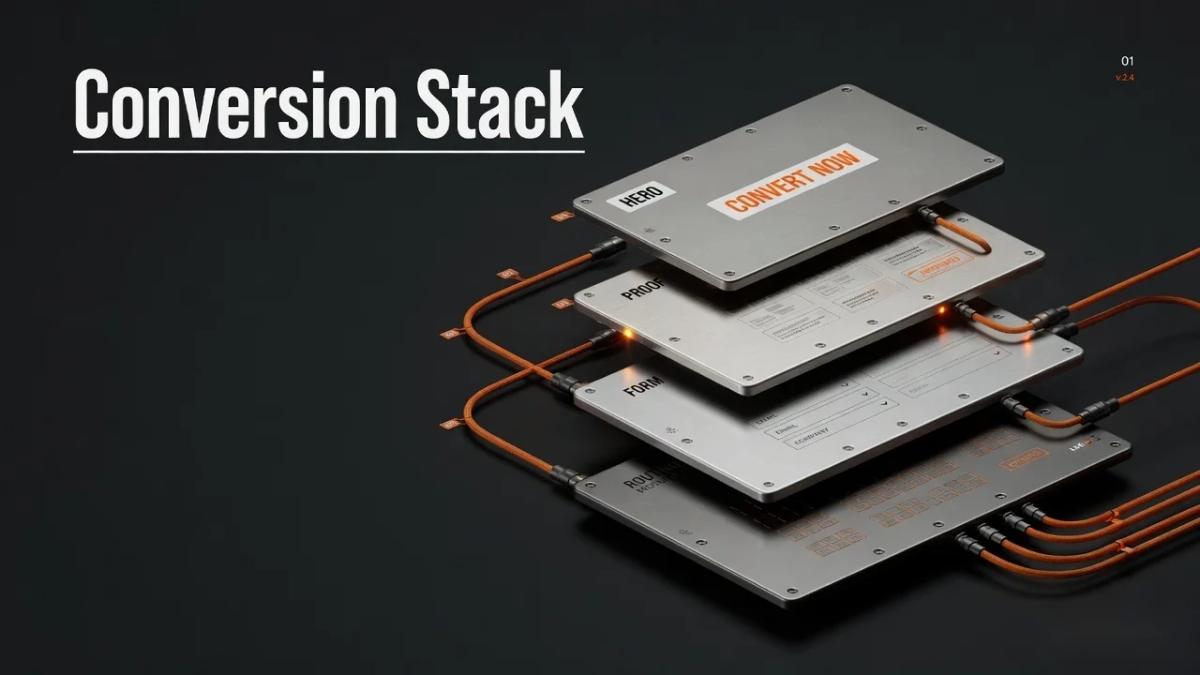
Landing page conversion architecture is the set of decisions that align traffic intent, offer, proof, form design, and post-submit routing so that captured demand becomes qualified pipeline — not a conversion-rate vanity number. A landing page is a conversion system with six modules: traffic quality and message match, offer clarity, proof hierarchy, form architecture, post-submit routing, and measurement. Creative is one input to that system, not the system itself.
Where the 2026 bar sits
The median landing page conversion rate across all industries is 6.6%, based on Unbounce’s analysis of 57 million conversions across 41,000+ landing pages (Unbounce Conversion Benchmark Report). HubSpot’s survey of 101 marketing professionals puts the average at 5.89%, with 10% considered a strong rate (HubSpot). Median conversion rates by industry:
| Industry | Median CVR |
|---|---|
| Financial Services | 12.3% |
| Health & Wellness | 10.0% |
| Professional Services | 7.4% |
| SaaS | 6.8% |
| Education | 6.1% |
| Ecommerce | 5.2% |
| Travel & Hospitality | 4.9% |
If your B2B page converts below 5%, the problem is structural, not aesthetic. Above 8%, you’re outperforming most competitors — scale what works instead of chasing marginal gains.
The benchmark conversation changed in 2026 in one important way: traffic itself now converts differently. AI-referred traffic to U.S. retail sites converted 38% worse than other traffic in March 2025 and 42% better by March 2026 — an 80-percentage-point swing measured by Adobe Digital Insights across a trillion-plus site visits (Demand Gen Report). Microsoft Clarity’s December 2025 analysis of 1,200+ sites measured AI referral sign-up conversion at 1.66% vs. 0.15% from organic search, and Semrush, Seer Interactive, and Ahrefs each measured B2B AI referral conversion at 4-10x traditional organic. G2’s March 2026 survey of 1,076 B2B software buyers found 51% now start research in an AI chatbot, and 69% switched vendors based on chatbot guidance (G2, via Demand Gen Report). The single best conversion lever in 2026 may be showing up inside the AI answer — see the AI search visibility playbook and the content distribution system that feeds it.
Module 1: Traffic quality and message match
Message match is the conversion rate of your ad, applied to your page. Mismatch kills conversion before layout matters.
Unbounce’s benchmark data shows email traffic converts at 19.3% on average — 60% higher than paid social (12%) and 77% higher than paid search (10.9%) — because email recipients arrive with context (Unbounce). Yet the 2026 Unbounce × Ascend2 State of Paid Media ROI report found 53% of marketers send most paid traffic to generic pages or homepages, and only 24% primarily use campaign-specific landing pages. Marketers who send paid traffic to homepages are far likelier to miss ROI goals — 62% of homepage-first senders fail to exceed them — while teams highly confident in their landing pages are 4x more likely to significantly exceed paid media ROI targets (31% vs. 7%) (Unbounce × Ascend2, via Demand Gen Report). The post-click destination is now the most underfunded part of paid media: 40% of marketers call destination-page optimization one of the most effective ways to maximize paid ROI, but only 31% invested in landing pages in the past six months.
Message match mechanics:
- Mirror the promise. If the ad says “Cut onboarding time by 40%,” the headline should say that, not “Welcome to Acme.” Dynamic text replacement is the standard mechanism for paid search.
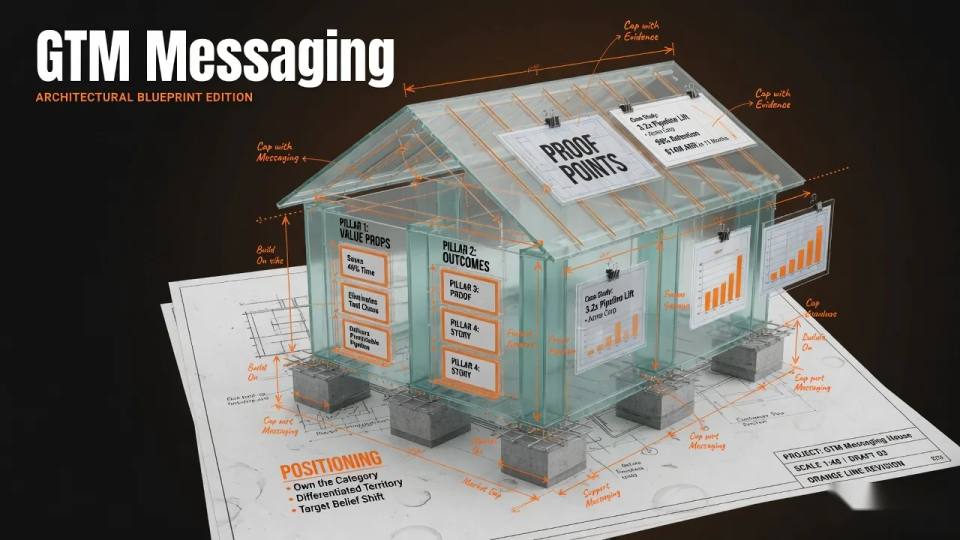
- AI changed the matching target. Buyers arriving from ChatGPT or Gemini have already compared vendors and pre-qualified themselves. The page now has to match the answer they were given — which means your content must be specific, extractable, and citation-worthy. G2 found 85% of buyers think more highly of vendors an AI chatbot mentions (G2). Message architecture work belongs upstream: see GTM messaging architecture.
- Simple copy converts. Unbounce found a -24.3% correlation between difficult words (3+ syllables) and conversion — 62% stronger than in 2020. Pages written at a 5th-7th grade level convert at 11.1%, versus 7.1% at 8th-9th grade and 5.3% at professional level.
Module 2: Offer clarity
State what the visitor gets, what it costs (time or money), and who it is for. Vague “learn more” CTAs waste high-intent traffic.
The CTA evidence is unusually consistent. HubSpot’s analysis of 330,000+ CTAs found personalized CTAs convert 202% better than default versions (HubSpot CTA statistics). PartnerStack lifted its homepage conversion from 6.66% to 14.09% (+111.55%) by changing “Book a Demo” to “Get Started.” Mailmodo raised conversion 110.35% by switching “Book a Demo” to “Talk to a Human.” Specific, benefit-framed CTAs beat transactional ones.
State explicitly:
- What the visitor gets (“A 14-page benchmark report with 2026 data”)
- What it costs (“Free — no credit card required” or “Takes 30 seconds”)
- Who it is for (“Built for B2B marketing teams with 10-200 employees”)
Addressing buyer fears on the page — “We’ll never share your email” — increased Marcus Sheridan’s form conversion by 80% (HubSpot). One line under the form can outperform a redesigned hero.
Module 3: Proof hierarchy
Order proof by the risk the buyer feels first: Is this for me? → Does this work? → Can I trust them? → What happens next?
Placement matters as much as content:
- Social proof directly under the CTA lifted Augmentive’s conversion 68.02% (HubSpot).
- Doubt removers under the CTA lifted Nomad Cooks from 9.5% to 21.3% (+124%).
- White space around the CTA lifted Open Mile conversions 232% (VWO, cited in HubSpot).
The proof stack for B2B, in order of leverage:
- Customer logos — instant recognition; above the fold or just below hero
- Specific case studies — “reduced churn 34% in six months” beats “customers love us”
- Quantified results — “10,000+ teams” beats “thousands”
- Testimonials with context — name, role, company, outcome
- Third-party reviews — G2, TrustRadius, Capterra ratings
38.6% of marketers say video is the #1 landing page element affecting conversion (HubSpot). In 2026 there’s a second reason proof matters: AI chatbots that recommend vendors draw heavily on review ecosystems and third-party surfaces. Your landing page proof and your review profiles are one system, not two.
Module 4: Form architecture
Fewer fields is not always better. Match friction to offer value and sales capacity — a demo form can ask more than a checklist download.
The nuance in the data:
- Only 10.9% of marketers say name and email are essential; 30.7% say four questions is the ideal landing page form (HubSpot).
- Baymard’s checkout research (the closest thing to a large-scale form baseline) found the average checkout form has 11.3 fields and 22% of users have abandoned a checkout because of complexity; 14% abandon if a phone number is required without explanation (Baymard Institute).
- CXL’s form testing work found multi-step forms can convert better than short single-page forms — Advanced Grass converted 214% better with seven questions across two steps than with three questions on one screen (CXL). More fields as steps feel like less effort.
- Captchas cost submissions: Stanford research found they reduce form submissions up to 30%; Animoto’s conversion rose from 48% to 64% after removing them (CXL). Use honeypots and server-side validation instead.
- Expedia made an extra $12M/year by removing one field; Marketo gained 34% more leads by shortening its form (CXL).
Autofill is the biggest ignored lever. Chrome’s analysis of millions of form loads found autofill users abandon forms 75% less and fill them 35% faster (Chrome Autofill Insights). Standard HTML input types, autocomplete attributes, and single-column layouts (which beat multi-column in most of the 500 A/B tests documented by Atticus Li) make autofill work.
The friction-value equation:
| Offer type | Recommended fields | Notes |
|---|---|---|
| Ebook/checklist download | 2-3 (name, email, company) | High volume, low qualification |
| Webinar registration | 3-5 (+ role, company size) | Medium volume, medium qualification |
| Free trial | 3-4 | Lower volume, higher qualification |
| Demo request | 5-7 (+ phone, company size, timeline) | Low volume, high qualification |
| Consult/contact | 4-6 | Variable |
Progressive profiling — three fields now, enrichment over later interactions — gets qualification data without upfront friction. And if the offer is low-value, reconsider whether a form is the right demand capture mechanism at all: GoodUI’s long-standing pattern is to expose fields on the page rather than bury them.
Module 5: Post-submit routing
The conversion rate is the handoff, not the submit. A page that converts at 8% but delivers leads nobody acts on is a leak, not a success. The classic speed-to-lead evidence — the 2011 Lead Response Management Study, still the most cited reference in this area — found leads contacted within the first hour were roughly 7x more likely to qualify than leads contacted later. No 2026 study has overturned it; most teams still aren’t close. Treat it as a floor.
Routing architecture:
- Confirmation with next steps. Never a generic “Thank you”: show the resource delivery, timeline, and what happens next.
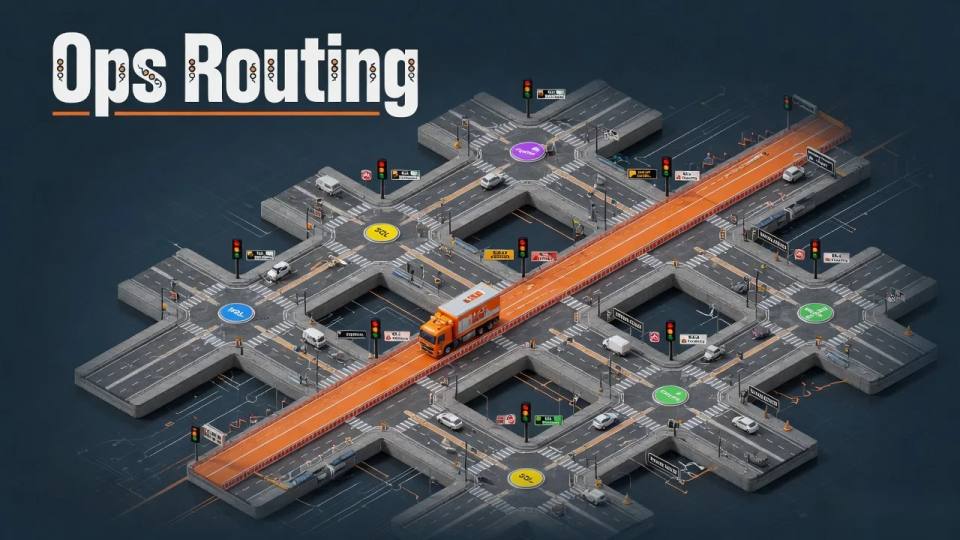
- Route by ICP fit, not round-robin. A 500-person SaaS company lead should not enter the same queue as a 5-person startup. Define fit with the same rigor as the outbound ICP system; this is where marketing-ops routing and lead qualification rules pay for themselves.
- SLAs by score. Demo requests get contact within 15 minutes; ebook downloads enter nurture. Route high-intent forms straight to a booking link on the thank-you page — the 2026 pattern is post-submit routing into scheduling, so intent is spent on a calendar, not in an inbox.
- Sales-marketing feedback loop. Track stage movement (MQL → SQL → Opportunity → Closed), not submits. 43.6% of marketers say lead generation is their top landing page goal while 33.7% say direct purchase (HubSpot) — route accordingly, and align sales capacity before you add form fields or traffic.
Module 6: The measurement loop
- Conversion rate by source — email at 19.3% vs. paid search at 10.9% tells you where to invest (Unbounce)
- Cost per qualified lead (CPQL), not cost per submit
- Stage movement rate — what percentage of page leads become opportunities?
- Time to first touch — the ops-health metric for speed to lead
- Lead-to-close by page — which pages produce revenue, not just forms
The full decision framework lives in pipeline metrics that matter. Pages that convert but don’t move stage are creative wins and business losses.
What changed in 2026
Four developments the classic landing page playbook doesn’t cover:
- AI agents fill forms now. OpenAI’s Operator — launched January 2025 and folded into ChatGPT as “agent mode” — is explicitly built to complete tasks like filling out forms (OpenAI). G2 found 41% of B2B software buyers use Deep Research tools for evaluations. Practical consequences: agent traffic converts at 4-10x rates, so pages need machine-readable clarity; honeypot fields and validation matter more; and human-verification friction that blocks agents also blocks your highest-intent human traffic.
- AI-referred traffic inverted the conversion curve. In twelve months, AI-referred traffic went from converting 38% worse than other traffic to 42% better (Adobe Digital Insights). Message match now means matching the AI answer the buyer received, not just the ad they clicked. Pages need extractable statistics, named comparisons, and direct answers — the content that gets cited by ChatGPT and Perplexity is the content that gets the clicks.
- AI-personalized landing pages at scale. Optimization platforms now generate and route page variants automatically — Unbounce’s Smart Traffic claims an average 30% conversion lift for users of optimization software (HubSpot). Combined with the 202% personalized-CTA effect, the 2026 play is a handful of tested variants per campaign, not one “perfect” page.
- Post-submit routing into booking. The thank-you page is now a routing hub: booking links for high-intent offers, resource delivery for low-intent ones, scoring that decides which. Conversion architecture ends where pipeline begins — see the B2B demand generation operating system for where that handoff sits.
Common failure modes
- Homepage-first paid media. 53% of marketers do it; 62% of them miss ROI targets. Send paid traffic to a page built for that promise (Unbounce × Ascend2).
- Proof as decoration. Logos stacked in the footer, no case study near the CTA, no doubt removers under the button.
- Form-field maximalism. Asking for phone + revenue + timeline on a checklist download, or building 9-field forms without multi-step structure or autofill support.
- Captcha walls on high-intent forms. Up to 30% of submissions lost — and the friction now also blocks helpful agents.
- Routing by alphabet. Round-robin distribution, no SLA by score, no booking path, generic thank-you page.
- Measuring submits as success. No stage movement tracking, no CPQL, no sales feedback loop.
- Optimizing without traffic. 100-visitor A/B tests produce noise. Conversion Rate Experts’ documented wins — Crazy Egg +363%, Voices.com +400%, Moz +170% — all came from systematic diagnosis on real traffic (Conversion Rate Experts), not pixel fiddling.
Build checklist
- Landing page exists per campaign promise — paid traffic never lands on the homepage
- Headline mirrors ad copy, search query, or the AI answer the buyer received
- Value proposition explicit within 5 seconds: what, what it costs, who it’s for
- CTA specific and benefit-framed; personalization by source or segment where possible
- Proof and doubt removers placed directly under the CTA
- Form fields matched to offer value; multi-step structure for 5+ questions; autofill attributes set
- No captchas; honeypot + validation instead
- Page loads in under 2 seconds on mobile (1-second pages convert ~3x better than 5-second, per Portent via HubSpot); 44px+ tap targets; no horizontal scroll
- Thank-you page delivers the resource, sets expectations, and routes: booking link for high intent, nurture for low intent
- CRM routing by score and ICP fit, with a speed-to-lead SLA
- Stage movement and CPQL tracked per page; one test hypothesis queued
LoudDemand note
Conversion is a system: traffic quality → message match → offer → proof → form → routing → measurement. The post-click experience is where campaigns win or lose, and AI has made traffic quality more valuable, not less. Build the system first, then optimize the surface.
Citations