

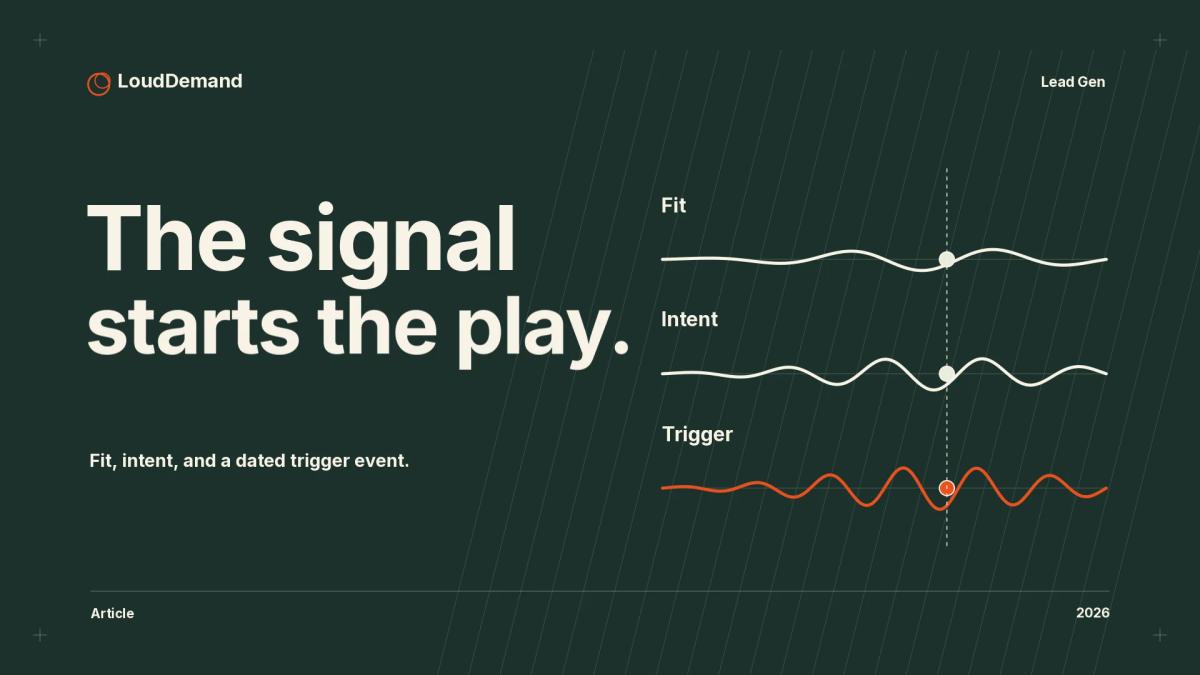
Signal-based selling turns observable buying signals into dated, routable actions: a new VP of Sales, a funding round, a competitor’s pricing change, a renewal date. Intent programs rank accounts, while signal-based selling works one trigger event at a time, so the output is a dated action with an owner and a deadline.
Demand programs aligned with buyer intent signals produced 93% more multi-touch engagement and 21% more leads per account, and were 1.6x more likely to reach decision stage. INFUSE and G2 market study across 11 cybersecurity programs, July 2026 (Demand Gen Report).
That study covered 243,000 G2 Buyer Intent accounts, so treat the effect size as directional.
Why signal-based selling matters in 2026
The measurement system changed before the playbook did. In the 2026 B2BMX Insights Benchmark, pipeline influenced became the top metric marketing teams answer for, at 44%, overtaking opportunities generated and MQLs/SALs. Revenue-based quotas rose from 25.3% to 33.3% in the same survey.
That shift is awkward for scored intent: an intent score is a model output you cannot defend when a buyer asks why you contacted them, while a dated trigger event can be defended in one sentence. Budget is moving the same way, with 60.4% of marketers now prioritising budget for AI-powered tools and platforms, up from a year earlier when account-based marketing led that list at 44.7%. Forrester’s May 2026 “GTM Singularity” report made the same argument, naming MQL obsession, gated content, impersonal mass emailing and siloed teams as untenable.
Buyers moved too. G2’s March 2026 survey of 1,076 B2B software buyers found 51% now start research in an AI chatbot more often than with Google, up from 29% eleven months earlier, and 71% rely on AI chatbots during research; 69% chose a different vendor than planned on chatbot guidance. TrustRadius’s 2026 Buying Disconnect report, based on a January 2026 survey of nearly 2,500 technology buyers and vendors, found 83% shortlisted three or fewer products.
My read: the gap between something changing and the shortlist closing is shrinking, so latency now matters more than targeting precision.
The signal based selling framework: three layers
Signal-based selling makes a dated trigger event the unit of work, not the account list. A program that only produces lists of accounts has not started yet.
A fit signal is a fact about a company that stays true for months. An intent signal is a behaviour showing research is happening right now. A trigger event is a discrete, dated change that gives you a reason to talk today.
Those layers decay at different speeds, so they cannot share one scoring model, one list and one cadence. This is event driven marketing with a deadline attached.
| Layer | Example signal | Typical decay window | Likely play | Confidence |
|---|---|---|---|---|
| Fit | Headcount inside the ICP band | 6–12 months | Tier-1 list, quarterly review | High |
| Intent | Category page views on a review site | 2–4 weeks | Comparison content, landing page | Medium |
| Intent | Pricing page visit | 1–2 weeks | Cost calculator, pricing objection email | Medium |
| Trigger | New VP of Sales hired | 3–10 days | One-to-one note to the new hire | High |
| Trigger | Funding round announced | 3–10 days | Budget-timing email to RevOps | High |
| Trigger | Competitor changes pricing | 1–3 days | Price-positioning email to a segment | Medium |
| Trigger | Job post for a role you sell into | 5–14 days | Role-specific economics email | High |
| Trigger | Regulatory deadline in your category | 30–180 days | Deadline readiness checklist | High |
Signal decay is a design parameter, not a side effect. Fit signals sit in your CRM for a year and are almost worthless as a reason to email today, while trigger events are worth hours and are the only layer you can name out loud without sounding strange. Do not route all three into the same queue.
Trigger events: why a dated trigger beats a scored threshold
A dated trigger wins on three things a score cannot deliver. It is explainable in one sentence, it is actionable within a day, and it does not ask the buyer to trust a vendor’s model.
That matters more now because buying groups are bigger and intent is narrower. A B2BMX 2026 panel, reported in April 2026, put two-thirds of B2B buying committees at six or more stakeholders and warned that intent is almost always persona-specific. G2 data cited in the INFUSE study put buying groups at nine members on average, with buying cycles compressing to seven months, and the panel’s recommendation was signal stacking: several people inside one account researching related topics, validated against role breadth and stage fit.
A trigger-event catalogue for a typical B2B category
Take a team selling workflow software to revenue and security leaders. These are the trigger events worth building, and where each one shows up.
| Trigger event | Real data source | Freshness from detection | First contact |
|---|---|---|---|
| New leader in your buyer role | Careers page, public headcount change | 1–3 days | The new hire |
| Funding round | Press release, Crunchbase feed, Form D filing | 1–5 days | CFO or RevOps |
| Job post for a role you sell into | Careers page, ATS feed (Greenhouse, Lever) | Same day to 48 hours | Hiring manager |
| Competitor pricing change | Pricing page, changelog or RSS, review site | 1–3 days | Buying group |
| New tool in their stack | BuiltWith or Wappalyzer, vendor posts | 1–2 weeks | IT or RevOps |
| Regulatory deadline on your category | European Commission AI Act timeline | Months ahead | Compliance or IT |
| Contract renewal window | Your own CRM and contract records | 30–90 days | Existing account owner |
| Shortlist forming on a review site | Category page activity on G2 or TrustRadius | 1–7 days | Roles in the group |
Three of those rows come free if you already own the data, since renewal dates, job postings and product telemetry are first-party. SEC Form 8-K filings for leadership changes and Form D filings for funding rounds are equally dated and reliable. The last row is where teams overreach: review-site activity tells you a buying group is active, not which person to email.
Wiring signals to plays: the routing table
Routing is where most signal programs fail. Detection is the easy half, and the real question is what happens in the four minutes after a trigger fires.
| Signal | Trigger condition | Play and owner | Response SLA | Channel |
|---|---|---|---|---|
| Funding round | Public announcement, account matches ICP | Benchmark asset to CEO or CFO | Same business day | |
| New VP of Sales | Headcount change, role matches buyer | One-to-one from the SDR pod | Within 24 hours | |
| Job post for your category | ATS feed updated | Economics email to hiring manager | Within 24 hours | |
| Competitor price change | Pricing page diff detected | Segment email on price positioning | Within 24 hours | |
| Renewal window | Contract end inside 90 days | Executive business review | 5 business days | Call, email |
| Compliance deadline | Date inside 180 days | Deadline checklist guide | 10 business days | Email, content |
A trigger becomes intent triggered outreach only when a play fires against it, which makes the SLA the real design decision. Lusha, a contact-data vendor writing in Demand Gen Report in October 2026, put a benchmark on this: roughly 13,600 B2B contacts change jobs every working day, and a new hire’s stack is usually locked in within about 30 days, so their benchmark is acting on 80% of live signals inside that window.
If your signal latency is 14 days, you have spent half the window in a queue. Apollo’s September 2026 launch of a signal-based execution system, which captures buying signals continuously and decides who to reach and when, is the tooling version of the same idea, so set the SLA before you set the budget.
Signal-based selling vs ABM vs intent-based marketing
Signal-based selling is not a replacement for account-based marketing. It is a different unit of work underneath the same account strategy.
| Dimension | Account-based marketing | Intent-based marketing | Signal-based selling |
|---|---|---|---|
| Unit of work | Tiered account list | Account score | Dated trigger event |
| Output | Account-targeted campaign | A scored list to route | One action, one owner, one deadline |
| Explainable to a buyer | Partly | No | Yes, in one sentence |
| Typical failure mode | Personalisation theatre | Unauditable model, false positives | Latency and overfitting |
| How it gets measured | Engagement, penetration | MQLs, pipeline influenced | Pipeline influenced, by cohort |
ABM is not failing, it is saturating. Demand Gen Report’s 2026 ABM Benchmark found nearly 80% of surveyed organisations now actively executing an ABM strategy, with 52% saying their efforts meet expectations, 23% reporting they exceed them and 10% greatly exceeding them. The same research found 43% of respondents struggle to connect AI with their martech stack, which is where signal-based selling earns its place.
If your ABM programme already has account selection, content and measurement, adding a trigger layer on top is cheaper than replacing it. Our account-based marketing strategy guide covers the account layer in full.
How to build a signal-based selling program
- Pick one category and one trigger family. A team selling security software to banks should start with funding rounds and regulatory deadlines, not an intent score across 30,000 accounts.
- Write the taxonomy before you buy anything. Record the layer, decay window, play, owner and confidence per signal. Anything you cannot name a play for gets deleted.
- Name the source per trigger. Prefer first-party records, then public disclosure, then third-party panels, and know where each number came from before you quote it.
- Write the message from the trigger. The first line should reference the change, not your category, and capability copy belongs in the body.
- Set the SLA and instrument latency. Track the time from signal to first human touch, not the number of emails sent.
- Decide what you will never say. Write down the creepy line and ban it, because reps under pressure will cross it without noticing.
- Instrument attribution, then prune. Tag the account, trigger type and date at first touch, so you can report pipeline influenced by cohort, and kill any signal that produced no opportunity after a reasonable sample.
If the account selection underneath is still fuzzy, sort that first. Our outbound ICP system covers that layer, and identifying in-market B2B buyers with intent data covers how to tell a real buyer from a researcher.
Tools that detect buying signals
The tooling splits into three groups, and one from each group beats three from the same group.
- Third-party intent and signal panels. 6sense, Demandbase, Bombora, Intentsify, HG Insights (which acquired MadKudu in 2025), Apollo, and buyer intent data from G2 or TrustRadius. Treat published scale figures as claims: Intentsify says its buyer intelligence comes from 1.1 trillion monthly intent signals across 4.2 million in-market accounts, and Clay says more than 500,000 GTM teams use its layer.
- First-party sources you already own. CRM contract dates, recruiting pages and ATS feeds, product usage, call recordings and web analytics. Panels give you real-time intent; first-party records give you dates you can defend in a reply.
- Orchestration and routing. Clay, Apollo and the automation layer inside HubSpot or Marketo decide what fires, who owns it and when it goes out.
Two cautions. Gartner’s 2026 CMO Spend Survey found CMOs now allocate 15.3% of marketing budgets to AI while only 30% report mature AI readiness, so more signal tooling is not the same as a working signal program. And Lusha reports the average GTM stack now runs 23 vendors deep, so a new panel adds another feed to a system where most output never reaches a rep.
For a structured comparison of the data providers, start with the intent data provider roundup.
Common mistakes
Mixing layers into one score. A tenure score that blends headcount, page views and a funding event is unauditable, so keep the layers separate and route them differently.
Ignoring decay. Treat every signal as fresh and your reps will email people about a funding round from 2024.
Queueing the moment. A trigger with a 14-day SLA is a slower list, so measure latency like speed to lead.
Crossing the creepy line. The UK Information Commissioner’s Office is explicit that marketing rules are stricter for individuals than for companies, and unsolicited electronic messages to individuals usually need consent or a soft opt-in. For corporate buyers, reference a public fact, name the business reason, address a role, and offer an opt-out.
Compare two openings. Say “Congrats on the Series C, here is how peer companies handled the same budget cycle,” and never say “I saw your VP Sales posting and noticed you downloaded our ROI guide.” The second tells a buyer you watched their hiring page, which no reply rate survives.
Confusing activity with pipeline. Signal programs post beautiful activity numbers: emails sent, pages visited, accounts scored.
With pipeline influenced now the top metric at 44%, those numbers will not carry a budget conversation. Tag every touch with its trigger and report influenced pipeline by cohort, and keep a matched group of accounts with no signal outreach so you can compare conversion.
FAQ
What is signal-based selling?
Signal-based selling is a GTM motion where a dated change in a buyer’s company, such as a new hire or a funding round, is the unit of work that triggers a specific action. The event routes to a named play with a deadline instead of adding the account to a scored list.
How is signal-based selling different from ABM or intent-based marketing?
ABM starts from a target account and personalises for it, while intent-based marketing scores accounts and waits for a threshold. Signal-based selling starts from the change itself, so the output is one dated action with an owner and a deadline. The two stack: ABM decides who matters, signals decide when to act.
Which buying signals are worth selling on?
Dated, public, relevant-to-a-role-you-sell-into events: a new leader in your buyer role, a job post for a role you sell into, a funding round, a competitor’s pricing change, a renewal date in your CRM, or a regulatory deadline. Fit and intent data still matter, but decay at different speeds.
How do you build a signal-based selling program?
Start with one category and one trigger family, write the taxonomy with a decay window and a named play per signal, set a same-day or 24-hour deadline on dated triggers, instrument trigger-to-opportunity attribution, and prune signals that never produce pipeline. Buy tooling last.
What tools detect buying signals?
Intent and signal panels such as 6sense, Demandbase, Bombora, Intentsify, HG Insights and Apollo, plus review-site intent from G2 and TrustRadius, and orchestration layers like Clay for routing. First-party sources, including CRM contract dates and careers pages, produce the best dated triggers.
How do you stop signal-based outreach from feeling creepy?
Reference the public trigger and the business reason, not the surveillance method. Address the role instead of the individual, keep the message short and specific to the change, make the opt-out obvious, and follow consent rules, since UK PECR guidance sets stricter rules for individuals than corporate ones.
What results do signal-based programs actually produce?
In the INFUSE and G2 study published in July 2026, accounts appearing in both G2 Buyer Intent data and the demand programme saw 93% higher multi-touch engagement, 21% more leads per account and 1.6x more likelihood of being at decision stage, across 11 cybersecurity programs. It is one vendor study in one category, so treat it as directional.
What to do next
Pick one trigger family and prove the loop before you buy a platform. Write down the ten signals you can detect today from data you already hold, decide the play and owner for each, set a same-day SLA, and run it for one quarter.
Then measure it properly and report it as signal based revenue: influenced pipeline, tagged by trigger type, compared against a holdout group. If reply quality on those sends looks off, the problem is usually the message rather than the trigger, so read our notes on outbound reply quality and check your cold email deliverability before you blame the signal.
Sources & references
- Study Finds Demand Programs Aligned with Buyer Signals Deliver 93% More EngagementDemand Gen Report (B2BMX Insights) · Accessed Oct 16, 2026Demand Gen Report, July 2026
- New G2 Research: Half of B2B Software Buyers Now Start Their Research With AI ChatbotsG2 via PR Newswire · Accessed Oct 16, 2026G2 via PR Newswire, April 2026
- B2B Marketers Face Growing Pressure to Prove ROI as Revenue-Based Quotas RiseDemand Gen Report (B2BMX Insights) · Accessed Oct 16, 2026Demand Gen Report, October 2026
- The 2026 B2BMX Insights 2026 Benchmark Survey Results: B2B Marketing Enters the AI EraDemand Gen Report (B2BMX Insights) · Accessed Oct 16, 2026Demand Gen Report, October 2026
- 2026 ABM Benchmark Survey: AI's Biggest Impact Is Personalization At ScaleDemand Gen Report (B2BMX Insights) · Accessed Oct 16, 2026and Demand Gen Report, May and June 2026
- 2026 Account Based Marketing (ABM) Benchmark Survey Findings: ABM Moves Beyond Pilot Stage, With AI Powering Smarter ExecutionDemand Gen Report (B2BMX Insights) · Accessed Oct 16, 2026and Demand Gen Report, May and June 2026
- TrustRadius: AI Has Changed How Buyers Research, But Not What They TrustDemand Gen Report (B2BMX Insights) · Accessed Oct 16, 2026Demand Gen Report, July 2026
- B2B Buying Decisions Demand Consensus, Not Champions: Lessons From B2BMX 2026Demand Gen Report (B2BMX Insights) · Accessed Oct 16, 2026Demand Gen Report, April 2026
- Forrester Report Calls for New GTM Approach by B2B LeadersDemand Gen Report (B2BMX Insights) · Accessed Oct 16, 2026Demand Gen Report, May 2026
- Gartner 2026 CMO Spend Survey Finds CMOs Allocate 15.3% of Marketing Budgets to AI, But Only 30% Are Ready to Scale AI CapabilitiesGartner · Accessed Oct 16, 2026Gartner, May 2026
- What Good Looks Like in B2B Sales Data in 2026Demand Gen Report (B2BMX Insights), guest column by Lusha · Accessed Oct 16, 2026Demand Gen Report, Lusha column, October 2026
- Apollo Introduces New AI-Powered GTM Platform for Revenue TeamsDemand Gen Report (B2BMX Insights) · Accessed Oct 16, 2026Demand Gen Report, September 2026
- Intentsify Partners with Clay on Intent DataDemand Gen Report (B2BMX Insights) · Accessed Oct 16, 2026Demand Gen Report, September 2026
- Guide to PECR: Electronic and telephone marketingInformation Commissioner's Office (ICO) · Accessed Oct 16, 2026ICO, 2026