

The answer, before the argument
If you run outbound in 2026 and report a single number to leadership, report this one:
Positive-intent replies per 1,000 sends, against a named ICP segment.
Not open rate — Google states plainly that it does not track open rates and that low open rates are not a reliable indicator of deliverability (Gmail sender guidelines). Not raw reply rate either, because a “reply” can be a booked meeting, an out-of-office, a wrong-person redirect, or “remove me.” Those four things have wildly different economic values and they average into a number that means nothing.
The benchmark you’re measuring against: the platform-wide average cold-email reply rate is 3.43%, the top quartile clears 5.5%, and the top decile exceeds 10.7% (Instantly, Cold Email Benchmark Report 2026, billions of events, January 1 – December 18, 2025). A campaign at 5% reply with a 12% positive share is worse than a campaign at 3.5% reply with a 55% positive share. Only the taxonomy tells you which one you’re running.
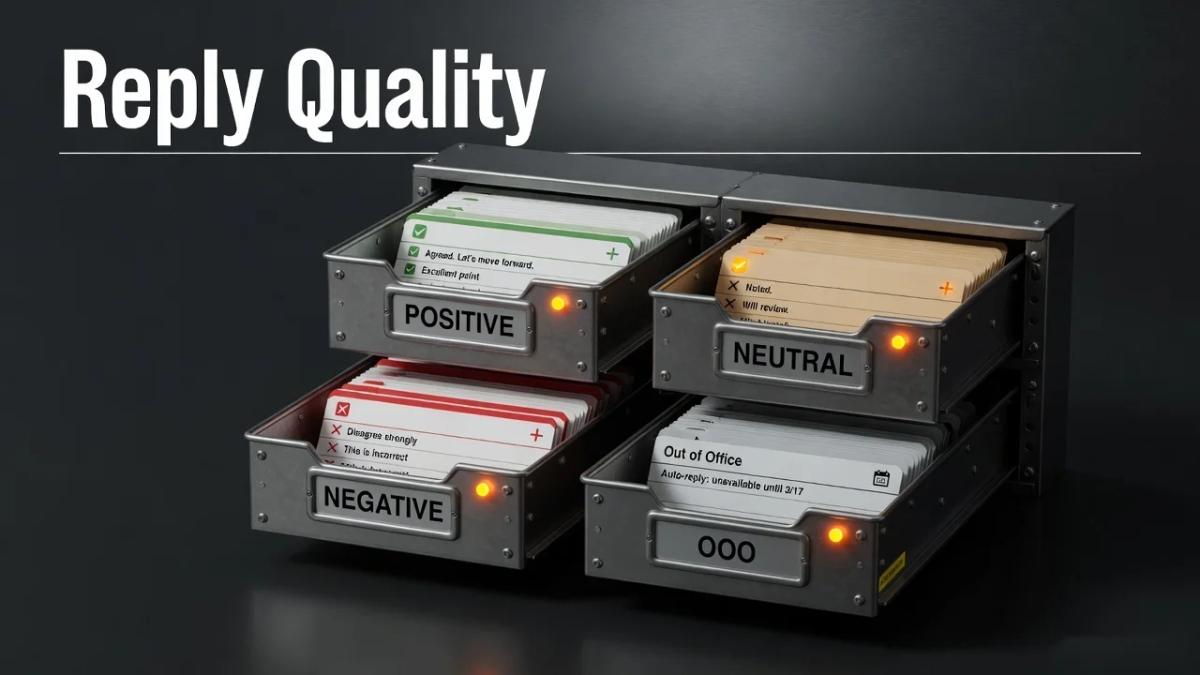
The reply taxonomy
Eight buckets. Any sequencer worth using in 2026 can apply them automatically; the discipline is agreeing on definitions before you turn classification on.
Positive — bookable. An explicit or near-explicit yes: “send times,” “let’s talk Tuesday,” “who should I loop in?” This is the numerator of your real metric.
Positive — deferred. “Not now, circle back in Q1.” Genuine interest with a timing constraint. Route to a nurture list with a dated trigger, not back into the same cold sequence.
Neutral / information request. “Send me a one-pager.” Ambiguous. Some convert; most are polite deflection. Count them separately or you will inflate your pipeline forecast by 2–3x.
Objection. “We already use X,” “no budget,” “we build in-house.” Objections are good data — they mean the message landed and the account is in-category. A campaign with zero objections is usually a campaign nobody read.
Negative — not relevant. “Wrong company, we don’t do that.” This is a targeting defect, not a copy defect.
Wrong person / referral. “Talk to Priya.” The highest-yield category per unit of effort and the one most often deleted by an unsupervised inbox.
Auto-reply / OOO. Machine noise with a useful field: the return date. Friday produces the heaviest auto-reply volume as prospects set OOO, which is precisely why the benchmark data recommends triaging on Friday and restarting conversations Monday.
Unsubscribe / complaint. The compliance floor and the deliverability tripwire. Treat these as the most expensive replies you receive.
The reason to split negative — not relevant from objection, and positive — bookable from neutral, is diagnostic. Each pair points at a different broken system. Objections mean fix the offer. “Not relevant” means fix the list. Neutral-heavy means fix the CTA.
The 2026 benchmark picture
The tier structure
The Instantly dataset segments senders into three tiers: Tier 3 (average, 3.43%), Tier 2 (top quartile, 5.5%+), and Tier 1 (elite, 10.7%+). What’s notable is the report’s own attribution of the gap. Tier 3 campaigns already have healthy inbox placement, correct SPF/DKIM/DMARC, sane volume, and acceptable bounce rates — the technical layer is solved. What they lack is targeting precision and message refinement.
That reframes the whole optimization question. If you’re at 3.4%, buying more infrastructure will not move you. Warming another twenty domains will not move you. The constraint is upstream, in segment definition and first-touch craft.
Step one is 58% of your ceiling
The single most actionable number in the 2026 data: 58% of all replies arrive on step one, with the remaining 42% distributed across follow-ups. Optimal sequence length is 4–7 touches; below four gives up early, beyond seven produces diminishing returns unless each touch carries genuinely new value.
Two implications operators consistently get backwards:
- Rewriting follow-ups is a 42% lever; rewriting the opener is a 58% lever. Most teams do the opposite because the opener feels “done.”
- Replies continue past step ten, at low rates. Well-paced sequences catch prospects at different readiness moments. Killing every sequence at step three because the dashboard flattens throws away real volume.
The reported craft profile of elite first-touch emails is unglamorous and consistent: under 80 words, a hyper-relevant subject line tied to a specific situation, a single low-cognitive-load CTA, and problem-first positioning. The report also notes that step-two emails written as if they were replies — “quick follow-up on my note below” — outperform formal follow-up formats by roughly 30%.
Timing
Wednesday delivers peak engagement; Monday is the highest-volume launch day; Friday is the auto-reply surge. This is a modest edge compared to targeting, but it’s free.
Deliverability is now a reply-quality problem
The 2024–2026 mailbox-provider rules changed what “bad replies” cost you. Under Gmail’s requirements, bulk senders (5,000+ messages/day to Gmail accounts) must run SPF, DKIM and DMARC with alignment, TLS transport, valid forward and reverse DNS, one-click unsubscribe on marketing and subscribed mail, and must keep Postmaster Tools spam rates below 0.30% — with Google explicitly recommending below 0.10%. Yahoo mirrors the requirement set, adds a two-day deadline for honoring unsubscribes, and calculates spam rate on inbox-delivered mail (Yahoo Sender Hub). Microsoft applied the same authentication floor to Outlook.com consumer domains for senders above 5,000/day, with non-compliant mail routed to Junk and rejection signalled as the eventual end state (Microsoft, April 2025).
Read that as a feedback loop rather than a checklist. Engagement quality drives placement; placement drives engagement. Every “not relevant” reply is a near-miss complaint from someone who should not have been on the list, and complaints are now metered against a 0.3% ceiling that is trivially easy to breach with a few thousand badly targeted sends. Bad targeting is no longer merely inefficient; it is self-terminating.
Two operational floors worth defending: bounce rate under 2%, and enterprise gateways (Proofpoint, Mimecast, Barracuda) either excluded or handled with a deliberate strategy rather than the same bulk cadence as everyone else.
AI reply routing: what it actually does well
Automatic reply classification is now a commodity feature rather than a premium add-on. Instantly’s implementation applies AI labels to incoming replies across 50+ languages, ships built-in Interested / Not interested / Out of Office labels by default, allows custom labels, and — importantly — includes a Test AI pane where you paste a sample reply and see which label the model assigns before you turn it loose on live campaigns (Instantly docs). Misclassifications are corrected via thumbs up/down and by editing the label description, which is the actual tuning surface: the label’s written definition is your prompt.
The reply-agent tier goes further — drafting responses, handling objections, sharing scheduling links, and writing status changes back to CRM, with a human-in-the-loop mode that requires approval before sending and an autopilot mode that escalates edge cases (Instantly AI Reply Agent).
Three rules for using this well:
Start in human-in-the-loop. Run it in approval mode for at least 200 replies. You are not testing whether the model can write English; you are testing whether your label definitions match how your market actually phrases things. Vertical language breaks generic classifiers fast — “we’re already covered” means objection in one category and not relevant in another.
Write label definitions like specifications, not adjectives. “Interested” is a bad definition. “Prospect asks for a time, a demo, pricing, or the right internal contact” is a usable one.
Never automate the negative path. Unsubscribes, complaints and “remove me” replies should be processed deterministically and fast — Yahoo’s two-day window is the hard floor, and same-day suppression is the sane operating standard. This is a compliance function, not an AI function.
The genuine value of classification is speed-to-lead on the positive bucket. A response inside minutes rather than the next morning is the difference between a booked meeting and a competitor’s booked meeting.
What actually separates the top decile
The 2026 data attributes elite performance to micro-segmentation, problem-focused messaging, weekly A/B testing, and smart automation — auto-triage of replies plus subsequences that branch on keywords or lead status. Translated into operator terms:
Segments small enough to write one true sentence about. If you cannot write a line that is false for the adjacent segment, your segment is too wide. “You’re hiring four SDRs in Austin” is a segment. “You’re a B2B SaaS company” is a mailing list.
Right-time triggers over interval scheduling. Hiring signals, funding events, product launches, and website-visit data replace the arbitrary “day 1 / day 4 / day 8” cadence. The prediction the benchmark report closes on is that the next frontier is reaching the right people at the right moment, not merely reaching the right people.
Weekly test cycles with positive-intent as the success metric. Testing on total reply rate will reliably select for subject lines that provoke “please stop emailing me.”
Consistency over bursts. Teams that maintain stable domain health and steady send volume see 15–20% higher reply rates in the platform dataset. Erratic volume — 500 Monday, nothing midweek, 1,000 Friday — reads as suspicious to filters and degrades placement.
On AI-written copy: the honest 2026 position is that model-generated first drafts are now the baseline input for elite teams, with AI agents absorbing the research and sequencing workload so humans concentrate on positioning and messaging strategy. The differentiator was never “AI versus human.” It is whether the inputs to the draft contain a specific, verifiable fact about the account. A generic prompt produces generic copy at speed, which is the worst possible outcome under a 0.3% complaint ceiling.
The audit you can run this week
- Export the last 30 days of replies. Tag every one against the eight-category taxonomy. Hand-tag the first batch even if you have automation — you need to see the raw language.
- Compute positive-intent rate = (positive-bookable + positive-deferred) ÷ sends. Publish that number, not reply rate.
- Compute the held-meeting conversion from positive-bookable. If more than a third evaporate before the call, your qualification language is over-promising.
- Check bounce rate. Above 2%, stop and clean the list before touching anything else.
- Check Postmaster Tools spam rate. Above 0.10%, treat it as an emergency, not a metric.
- Read 20 “not relevant” replies verbatim. If a theme appears three times, your ICP filter has a specific, fixable defect.
- Isolate first-touch reply rate from sequence-total. Step one should carry roughly 58% of replies. If it carries much less, the opener is the problem and no amount of follow-up tuning fixes it.
- Count your first-touch word count. Over 80 words, cut.
- Verify SPF, DKIM, DMARC alignment, one-click unsubscribe headers (RFC 8058), and that unsubscribes are suppressed within 24 hours.
- Turn on AI reply classification in approval mode. Tune label descriptions. Only then move the safe categories to autopilot.
The through-line
Everything above collapses into one claim: outbound in 2026 is rate-limited by relevance, and relevance is now enforced by the mailbox providers as well as by the buyer. Reply rates held stable through a period of rising send volume, which means the extra volume bought nothing. The teams sitting at 10%+ did not send more. They wrote to fewer people about something those people were already dealing with, they answered fast, and they measured the only reply that pays for itself.
Citations
Sources & references
- LoudDemand methodologyLoudDemand
- Cold Email Benchmark Report 2026Instantly
- Email sender guidelinesGoogle / Gmail Help
- Sender Requirements & RecommendationsYahoo Sender Hub
- AI Reply AgentInstantly