

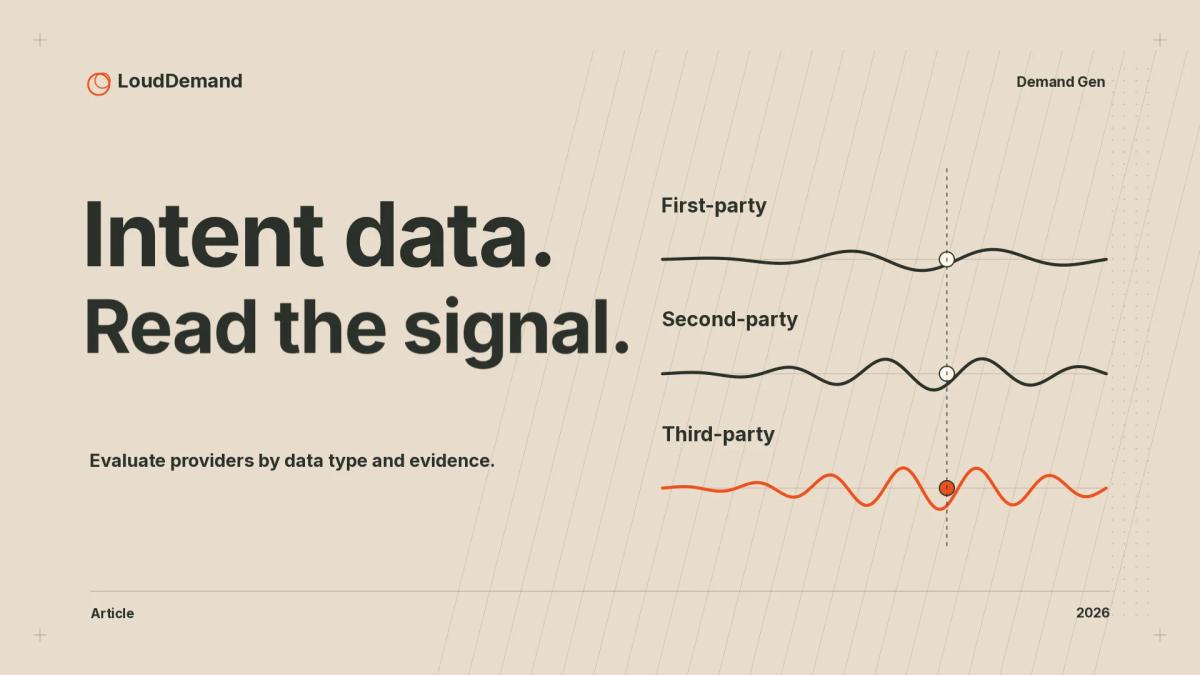
The best B2B intent data providers cannot be ranked by accuracy, because nobody has published an independent accuracy benchmark for this market. What you can compare is where each vendor’s signals come from, what they measure, and how they charge. Four data types cover the category publisher co-ops, third-party web behaviour, predictive scoring models, and intent inside review platforms.
Only two vendors here publish list prices: Leadfeeder and Factors.ai. Bombora, 6sense, Demandbase, ZoomInfo, Cognism and Informa TechTarget quote.
This comparison draws on published product information.
What “intent data” means in 2026
Intent data is a record of a buyer’s observable research behaviour what they looked at, searched for, and came back to resolved to an account.
Vendors use “intent data” for four different products, and much wasted spend comes from buying the wrong one.
- Publisher co-ops and first-party panels. Publishers share their reader behaviour with a cooperative, which scores which accounts are researching which topics. Bombora Company Surge is the reference implementation; Informa TechTarget runs the same shape inside its own media network.
- Third-party observed web behaviour. B2B bidstream data and IP-to-company resolution, inferring an account from the pages its people read. Demandbase, Leadfeeder, Cognism and Factors.ai work here.
- Predictive and scored intent models. Models that combine many weak signals into a probability an account is in-market. 6sense and ZoomInfo lead here; Factors.ai sells it as an add-on.
- In-platform buyer intent. Research captured inside a review or content destination the buyer already uses. G2 Buyer Intent, HG Insights’ TrustRadius layer and Informa TechTarget’s Buyer Intelligence sit here.
Which data type answers which question
Each type answers a different question, so pick the one that matches your decision.
| The question you actually have | Data type that answers it best | Why it wins there | What it misses |
|---|---|---|---|
| Which accounts on my list are researching my category now? | Co-op publisher panels (Bombora) | Behaviour observed on sites chosen for B2B research, not inferred from ad auctions | Publishers your buyers never read |
| Which companies visited my site and looked at pricing? | Third-party web behaviour (Demandbase, Leadfeeder, Factors.ai) | Your own domain data beats anything off-site | Visitors who never touch your site |
| Which of my 5,000 accounts will buy in 90 days? | Predictive scoring models (6sense, ZoomInfo) | Models rank a long list even when raw signal is thin | Accounts with no observable footprint |
| Which buyers are comparing me against a competitor? | In-platform intent (G2, HG Insights, Informa TechTarget) | Comparison and pricing-page views are the strongest B2B intent event | Buyers who never visit a review site |
| Who is researching us inside an AI assistant? | None of them yet | AI research happens in closed conversations no provider observes | Almost everything, and it is growing fastest |
Why nobody publishes an intent accuracy benchmark
There is no independent, audited test of how accurate B2B intent data is, and that should change how you read every B2B intent provider comparison you see.
The closest thing to an independent verdict is Forrester’s Q1 2025 Wave, Intent Data Providers For B2B, which scored 15 providers against 21 criteria on the depth, breadth and quality of their intent data. It named a set of Leaders 6sense, Bombora and Informa TechTarget among them and produced useful commentary on identity resolution and noise filtering. It is a vendor evaluation, not a precision test, and no precision rate is published for any provider.
What vendors publish instead falls into two buckets, and neither is an accuracy claim:
- Provenance claims. Bombora says 86% of the data in its Data Co-op is shared exclusively with Bombora for deriving intent, across a cooperative of thousands of media destinations tracking tens of thousands of topics and millions of B2B domains. That tells you where the data comes from, not how often the signal points at a real buyer.
- Coverage and volume claims. Demandbase says it looks annually at over 1 trillion monthly interactions across the web from B2B companies, spanning 4 billion IP addresses and 36 billion B2B site visits. Leadfeeder says it matches up to 45% of company-level website visitors. Both are ceilings on reach, not measures of precision.
Every published study in this category is also run by a vendor on its own dataset. A joint INFUSE and G2 study published July 16, 2026, drawing on 243,000 G2 Buyer Intent accounts and more than 130 campaigns across 11 cybersecurity programs, is good evidence about in-platform intent, not a neutral comparison.
The gap is also widening where no provider can see. Buyers are starting research somewhere new:
51% of B2B software buyers now begin their research with an AI chatbot more often than with Google, up from 29% eleven months earlier. G2’s March 2026 survey of 1,076 B2B software buyers (G2 via PR Newswire).
Research inside a chatbot is invisible to a bidstream feed, a publisher co-op and a review site. That is a category limit, and it grows every quarter.
The providers, by data type
Co-op and publisher first-party panels
Bombora Company Surge runs the clearest co-op model. Publishers, B2B brands and premium data providers share reader behaviour with a cooperative governed by consent-driven collection protocols, and Bombora scores account-topic pairs against each account’s own baseline rather than a global keyword spike. A Forrester line quoted on Bombora’s own site calls it “still the gold standard for account-level intent data feeds” and places it among the Leaders in its Q1 2025 Wave; pricing is quote only.
Informa TechTarget runs the same shape but owns its media: 220+ technology-specific digital properties and roughly 58 million permissioned first-party audience members. Buyer Intelligence, launched September 15, 2026, layers Pain Points, Pitch Assist and Persona and ICP Intelligence over directly observed person-level signals, and on October 21, 2026 the company announced a Demandbase integration for Q1 2027.
Third-party observed web behaviour
Demandbase is the most transparent vendor about its own method: its documentation says signals come through direct access to the bidstream via its B2B DSP, connecting it to over one million web publishers. Trending Intent is defined as signals up two standard deviations in the last seven days against the prior eight weeks, and Intent Strength is measured against peer groups of similar account size, so its scores are relative rather than absolute; it carries 865,000+ intent keywords across 113M+ companies and surfaces third-party feeds from Bombora, G2 and TrustRadius inside it as “Intent Surge”. Pricing is quote only: a platform fee plus a flat per-user fee.
Leadfeeder (formerly Dealfront, rebranded March 2026) works the other side of the transaction: your website is the signal. It resolves company-level visitors from IP, prices at €0, €79, €369 and €599 per month billed annually, and targets SMB and mid-market teams in Europe and North America. Its 45% visitor-match figure states the ceiling out loud.
Cognism treats intent as one contextual signal among several. Its pricing page splits Standard and Pro, includes five seats in each, and puts intent in Pro alongside hiring, funding and M&A, and job-change signals a job change may be the stronger trigger.
Factors.ai is the clearest mid-market option with published pricing: $199 per month on Lite, then $6,000, $20,000 and $30,000+ a year across Basic, Growth and Enterprise. G2 and LinkedIn intent signals can be added without a platform change, Bombora topics as an add-on, and predictive account scoring from Growth.
Predictive and scored intent models
6sense sells the scoring layer plus the activation. Its account intent scoring asks “how likely is this account to buy in the next 90 days” rather than “what is this account researching”, which makes it useful for ranking a long list and dangerous when treated as a trigger; its documentation separates first-party intent, second-party intent from review sites such as G2, TrustRadius, Peerspot and Gartner Digital Markets, and third-party intent from the open web. It tracks over 40 languages, resells partner signals from Bombora, TechTarget, TrustRadius and G2 in one place, and has been named a Leader in Forrester’s Wave for intent data two years running; pricing is quote only.
ZoomInfo prices intent as a credit-metered line item inside a broader data contract: Marketing Demand includes 25 intent topics, ABM Lite 100, ABM Enterprise unlimited, and Streaming Intent is a separate add-on priced on keyword volume and the size of the account universe you want to track.
Intent captured inside review and content platforms
G2 Buyer Intent is the most precisely documented product in the category. G2 lists nine signal types Profile, Pricing, Alternatives, Category, Compare, Sponsored content, Licensed content, Reference page and Competitive and scores every buying organisation on two axes: Buying Stage (Awareness, Consideration, Decision) and Activity Level (Low, Medium, High). Signals span G2, Capterra, Software Advice and GetApp, availability depends on your G2 plan, and audiences sync to LinkedIn Ads, Reddit Ads, Google DV360, The Trade Desk, Amazon DSP and LiveRamp.
HG Insights, which owns TrustRadius, packages two things most vendors keep apart: web-wide intent across a B2B publisher network, and Downstream Buyer Intent Category Intent and Product Intent captured from buyers comparing vendors on TrustRadius itself. High-intent designations score 80 and above, medium ones 64 to 80, and signals resolve against the buyer’s detected technology.
Master comparison: every provider, side by side
| Provider | Data type | Collection method | What it actually measures | Pricing model | Best for | Watch-out |
|---|---|---|---|---|---|---|
| Bombora Company Surge | Publisher co-op | Reader behaviour shared into Bombora’s Data Cooperative | Research intensity by account-topic pair vs each account’s baseline | Quote | Category-level account prioritisation | No published price; coverage = publisher list |
| Informa TechTarget Buyer Intelligence | Publisher first-party | Owns 220+ tech properties, ~58M permissioned audience | Person-level content consumption, pain points, activity | Quote | Enterprise tech buyers | Narrow vertical coverage |
| Demandbase | Third-party web behaviour | Own B2B DSP bidstream access, 1M+ publishers | Keyword intensity, Trending Intent, peer-relative scores | Quote: platform + per-user fee | Large ABM programmes | Relative scoring; 13 months of history |
| Leadfeeder | Third-party web behaviour | IP-to-company resolution on your site | Which companies visited, pages, campaigns | €0 / €79 / €369 / €599 per month; Enterprise custom | Mid-market teams wanting fast site signal | Matches up to 45% of company-level visitors |
| Cognism | Third-party web behaviour + context | Contact database plus contextual signals | Hiring, funding, M&A, job changes, intent filters | Quote, five seats included | Outbound teams where job changes drive timing | Intent is bundled, not standalone |
| Factors.ai | Third-party web behaviour + predictive | Visitor ID, G2 and LinkedIn signals, optional Bombora topics | Custom and predictive account scoring | $199/month Lite, $6K/$20K/$30K+ per year | Mid-market teams wanting scored accounts | Predictive scoring from Growth tier |
| 6sense | Predictive model | Native keyword intent plus resold partner signals | Model-scored in-market likelihood by keyword set | Quote | Enterprise scoring, activation, buying groups | No public pricing; accuracy claims vendor-reported |
| ZoomInfo | Predictive model | Web and keyword signals in a credit-metered contract | Intent topics, clusters, Streaming Intent add-on | Credits plus per-licence; 25/100/unlimited topics | Teams already in the ZoomInfo stack | Cost scales with keyword volume; credits drain |
| G2 Buyer Intent | In-platform review intent | Activity on G2, Capterra, Software Advice, GetApp | Nine signal types scored by Buying Stage and Activity | Tied to your G2 seller plan | Software buyers comparing vendors | Only sees review-site buyers |
| HG Insights / TrustRadius | In-platform plus web-wide | TrustRadius research plus a publisher network | Category and Product Intent vs installed tech | Quote; Fabric licensed separately | Technical products where comparison is the trigger | Needs detected technology installs |
A six-criterion scorecard for evaluating any intent provider
Most vendor comparisons score marketing pages instead of methodology. These six criteria apply to every provider above.
Start with criterion 2, because the identity graph is where most false positives are born. An identity graph is the company database that turns an IP address or cookie into a legal entity; intent is the behaviour recorded on top of it. Ask two intent data vendors for their match rate on your own traffic.
| Criterion | The question to ask | Why it decides outcomes | Red flag |
|---|---|---|---|
| 1. Signal provenance | Which properties generate the raw events, and how many? | Coverage ceiling is set by the source list, not the model | “Proprietary signals” with no source named |
| 2. Resolution method | How does the identity graph turn an IP or cookie into a company? | Misattribution produces false positives at the source | No published match rate |
| 3. Scoring transparency | Is the model explained, and does the score mean anything absolute? | Relative scores break if your account mix changes | Score described only as a number |
| 4. Recency handling | What window counts as “now”, and how long is history kept? | Acting on a stale surge burns rep trust | No decay window published |
| 5. Integration path | Can signals reach your CRM, MAP and sales tools in days? | A signal nobody receives is a cost with no return | Data delivered as a spreadsheet only |
| 6. Commercial terms | What is the minimum term, the overage rule and the exit clause? | Annual intent contracts are where money gets stranded | Quote-only with no published unit economics |
Criterion 3 is the most misunderstood. Demandbase measures intent strength against accounts of similar size and scores trending by comparing seven days to eight weeks, so a “high” score in one account tier is not the same as a “high” score in another. Ask what a global score is relative to.
How to run a 30-day intent pilot
Do not buy an annual contract off a demo. Run this instead.
- Write down the decision you need to make. “Which of 500 accounts do I contact this month” is a pilot. “Which vendor is best” is not.
- Pick two providers from different data types. A co-op feed and a review-site feed will disagree, and that disagreement is the signal.
- Ask each vendor for the same 40 named accounts. Your target list, not their demo account. If they will not name the accounts they will score, walk away.
- Reconstruct the signal by hand for 20 of them. Open the pages, check the dates, and see whether a human would have called it intent.
- Measure precision, not volume. Count how many flagged accounts a rep would have contacted anyway.
- Time the route to a rep. Past 48 hours from signal to a human looking at it, the signal has already decayed.
- Re-score the same accounts at day 30. If the flagged set barely moved, you are looking at a model, not a signal of timing.
Routing is where most of this breaks, and it is a marketing operations problem before a data problem. Marketing ops routing is where alert rules and suppression logic belong, and signal-based selling covers what a rep does in the first ten minutes.
Common mistakes
- Buying a platform when you needed a feed. A scoring platform is a 12-month commitment; a feed into your existing stack is a 90-day test. And if the signal lands in a tab nobody opens, you bought a report. Our ABM strategy guide covers activation, and Clay vs Apollo vs ZoomInfo compares the tools many teams route signals into.
- Treating an account-level flag as a person-level fact. “Acme is researching CRM software” says nothing about which of 400 people at Acme cares.
- Counting volume as quality. A provider flagging 40,000 accounts a month is not more accurate than one flagging 900.
- Ignoring the first-party layer. Your site, forms, CRM and webinar list carry zero false-positive risk. Fold them into the same account picture before you pay for anything.
- Waiting for a signal before starting the conversation. The buying group averages nine members and buying cycles are compressing to seven months, per the INFUSE and G2 study. A signal tells you when to accelerate an account you already care about.
Frequently asked questions
What are the best B2B intent data providers?
It depends on which data type you need, because no single vendor leads the whole category. Bombora leads on category-level account prioritisation, Demandbase and Leadfeeder on observing your own site, 6sense and ZoomInfo on predicting which accounts will buy, and G2 Buyer Intent and Informa TechTarget on buyers comparing vendors on review sites. For tooling that turns signals into contactable leads, see our roundup of the best AI sales prospecting tools.
How do you evaluate an intent data provider?
Use the six criteria above, then pilot two providers from different data types against 40 named accounts and measure precision by hand.
What is cooperative data and why does it matter?
Cooperative data is what publishers contribute when they share their own reader behaviour with a collective instead of selling it separately. Bombora calls its version a Data Cooperative, made up of thousands of media destinations tracking tens of thousands of topics and millions of B2B domains. The publisher list is the coverage ceiling, and consent-driven collection survives the loss of third-party cookies.
Which intent data provider fits a mid-market team?
Leadfeeder and Factors.ai publish prices a mid-market budget can absorb. Leadfeeder’s €369 and €599 monthly tiers work out to roughly €4,400 and €7,200 a year, and Factors.ai Basic is $6,000 a year. Enterprise-scale scoring from 6sense or Demandbase lands in a different budget range.
How accurate is third-party intent data, really?
Nobody publishes an audited rate, so you cannot know before you test it. Your own pilot produces the only precision number you can defend.
How much do intent data providers cost?
Only Leadfeeder (€0 to €599 per month billed annually) and Factors.ai ($199 per month to $30,000+ per year) publish prices; Bombora, 6sense, Demandbase, Cognism, HG Insights and Informa TechTarget quote. ZoomInfo charges by credits plus licences, with 25, 100 or unlimited intent topics by tier, and prices Streaming Intent by keyword volume and account universe. G2 Buyer Intent comes with your plan.
Should you buy intent data or build your own signals?
Build first, buy second. Your CRM, form fills, webinar registrations and site behaviour are first-party intent with no misattribution risk; buy third-party intent for the accounts those signals cannot see, and only once you know which gap you are filling. If you are buying because your own signals are unused, that is a routing problem, not a data problem.
What to do next
Put the six criteria in a one-page RFP and ask two providers from different data types to answer them about the same 40 named accounts. Teams that do this usually end up with a smaller, cheaper, better-routed stack. To get the mechanics first, read how in-market B2B buyers behave, then score the vendors against those criteria.
Sources & references
- New G2 Research: Half of B2B Software Buyers Now Start Their Research With AI ChatbotsG2 via PR Newswire · Accessed Oct 15, 2026G2/PR Newswire, 2026
- Study Finds Demand Programs Aligned with Buyer Signals Deliver 93% More EngagementB2BMX Insights / Demand Gen Report · Accessed Oct 15, 2026Demand Gen Report, July 16, 2026
- Find the Right B2B Buyers with Accurate Intent DataDemandbase · Accessed Oct 15, 2026Demandbase, 2026
- The Forrester Wave: Intent Data Providers For B2B, Q1 2025Forrester Research (evaluation hosted by 6sense) · Accessed Oct 15, 2026Forrester Research, Q1 2025
- Factors.ai Pricing: Free, Basic, Growth & Enterprise PlansFactors.ai · Accessed Oct 15, 2026Factors.ai, 2026
- Uncover In-Market Leads with Powerful Buyer Intent DataHG Insights · Accessed Oct 15, 2026HG Insights, 2026
- Informa TechTarget Launches AI-driven Buyer Intelligence SolutionInforma TechTarget · Accessed Oct 15, 2026Informa TechTarget, September 15, 2026