

Direct answer
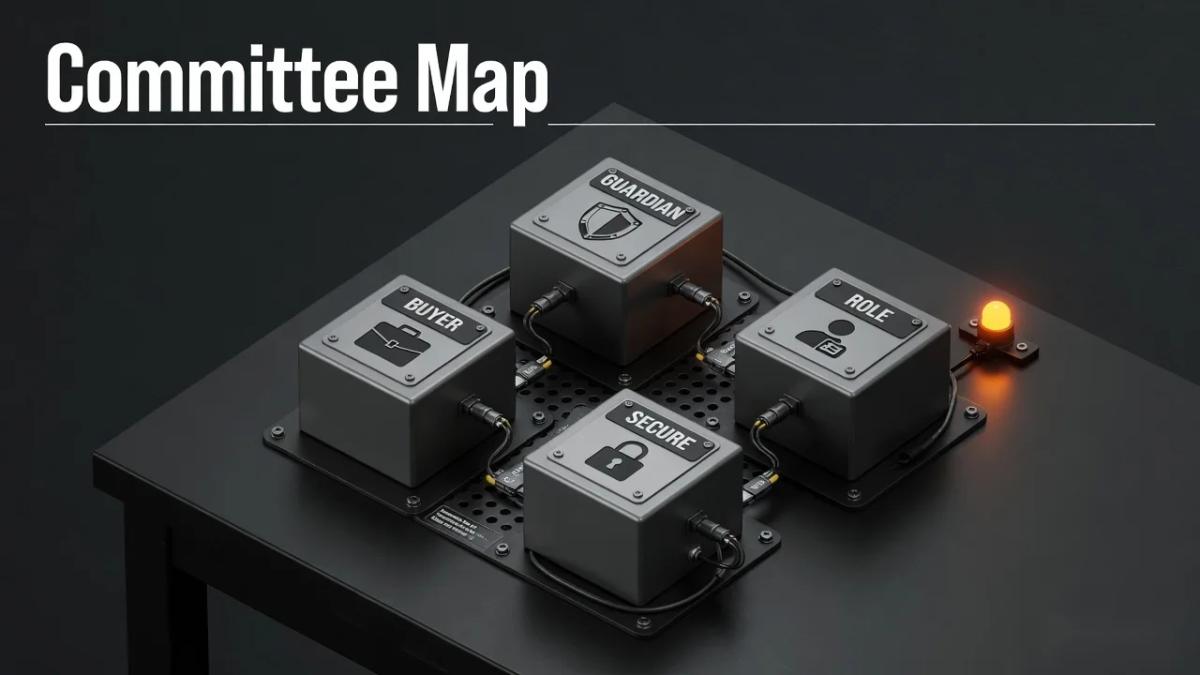
Buyer committee mapping is the practice of naming every role that must agree for a B2B purchase — economic buyer, champion, blocker, user, technical evaluator, and increasingly the AI agents that research on their behalf — then designing demand, content, and outbound so each seat gets a job-specific reason to engage.
If your funnel only tracks one title, you are measuring access, not consensus.
The 2026 committee is bigger, faster, and decided before you meet it
Start with size. The 6sense 2025 B2B Buyer Experience Report — nearly 4,000 buyers across North America, APAC, and EMEA — found typical purchases involve 10+ people and take just over 10 months, down from 11.3 in 2024. Committee size is the single strongest driver of cycle length, explaining roughly a quarter of the variation in how long a deal takes. More seats means a slower deal — unless you deliberately feed each one.
The harder finding: by the time a lead lands in your CRM, the committee has usually already picked a favorite. In 6sense’s data, buyers shortlist about four vendors on Day One and purchase from that list 95% of the time; the pre-contact favorite still wins about 4 out of 5 deals. Forrester’s Buyers’ Journey Survey puts it at 68% of buyers beginning a purchase with a preferred vendor in mind — and that vendor wins 55% of the time.
Two 2025–2026 shifts make mapping more urgent:
- First contact is happening earlier, but minds are not opening. The point of first contact moved from 69% of the journey (2023–24) to 61% in 2025 — six to seven weeks sooner — largely because buyers needed to evaluate AI capabilities inside products (58% said so) and economic pressure compressed cycles. Yet only about 20% of buyers actually switch vendors after engaging sellers. Earlier contact is a bigger window to confirm preference, not to reset it.
- Research is AI-mediated at scale. 94% of buyers use LLMs somewhere in the buying journey, and 89% of purchases now include AI features. Committee members show up to conversations with AI-generated comparisons already drafted — whether you prepared for that or not.
Gartner’s B2B buying journey research adds the behavioral layer: buying is nonlinear “looping” through six buying jobs — problem identification, solution exploration, requirements building, supplier selection, validation, and consensus creation. Consensus creation (“we need to get everyone on board”) is where most deals stall, and it is the job most demand programs ignore entirely. Meanwhile 75% of B2B buyers now prefer a rep-free experience, and Gartner warns that self-service digital purchases are far more likely to end in purchase regret. And 99% of B2B purchases are driven by organizational change — the committee exists because something internal shifted, not because someone liked your demo.
The blunt read: the committee decides a favorite before you get a meeting. Mapping tells you which seats are still movable and what each one needs to say yes.
The roles, and what each one actually needs
Map roles by function in the deal, not by job title. The same title plays a different role in every account — a “director of IT” can be champion in one company and blocker in the next.
| Role | Job in the deal | What they need | Common objection |
|---|---|---|---|
| Economic buyer | Budget authority, go/no-go | Business case, peer benchmarks, ROI tied to their numbers | “Why now, and what’s the risk?” |
| Champion | Internal selling, coalition-building | Narrative, battle cards, exec-ready summaries | “Will this make me look right?” |
| End user | Lives with the tool daily | Workflow demos, implementation timelines, training plans | “What changes for me on Monday?” |
| Technical evaluator | Integration, security, architecture | SOC 2, security questionnaire responses, API docs | “Does this pass security review?” |
| Blocker / procurement | Risk, contract, compliance | Vendor risk packs, compliance documentation | “What’s the exposure?” |
| AI agent | Researches, compares, drafts RFPs for all of the above | Structured facts, comparison tables, un-gated specifics | “Is this answer verifiable?” |
Two role dynamics deserve emphasis.
Economic buyer vs. champion. The champion’s enthusiasm does not buy anything. Most demand programs accidentally optimize for the champion — the person most likely to read your content and reply to outbound — and then assume budget follows. It doesn’t. Your content has to arm the champion with economic-buyer language: cost-to-value math, displacement timing, peer evidence. If the champion cannot translate your pitch to finance, the deal dies in the consensus creation job.
Blocker and technical evaluator. These roles arrive late with a veto. Security, procurement, and legal were rarely part of the early conversation, then kill a deal in the final stage because they were never mapped, let alone engaged. Put them in the map on day one, even if you only engage them at stage four.
How to map the committee
Committee mapping is forensic, not creative. You don’t invent personas — you reconstruct them from evidence. For each segment in your ICP system, pull from five sources:
- CRM and closed-deal history. Who appears on won and lost deals at each stage? Who disappears in stage four?
- Sales conversation notes. Every “run this past Ana in finance” is a map update. Your reps already know the committee; the problem is nobody records it.
- Intent and engagement data. Which titles at the account are researching your category — and which are conspicuously absent?
- LinkedIn and org data. Role changes, new hires, and job posts reveal when a committee is forming (a new CISO or a new procurement lead resets the map).
- Win/loss interviews. Ask explicitly: “Who influenced this decision that we never met?”
Run the exercise as a workshop, not a document. The one-day ICP workshop playbook and the ICP one-pager template give you the format; the output should be a per-account live map: who’s engaged, who’s missing, who’s the likely veto.
The map is a living field, not a deliverable. When a lead passes to sales, the handoff and routing should carry committee state: engaged seats, untouched seats, known blockers, and the champion’s internal narrative. If that state isn’t in the CRM, you haven’t mapped anything.
Build programs for the whole committee
1. Offers per role, not one offer per person
A product tour is champion bait. Pair it with committee-ready assets so every seat has something to consume: business-case one-pagers for economic buyers, security packs for evaluators, workflow demos for users, internal pitch decks for champions. This is landing page and offer architecture with a committee lens: each offer should be named for a job, not a persona.
2. Multi-thread outbound by role
Single-threaded outbound — same pitch, every title — reads as spam to five different inboxes. Sequence by role: different value proposition, different proof, different CTA. A security-review request for evaluators, a 15-minute briefing for the economic buyer, a demo for the user. Your outbound system should treat the committee map as the targeting layer.
3. Score committee coverage, not form fills
One form fill from the economic buyer is worth a dozen from researchers — but the real signal is coverage. Qualification should reward multi-seat engagement: role in the deal, seniority relative to budget authority, and how many distinct committee roles have engaged. An account with five engaged seats is a hotter opportunity than an account with one very enthusiastic one.
4. Build for consensus creation
The buying job nobody markets to: helping your champion get everyone on board. Pre-built internal presentation templates, comparison frameworks that pre-answer evaluator concerns, ROI models in economic-buyer language, and user success stories that reduce adoption anxiety. If your content calendar has nothing that a champion can forward to their CFO unedited, the consensus job is running unassisted.
Three 2026 shifts every committee map must absorb
1. AI agents now sit in the committee
Forrester’s buying networks research is explicit: treat buyer AI agents visiting your website as important extensions of the buying group — and equip them with accurate information. The buying network now includes external influencers, peers, consultants, and agents, not just the internal org chart. In 2024, 35% of Millennial and Gen Z buyers said 10+ people from outside their organization were involved in their purchase decision; that number grows every year.
The counterweight is Gartner’s July 2026 prediction: AI agents will outnumber sellers 10 to 1 by 2028, yet fewer than 40% of sellers will say agents improved productivity. Agent sprawl is real — the fix is the same one that works for human buyers: give agents the facts. Structured specifications, pricing pages, integration and security documentation, and comparison-friendly tables, un-gated. Note that LLM use is not replacing vendor engagement — 6sense found buyers still average 16 interactions per person with the winning vendor — but agents will draft the RFP either way. Drafting from your content beats drafting from your competitor’s.
2. Buying group activation is now a platform feature
Committee mapping used to be a consulting project. In 2026 it ships in the platform. Demandbase’s Buying Groups product uses an AI agent to build buying groups automatically, map known contacts to roles, fill gaps from a 150M+ contact database, and surface missing roles and silent influencers. Forrester’s B2B Revenue Waterfall has moved from framework to implementation guide, centering buying-group opportunities instead of MQLs. If you run ABM, committee coverage is now a standard field — the differentiator is what your team does with it, not whether you can afford the capability.
3. Preference precedes intent
Forrester’s analysts were blunt in August 2026: intent signals are often the effect of preference, not the cause of it. By the time in-market intent appears, the race is tilted toward a favorite. The LinkedIn B2B Institute’s GenAI research shows how early that tilt forms: GenAI buyers consider just 2.4 brands on average. Committee mapping therefore starts in the ICP and the brand program, not at the intent-data alert. Map who must agree, build preference before the purchase starts, and treat intent as confirmation of coverage rather than the starting gun.
Common mistakes
- Inventing personas without deal evidence. Map from won/lost deals and conversation notes, not theoretical org charts.
- Treating “director” as a universal buyer. Role is a function of the deal, not the job title.
- One nurture track for every role. Economic buyers and end users need different content, cadence, and CTAs.
- Scoring form fills instead of coverage. If your model can’t tell you how many seats are engaged, it’s measuring activity, not consensus.
- Ignoring the agent seat. Your content is being read by LLMs whether you publish for them or not.
- Claiming consensus metrics you don’t measure. If you aren’t tracking multi-threaded engagement, you are guessing.
Measuring committee engagement
| Metric | What it tells you |
|---|---|
| Committee coverage | Share of mapped roles engaged per account |
| Multi-threading ratio | Engaged contacts per account, weighted by role |
| Role-weighted pipeline | Pipeline value adjusted for economic buyer engagement |
| Time-to-consensus | First contact to full committee engagement |
| Blocker engagement rate | Whether security/procurement were reached before stage four |
| Agent visibility | Whether LLM answers about you include accurate, current facts |
LoudDemand note
Committee mapping is GTM hygiene. It belongs in ICP docs, playbooks, and CRM fields — not only in a slide deck. If your scoring model, nurture sequences, and sales handoffs do not account for the full committee, you are optimizing for a part of the deal that was never the whole deal.
The teams that win in 2026 are the ones that treat every deal as a committee decision — and design their demand engine accordingly.
Citations
Sources & references
- How To Win Mindshare In The GenAI RaceLinkedIn B2B Institute
- Demandbase Buying GroupsDemandbase