

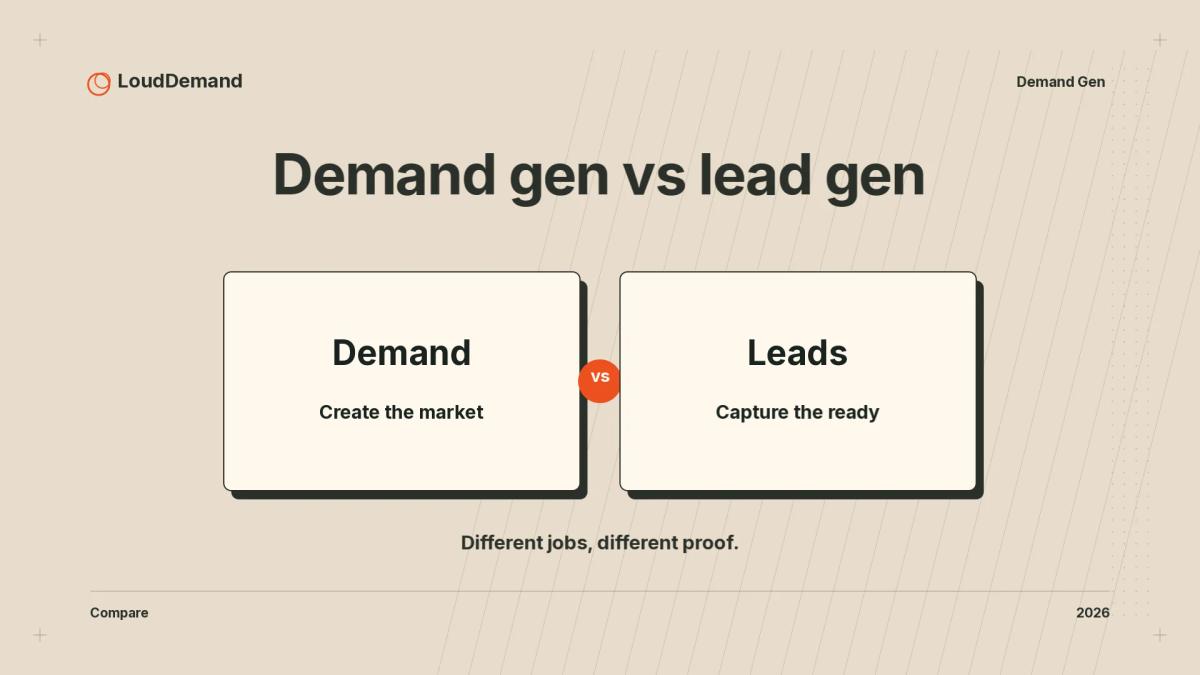
Demand generation vs lead generation is not a question about two stages of one funnel. It is two jobs with two different clocks.
Demand generation manufactures future demand by building memory, category belief and search visibility among buyers who are not shopping yet. Lead generation harvests demand that already exists by converting the small minority who are actively in market.
Run only the second and you compete for the same thin pool every quarter, paying more each time. Run only the first and you starve your capture layer the moment demand arrives.
Why this argument got louder in 2026
Money stopped growing, so every dollar got an argument attached to it. Gartner’s 2026 CMO Spend Survey, fielded January through March 2026 among 401 CMOs across North America and Europe, found average marketing budgets flat at 7.8% of company revenue, up from 7.7% in 2025.
Fifty-six percent of those CMOs said their marketing organization lacks the budget to deliver their 2026 strategy. Flat budgets turned a semantics debate into a budget fight.
The buyer also moved. Gartner’s March 2026 sales survey of 646 B2B buyers found 67% prefer a rep-free experience and 45% used AI during a recent purchase. G2’s March 2026 survey of 1,076 B2B software buyers found 51% now start research in an AI chatbot more often than with Google, up from 29% eleven months earlier, and 69% changed vendor plans on chatbot guidance.
When buyers arrive pre-sold and pre-shortlisted, teams that only capture existing demand fight over whatever is left.
Demand generation and lead generation are not funnel stages
Demand creation is the work of making buyers want a category they are not currently buying. Demand capture is the work of converting the buyers who already want it. Plenty of teams frame the same split as demand creation vs demand capture. The demand generation vs lead generation difference is not a location on a diagram.
The b2b funnel stages diagram most teams still draw implies a single sequence. That sequence is wrong.
What demand generation actually does
Demand generation builds memory before need. It publishes research that gets cited, runs events that get discussed, and repeats a category position until it is retrievable at the moment of purchase.
It runs on a long clock and rarely shows up in a weekly dashboard. Gartner’s June 10, 2026 brand survey of 426 senior marketing leaders found 84% of companies in what it calls a brand doom loop: brand gets undermeasured, that erodes confidence, and low confidence attracts less funding. A strong brand strategy makes companies twice as likely to exceed growth goals.
What lead generation actually does
Lead generation converts attention that already exists into a named person who has shown buying intent. It runs search ads, outbound sequences, landing pages, demo requests, webinars, gated forms and response handling.
It reports cleanly and fast, which is why it wins every internal budget argument.
The confusion starts when teams treat these as adjacent stages of one pipeline, so demand gen exists to feed lead gen and lead gen’s conversion rate grades demand gen. That framing breaks when AI changes discovery.
2X’s April 2026 AI Visibility Index found 96% of B2B companies are invisible in AI-driven buyer discovery, appearing only in late-stage queries. A buyer who meets you first in a comparison query had no earlier funnel stage to influence.
Demand generation now has a channel it did not have two years ago: buyers asking assistants. Demandbase’s own platform data shows ChatGPT-referred visits to the B2B sites it tracks rose 303% year over year to 2.6 million in June 2026, from roughly 645,000 a year earlier. Creation and capture now collide in one prompt.
Demand generation vs lead generation: side by side
The two disciplines differ on every dimension that matters for planning, from objective to failure mode.
| Dimension | Demand generation | Lead generation |
|---|---|---|
| Objective | Manufacture future demand and category memory | Convert demand that already exists |
| Mechanism | Narrative, research, category framing, repeated exposure, search visibility | Capture channels, response speed, qualification, conversion |
| Channel set | Editorial research, events, podcasts, newsletters, search and AI visibility | Paid search, paid social, outbound, landing pages, forms, webinars |
| Cycle length | Quarters to years; effects lag the spend | Days to weeks; results land in-quarter |
| Owner | Brand, content, product marketing, demand gen | Performance marketing, growth, sales development, RevOps |
| Budget behaviour | Fixed baseline; hard to cut mid-cycle without losing compounding | Variable; scaled against in-market volume |
| Primary metric | Influenced pipeline, branded search volume, share of answer, entry-point recall | Cost per qualified opportunity, lead-to-SQL rate, response time, pipeline per dollar |
| ROI shape | Front-loaded cost, back-loaded return, decays if paused | Near-flat cost, immediate return, linear in in-market supply |
| Failure mode | Thought leadership nobody remembers, no pipeline story | Rising auction prices for a shrinking, qualified slice of buyers |
The last row matters most. A demand gen program that cannot be measured gets cut in the first flat-budget quarter; a lead gen program that cannot scale gets noticed just as fast.
The 95/5 rule: why capture-only teams pay more
The B2B Institute’s 95-5 Rule says roughly 5% of the buyers in a category are actively in market at any moment, and the other 95% are out of market. The number comes from buying-cycle data, not from a survey of marketer sentiment.
Only about 5% of buyers in a category are in market at any given time and 96% of B2B marketers expect advertising to work within two weeks. The B2B Institute calls that expectation a myth, and says ads reach buyers who aren’t even in the funnel yet (95-5 Rule, LinkedIn B2B Institute).
Read the rule as a competitive constraint. Every lead gen team in your category is chasing the same 5%, so the marginal price of that 5% rises as more of them show up, while the 95% quietly decides which brand to remember.
First Page Sage’s October 2026 benchmark shows the other side of that pressure. Across its 30 industries, the average paid lead cost 29% more than an organic one, and organic cost per lead rose in every industry, an average increase of 7.3%, which the report attributes to AI-generated answers eating clicks.
The three industries with the biggest organic cost increases were B2B SaaS (+13.4%), Legal Services (+12.4%) and Software Development (+12.4%). First Page Sage explains these as the industries whose buyers begin with informational research queries.
What each one costs, and what each one returns
The available research does not establish a 2026 cost-per-MQL benchmark. Use cost per lead and stage-to-stage conversion separately rather than treating them as interchangeable.
| Measure | Verified figure | Source |
|---|---|---|
| Blended cost per lead, 30 industries | $400 average, up 2.2% year over year | First Page Sage, Oct 2026 |
| B2B SaaS cost per lead | $249 blended (2025: $237); paid $318, organic $186 | First Page Sage, Oct 2026 |
| Paid versus organic gap | Paid costs 29% more; premium narrowed from 40% to 29% | First Page Sage, Oct 2026 |
| Cost per lead, Google and Microsoft Ads | $66.69 average, first annual fall in five years | WordStream and LocaliQ, May 2026 |
| New lead to MQL | 38% high AI adopters vs 27% low adopters | ICONIQ Growth, 2026 (150+ leaders) |
| MQL to SQL | 37% high adopters vs 29% low adopters | ICONIQ Growth, 2026 |
| Activation plus buyer-intent signals | 21% more leads per account, 93% more multi-touch engagement, 1.6x likelier to reach decision | INFUSE and G2, Jul 2026 (243,000 accounts) |
| Cost per MQL | No verified 2026 benchmark published | |
| Pipeline per dollar | No verified 2026 benchmark published | |
| Payback period | No verified 2026 benchmark published |
First Page Sage defines a lead as “a direct connection with a prospective customer who is interested in purchasing a product or service, made by email, phone, or in-person introduction,” which is not a marketing qualified lead. Treat its numbers as cost per lead, not cost per MQL.
The most useful line in that benchmark is not a dollar figure. CPL rises with contract value and sales cycle length, and organic channels produce higher long-term ROI than paid channels while taking longer to deliver. Demand creation and capture describe the same trade from opposite ends.
Gartner’s June 2026 media spend data shows where the pressure lands. Awareness and conversion now account for 62.6% of total media spend, up more than 10% since 2024, while loyalty and retention spending fell 29% to under 15%. The most AI-mature organizations there allocate more to loyalty and retention and less to digital.
MQL vs SQL: is the MQL still a useful metric?
Keep MQL as an operating number, drop it as a scorecard metric. Forrester’s April 2026 GTM Singularity research argues this explicitly, listing marketing-qualified lead obsession alongside gated content, impersonal mass emailing and siloed teams as practices B2B firms failed to change.
The Forrester report recommends tying metrics to customer objectives, a return on objective approach, and dismantling the divide between brand and demand. Dave Frankland, Forrester’s research director, put it plainly: “The GTM singularity is a reckoning for B2B leaders forcing them to rethink their mandate entirely.”
Content Marketing Institute and MarketingProfs’ 2026 B2B Content and Marketing Trends report, based on 1,015 B2B marketers, backs the sceptics. Only 12% of B2B marketers rate themselves highly effective, and while 65% of effective teams credit content relevance and quality and 53% credit team skills, just 45% credit alignment with sales and 20% credit budget allocation.
The constraint is not budget volume. It is whether sales and marketing agree on what a qualified buyer looks like.
A marketing qualified lead is still a useful routing label inside your own systems, and a weak predictor of revenue on its own. In the same CMI survey, 33% still call measuring content effectiveness a top challenge, and 40% name “creating content that prompts action” as their hardest problem.
If you need one funnel metric to run the business, use cost per qualified opportunity and pipeline per dollar. Keep MQL as the handshake between marketing and sales, not the scoreboard. Our research on MQL to SQL leak patterns covers where that handshake breaks.
How to run both: a seven-step operating sequence
The two disciplines work as one system when you sequence them deliberately and measure them separately.
- Fix the category story first. If nobody can explain your category in one sentence a buyer would repeat to a colleague, demand generation has nothing to amplify. Write it, test it on five recent wins, rewrite it if it fails.
- Build the memory asset. Research, a named point of view, and an owned channel where people actually read. Original research is what gets cited in AI answers and by analysts.
- Decide where capture happens. Pick two or three channels where in-market buyers show up and instrument them properly. The inbound versus outbound demand comparison covers that choice. Gartner’s 2026 CMO Spend Survey shows digital media now absorbs more than two-thirds of media investment.
- Build the response layer, because that is where lead generation ROI lives. Speed to lead, qualification logic, and a routing SLA between marketing and sales. Lead generation ROI is won in the minutes after a form fill, not in the ad auction.
- Wire buyer-intent signals into the activation layer. The INFUSE and G2 study tracked 243,000 intent accounts across 11 cybersecurity programs and found accounts showing up in both demand activation and buyer-intent data generated 21% more leads per account and were 1.6 times likelier to reach the decision stage.
- Report two scorecards. Capture on cost per qualified opportunity and pipeline per dollar; demand on influenced pipeline, branded search volume, share of answer and recall among the out-of-market 95%.
- Review both against the same buyer, not against each other. The pipeline metrics that matter work covers this, and the B2B demand generation operating system covers the operating model.
Then score them separately, with metrics that belong to each discipline:
- Demand generation: influenced pipeline, branded search volume, share of answer in AI answers, entry-point recall
- Lead generation: cost per qualified opportunity, lead-to-SQL rate, speed to first response, pipeline per dollar
If step 6 feels like reporting theater, run the demand gen audit worksheet first. The b2b demand generation strategy piece covers the demand side.
When lead generation is the correct choice
Lead generation is the right primary bet when demand already exists, the buying window is narrow, and each deal is worth enough to justify a response-driven motion. It is also right when you are early and need cash.
| Situation | Lead with | Why |
|---|---|---|
| Buyers already search your category by name | Lead generation | The intent exists; you pay to show up |
| Low ACV, high volume, short cycle | Lead generation | Fast payback beats compounding |
| Category is new, nobody searches it | Demand generation | There is nothing to capture |
| Long cycle, enterprise ACV, small pool | Demand generation | Memory must exist before the RFP lands |
| 6+ month cycle, five-person committee | Both, demand first | Memory must exist before committee research |
| You are the challenger with no association | Demand generation | Capture alone buys a commodity comparison |
| Retention and expansion drive growth | Demand generation | Loyalty spend fell 29% to under 15% |
| Rep-free buying is the norm | Both | 67% of B2B buyers prefer rep-free |
That last row is why I would stop treating this as a choice at all. Gartner’s survey found confident buyers are twice as likely to report a high-quality deal, and confidence is built by the demand side.
Common failure modes
The most common failure is treating demand gen as a lead gen project with a longer fuse. You set a target, the target does not move in a quarter, and the budget gets pulled.
The second is letting demand gen own the brand and lead gen own the numbers, so neither can prove the other works. Forrester’s call for a shared view of the prospect is a request for one shared set of numbers.
The third is chasing volume. WordStream’s 2026 benchmarks found average cost per lead in Google and Microsoft Ads fell to $66.69, the first annual decline in five years, but the practitioner quoted there warned that high lead volume means nothing if those leads are not converting into revenue. Frame every lead count as pipeline vs lead volume.
The fourth is treating AI content volume as demand generation. HubSpot’s 2026 State of Marketing found 80% of marketers now use AI for content creation, and calls that output “mostly average.” More supply is not more memory.
FAQ
What is the difference between demand generation and lead generation?
Demand generation creates future demand: category memory, search visibility and preference among buyers not yet shopping. Lead generation captures demand that already exists among buyers actively in market. One changes the size of the pool; the other converts the pool you have.
Does a company need both, or pick one?
Both, in a ratio set by your market maturity. New markets need demand generation first.
Where demand already exists and the window is short, lead generation comes first. Never run them as substitutes; one quietly absorbs the other’s budget.
Which one has better ROI and how do you actually measure it?
Lead generation has better ROI inside a quarter; demand generation has better ROI across a buying cycle. Measure capture on cost per qualified opportunity, pipeline per dollar and speed to response. Measure demand on influenced pipeline, branded search volume and share of answer.
What budget split between demand generation and lead generation is right?
No published 2026 benchmark exists for this split. The Demand Gen Report’s 2026 Demand Generation Benchmark Survey was still in the field as of September 2, 2026, so that survey cannot establish the split. Use Gartner’s 62.6% of media spend on awareness and conversion as your anchor.
Is the MQL still a useful metric?
Useful as a routing label, weak as a scorecard metric. Forrester’s 2026 GTM Singularity research names MQL obsession as a practice that no longer works, and ICONIQ’s 2026 data shows MQL-to-SQL conversion swinging from 29% to 37% depending on the org.
When is lead generation the correct choice over demand generation?
When demand already exists, the window is narrow, and deals are worth enough to justify a response-driven motion. Named accounts in market, low ACV with high volume, or a category people already search for are all lead gen territory.
How do you explain demand generation to a CFO who wants lead counts?
Show them what a lead is worth, not how many there are. Gartner found 84% of companies in a brand doom loop where brand gets undermeasured and then loses funding, and that a strong brand strategy makes companies twice as likely to exceed growth goals. Ask for one funded experiment on each side.
What to do next
Pick one program in each column and give each a different scorecard, a different clock and a different owner. Write down what a marketing qualified lead is worth in dollars this quarter, and how many of those buyers were in market when you first met them. That tells you which discipline is doing the work.
Sources & references
- Forrester: The GTM Singularity Is Collapsing Traditional Go-To-Market ApproachesForrester · Accessed Oct 10, 2026Forrester, 2026
- New G2 Research: Half of B2B Software Buyers Now Start Their Research With AI ChatbotsG2 via PR Newswire · Accessed Oct 10, 2026G2 via PR Newswire, 2026
- Gartner 2026 CMO Spend Survey Finds CMOs Allocate 15.3% of Marketing Budgets to AI, But Only 30% Are Ready to Scale AI CapabilitiesGartner · Accessed Oct 10, 2026Gartner, 2026
- Gartner Marketing Survey Finds Awareness and Conversion Account for 62.6% of Total Media SpendGartner · Accessed Oct 10, 2026Gartner, 2026
- Gartner Marketing Survey Finds 84% of Companies Are Stuck in a Brand Doom LoopGartner · Accessed Oct 10, 2026Gartner, 2026
- Gartner Sales Survey Finds 67% of B2B Buyers Prefer a Rep-Free ExperienceGartner · Accessed Oct 10, 2026Gartner, 2026
- 95-5 RuleLinkedIn Marketing Solutions (B2B Institute) · Accessed Oct 10, 2026LinkedIn B2B Institute, no date shown
- Leaner, Smarter, Flatter: Inside the Modern GTM OrganizationICONIQ Growth · Accessed Oct 10, 2026ICONIQ Growth, 2026
- 9 Takeaways and Insights From the 2026 B2B Content and Marketing Trends ReportContent Marketing Institute and MarketingProfs · Accessed Oct 10, 2026CMI and MarketingProfs, 2026
- Average Cost Per Lead by Industry - 2026First Page Sage · Accessed Oct 10, 2026First Page Sage, Oct 2026
- Google Ads Benchmarks 2026: Competitive Data & Insights for Every IndustryWordStream and LocaliQ · Accessed Oct 10, 2026WordStream and LocaliQ, May 2026
- Demandbase: ChatGPT Referrals to B2B Websites Nearly Quadrupled in a YearDemand Gen Report · Accessed Oct 10, 2026Demand Gen Report, Aug 2026
- Study Finds Demand Programs Aligned with Buyer Signals Deliver 93% More EngagementDemand Gen Report · Accessed Oct 10, 2026Demand Gen Report, Jul 2026
- 2X Survey Finds 96% of B2B Companies Are Invisible in AI DiscoveryDemand Gen Report · Accessed Oct 10, 2026Demand Gen Report, Apr 2026
- Where Your 2026 Budget Actually Goes: Take the Demand Gen Benchmark SurveyDemand Gen Report · Accessed Oct 10, 2026Demand Gen Report, Sep 2026