

Quick verdict
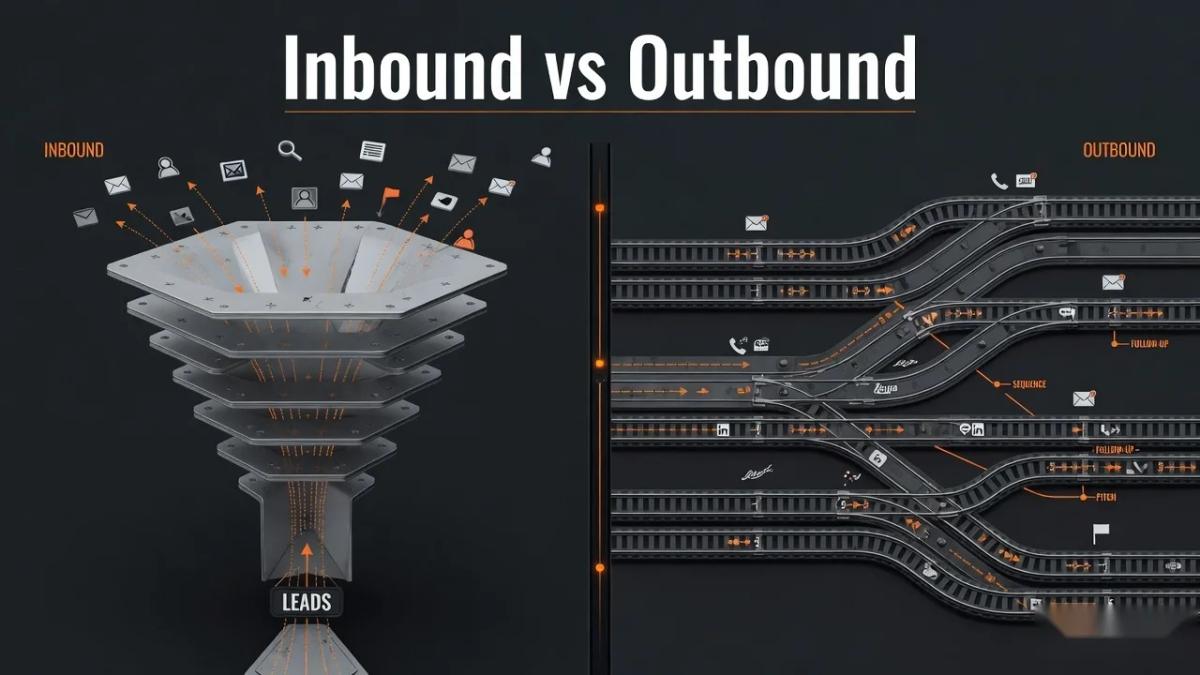
If you sell a $50K+ ACV solution into a niche pool of a few thousand accounts, outbound still gets you into conversations faster. If you sell $5K–50K ACV into a broad market where buyers actively research, inbound builds pipeline that compounds. Most B2B teams need both — the question is ratio, not either/or.
The 2026 data sharpens that split. Gartner’s current B2B buying research finds 75% of buyers prefer a rep-free experience, and 6sense’s 2026 study shows buying groups average nearly 11 people who spend roughly six months researching before they ever talk to a seller. Meanwhile the average cold email reply rate sits at 3.43% — per Instantly’s benchmark report of billions of sends — so outbound’s floor is lower and its ceiling is reserved for teams that earn relevance.
Here’s the framing that survives contact with reality: inbound wins at scale over long time horizons, outbound wins when the account pool is small and speed matters, and in 2026 both are only as good as the intent signals and AI systems running underneath them.
The 2026 landscape: three things actually changed
Buyers are more rep-averse than the last time you read this stat
The old “67%” figure still circulates on LinkedIn. The current number on Gartner’s own page — updated April 2026 — is 75% of B2B buyers who prefer a rep-free sales experience. Read the fine print before you mourn outbound: Gartner also found buyers are 1.8 times more likely to complete a high-quality deal when they use supplier-provided digital tools in partnership with a rep than on their own. Rep-free preference is not anti-sales; it’s anti-bad-timing.
The more consequential Gartner finding is structural: 99% of B2B purchases are driven by organizational changes, and buyers “loop” through six buying jobs — problem identification, solution exploration, requirements building, supplier selection, validation, and consensus creation — revisiting each at least once. You are not selling into a funnel; you are selling into a loop that sellers barely see.
6sense’s June 2026 study quantifies that blindness. A typical buying journey runs over 10 months, about 6 of them in a “selection phase” where the buying team shortlists and ranks vendors anonymously. The vendor they surface with as their top choice wins 8 times out of 10. Inbound and outbound both fail when they optimize only for the moment a buyer identifies themselves — by then, influence is mostly spent.
AI went from experiment to baseline — with a quality caveat
HubSpot’s 2026 State of Marketing finds 80% of marketers now use AI for content creation and 75% for media production, with 61% calling AI the biggest disruption to marketing in 20 years. Content Marketing Institute’s 2026 B2B report (1,015 marketers, with MarketingProfs) is more sobering: 95% of organizations use AI-powered applications, and 89% use AI for content creation — but while 87% say productivity improved, only 58% say content quality improved, and 12% say quality got worse.
The strategic implication: AI removed the cost of producing average content, which means average content is now worth nothing. HubSpot’s SVP of Marketing, AI, & GTM Kieran Flanagan put it plainly in the 2026 report: “Today, more content is generated by AI than by humans. But it’s mostly average. Consumers seek human-created content.” Inbound differentiation in 2026 is judgment, data, and point of view — not output volume.
On the outbound side, Gartner’s July 2026 press release predicts AI agents will outnumber sellers 10 to 1 by 2028 — yet fewer than 40% of sellers will say agents improved their productivity. The same release reports a Gartner survey of 210 CSOs (Jan–Feb 2026) in which 60% say their revenue number is driven largely by elements outside their control. Agents are coming; most teams have not fixed the data, workflow, and seller-experience layer that determines whether agents help.
Deliverability rules rewrote the cold email unit economics
Since February 1, 2024, Gmail and Yahoo have required bulk senders to authenticate (SPF or DKIM, plus DMARC above 5,000 messages/day to Gmail), keep spam rates under 0.3% — Google recommends 0.10% — and support one-click unsubscribe. These rules are still the operating system for cold email in 2026, and they punish the spray-and-pray playbook structurally: sender reputation now depends on recipient engagement, not just list size. GDPR and PECR in the EU/UK, and CAN-SPAM in the US, remain the legal frame for B2B cold outreach, which means legitimate-interest arguments and list hygiene carry real risk if you treat consent carelessly.
The practical effect: outbound’s old advantage — cheap marginal reach — is gone. The cost is now concentrated in data quality, deliverability infrastructure, and message relevance, which is exactly where the best 2026 performers spend their money.
What inbound looks like in 2026
Inbound is no longer “write posts and pray.” The 2026 model has three layers:
Content built to be cited, not just clicked. With buyers researching through AI assistants, being the source an assistant cites is the new page one. That rewards original data, named sources, clear definitions, and direct answers — the same qualities CMI’s research associates with content that prompts action, which 40% of B2B marketers still name as their top challenge.
First-party audiences. CMI’s 2026 data shows 91% of B2B marketers collect first-party data, most commonly through direct engagement (77%), gated content and webinars (68%), and CRM interactions (63%). Newsletters, communities, and podcasts are the channels AI-generated content hasn’t saturated — and they’re owned distribution that works when organic reach doesn’t.
Signal-aware capture. The form fill is a late signal. 6sense finds only 42% of organizations track anonymous engagement at all, even though that’s the signal category that reveals the selection phase. Inbound in 2026 watches which accounts research, not just which people raise their hands.
What outbound looks like in 2026
The 2026 outbound motion is narrower, signal-triggered, and multi-channel:
Targeting by intent, not by list size. 6sense’s outbound users rank LinkedIn outreach (52%) as their most important activity, ahead of direct mail (50%), partner referrals (46%), cold email (41%), events (41%), and cold calling (26%). Cold email is one ingredient in a coordinated sequence, not the whole dish.
Delivery discipline as a growth lever. Instantly’s 2026 benchmark report — billions of interactions across its platform from January 1 to December 18, 2025 — is blunt about what separates tiers: average reply rate 3.43%, top quartile 5.5%, top decile 10.7%+. Elite campaigns keep first emails under 80 words, run a single clear CTA, hold bounces under 2%, and keep consistent sending volume — teams with stable domain health see 15–20% higher reply rates.
Sequences designed around persistence. First-touch email captures 58% of all replies; follow-ups earn the remaining 42%, with 4–7 touchpoints the sweet spot. One detail from the data is worth stealing: a step-two email written to feel like a reply — “quick follow-up on my note below” — outperforms a formal follow-up by roughly 30%. Wednesday is the highest-engagement sending day.
When inbound wins
Your buyers search for solutions to problems they recognize. If your category is established and buyers Google, browse review sites, or ask AI assistants for options, inbound captures intent that outbound would pay to manufacture. 6sense’s 2026 data shows inbound is the closest thing to a universal strategy — nearly 7 in 10 organizations rely on it in some capacity — partly because it’s the lowest-friction way to serve a 10-person buying group during its anonymous research phase.
Your ICP is broad. With tens of thousands of addressable accounts, content and search reach them at a cost per touch no SDR team can match. The compounding effect is real: CMI’s 2026 report found 61% of B2B marketers say their content strategy effectiveness improved year over year, with strategy refinement — not budget — the most cited driver.
Your product needs education or comparison. Complex, considered purchases reward depth: walkthroughs, calculators, and honest comparison content do work that a cold email can’t. Gartner’s buying-journey data supports this — 64% of tech buyers familiar with the product prefer a fully digital buying experience, and as familiarity drops, they want humans for use-case guidance.
You’re building a category. You cannot outbound a market into existence. When the problem itself needs naming, thought leadership and editorial content are the only scalable vehicles. CMI found 96% of B2B organizations now produce thought leadership, with LinkedIn rated the most effective channel (76%), followed by email newsletters (54%) and webinars (52%) — the bar for distinctiveness is high precisely because participation is universal.
You have 12+ months of patience. Inbound returns arrive on a lag. If you need pipeline in a quarter, inbound alone is the wrong answer.
When outbound wins
Your account pool is small and your ACV is high. Two thousand possible accounts at $100K+ is a targeting problem, not an attraction problem. Outbound exists to engineer conversations with specific people in specific accounts — and in 2026, the best versions of it start from signals, not cadences. The 6sense BDR research has found for five consecutive years that the strongest predictor of BDR performance is perceived support — supported BDRs average 100% of quota. Outbound is a system, not a script.
Buyers don’t know a solution exists. Unrecognized problems get no search volume. Outbound educates at the account level and creates the category one conversation at a time.
You need pipeline faster than content compounds. Outbound conversations can start in weeks. This is why seed and early-stage companies lean outbound — the trade is speed for sustainability: stop sending and the pipe dries up.
Your product is obvious but unprioritized. Some solutions need no explanation, just urgency. A well-timed, well-targeted outreach creates the nudge that content can’t.
Buying-group orchestration beats individual leads. Gartner’s hybrid finding — 1.8x more likely to close a high-quality deal with reps plus digital tools — only works if you’re engaging the whole group. The winning 2026 pattern is account-level: identify the committee, serve its anonymous research with digital assets, then enter with sales when the group is in validation. 6sense’s ABM research shows adoption actually fell to 27% in 2026 (from 43% in 2023) — the gap between what the data says and what teams do is itself a competitive opening.
Cost and ROI: what the 2026 numbers actually support
The honest position: there is no reliable public benchmark for 2026 CPL by channel that I’d stake a budget on. What is verifiable is the performance distribution of the channels themselves, so use these as your denominators:
Cold email. Model pipeline math on the 3–5% reply-rate band, and treat double-digit reply rates as an elite outcome, not a plan. Instantly’s tier data — 3.43% average, 5.5% top quartile, 10.7%+ top decile — plus the 58%/42% first-touch/follow-up split gives you a defensible funnel: 10,000 well-targeted contacts at a 4% reply rate is 400 conversations, and your meeting rate on those conversations is what you actually control.
Inbound. The compounding cost curve is directionally sound — content assets keep producing after the creation cost is sunk — but the 2026 constraint is dilution. With 89% of B2B marketers using AI for content, “more content” no longer differentiates; CMI’s top content challenges are creating content that prompts action (40%), resource constraints (39%), and measuring effectiveness (33%). Budget inbound for distribution and quality, not raw volume.
The planning ranges below are rough estimates for framing purposes, not sourced benchmarks — treat them as sanity checks, not vendor quotes:
| Component | Startup | Mid-market | Enterprise |
|---|---|---|---|
| Inbound: content, SEO, automation, distribution | $14K–33K/mo | $48K–125K/mo | $150K–420K/mo |
| Outbound: SDR capacity, data, sequences, delivery infra | $15K–28K/mo | $37K–73K/mo | $93K–190K/mo |
| Timeline to first meaningful pipeline | 6–12+ months (inbound) | 1–3 months (outbound) | varies |
| Cost trajectory | Declines per lead as assets compound | Roughly constant per conversation | depends on data quality |
The rule of thumb that still holds: at equal spend, outbound produces pipeline 3–4x faster in year one; inbound becomes the cheaper engine somewhere in months 18–24 if you survive long enough to let it compound. Measure your own crossover point — it’s a function of your ICP, not a universal law.
Measuring each motion fairly
Comparing inbound and outbound on the same dashboard is how teams fool themselves. The fixes:
Use different time windows. Outbound: 90-day cycles from sequence start to qualified meeting. Inbound: 12-month rolling windows, because a post published today influences a deal six months from now. A fair comparison is pipeline generated per dollar over a 12-month rolling period — that captures outbound’s speed and inbound’s compounding in one number.
Measure influence, not just attribution. For inbound, track content-assisted pipeline (deals where content was touched at any stage), plus leading indicators like organic traffic to money keywords and AI-assistant citations. For outbound, measure cost per qualified conversation and pipeline per SDR per month — reply rate is a health metric, not an outcome.
Respect the selection phase. 6sense’s data says the form fill happens near the end of a 10-month journey. If your only inbound KPI is form fills, you’re measuring the last mile while the buying group decided months earlier. Track anonymous account engagement as a leading indicator for both motions.
Run incrementality tests. Pause one channel for 30 days and watch the blended pipeline. This is the closest thing to a controlled experiment most teams ever get, and it settles arguments faster than any attribution model.
The metric that survives scrutiny: pipeline generated per dollar spent over a rolling 12-month window, per channel, with a blended CAC as the single leadership number. Everything else is diagnostic.
KPI sets that don’t lie
| Inbound (12-month lens) | Outbound (90-day lens) |
|---|---|
| Content-influenced pipeline (deals touching content) | Cost per qualified conversation |
| Money-keyword organic traffic trend | Pipeline generated per SDR per month |
| AI-assistant citations / brand mentions | Reply rate (health signal, not outcome) |
| Anonymous account engagement on target accounts | Sequence-to-meeting conversion rate |
| Newsletter/community growth and response | Deliverability: spam rate, bounce rate, inbox placement |
Run both sets on the same blended dashboard, and never present one channel’s leading indicators against the other channel’s lagging outcomes — that mismatch is the most common way this comparison gets rigged, usually without anyone noticing.
Building the mix
These allocations are directional frameworks, not laws — adjust to your data.
| Company stage | Inbound | Outbound | Logic |
|---|---|---|---|
| Pre-seed / Seed ($0–5M ARR) | 20–30% | 70–80% | Speed to pipeline, small team, high-ACV focus |
| Early ($5–20M ARR) | 40–50% | 50–60% | Build the content engine while outbound scales |
| Growth ($20–100M ARR) | 55–65% | 35–45% | Inbound compounds; outbound targets strategic accounts |
| Enterprise ($100M+ ARR) | 65–75% | 25–35% | Brand carries; outbound for key accounts and expansions |
| ICP characteristic | Lean toward | Why |
|---|---|---|
| Under 5,000 possible accounts | Outbound | Inbound can’t scale to a small pool |
| 5,000–50,000 accounts | Balanced | Both channels clear their cost floor |
| 50,000+ accounts | Inbound | Content economics win at volume |
| ACV over $100K | Outbound | Personalization cost justified per deal |
| ACV $10K–100K | Balanced | Both motions ROI in this band |
| ACV under $10K | Inbound | Volume economics favor content |
Budget bands follow the same logic: under $50K/month total marketing budget, run roughly 30% inbound / 70% outbound — build a minimal content foundation, prioritize conversations. At $50K–200K/month, move toward 40–50% inbound while outbound holds velocity. Above $200K/month, shift to 60–70% inbound and use outbound for strategic account plays — that’s the point where compounding overtakes velocity.
One table, three lenses. If you want a single reference for planning conversations, combine the three inputs:
| Your situation | Lean | Typical split |
|---|---|---|
| Seed-stage, high ACV, small TAM | Outbound | 25/75 |
| Seed-stage, low ACV, big TAM | Outbound-leaning | 40/60 |
| Growth-stage, mid ACV, mid TAM | Balanced | 50/50 |
| Growth-stage, broad market, low ACV | Inbound-leaning | 60/40 |
| Enterprise, high ACV, strategic accounts | Inbound with ABM | 65/35 |
Wherever you land, the test is the same each quarter: does the channel with 70% of the budget also carry 70% of the pipeline-per-dollar? If not, rebalance — the frameworks are starting points, and your blended pipeline number is the only referee.
The handoff design matters more than the ratio. Three feedback loops separate good mixes from bad ones:
- Outbound insights feed inbound content. The questions SDRs actually get asked are your best editorial calendar. Sales conversation data is original research waiting to happen.
- Inbound engagement prioritizes outbound targets. An account that consumes your content but never converts is the single best outbound lead you have. Route engagement scores into sequences.
- Share intent signals across both. The same account-level signals that trigger a sequence should inform which content gets built and promoted. Treat signal quality as shared infrastructure, not a marketing or sales asset.
How to run this comparison inside your company
The frameworks above are only useful if you turn them into a process. A workable one, in order:
- Write down your ICP and ACV thresholds. The single most contested number in this whole debate is how many accounts you actually sell to. Pull your last 24 months of closed-won accounts, count distinct companies, and compute median ACV. Those two numbers — not ideology — set your starting ratio.
- Reconstruct pipeline by source. Tag every open opportunity with its first meaningful source: inbound capture, outbound sequence, partner, account expansion. Do it for 90 days before changing anything.
- Compute 12-month pipeline-per-dollar per channel. Include people costs, tooling, and infrastructure, not just ad spend. This is the number you’ll defend to the CFO.
- Run one 30-day incrementality test. Pause outbound to a subset of segments, or stop paid amplification on a content pillar, and measure blended pipeline impact. Expect pushback; expect to learn more than any benchmark can teach you.
- Set handoff SLAs in writing. Speed to lead is an outbound killer — define who touches a reply, and how fast, before the sequence launches. 6sense’s BDR research has found support levels are the strongest predictor of BDR quota attainment for five straight years; the support your outbound team feels is measurable infrastructure.
- Revisit the ratio quarterly. ICPs drift, products reprice, and channels decay. A mix reviewed once a year is already two quarters stale.
AI’s role in each motion
Inbound. AI has collapsed production cost, which is why 2026 content competition is about evidence and voice. CMI’s data — 87% report productivity gains but 58% quality gains — tells you the machine gets you volume; the humans get you cited. On the operational side, only 28% of B2B marketers say they experiment with AI agents at all, so agentic content workflows are still early — another low-adoption gap with a compounding payoff for the teams that close it.
Outbound. AI now handles the work SDRs hated: research, sequencing, and triage. Instantly reports AI agents handle roughly 80% of research and sequencing work for elite teams, and 6sense finds 31% of intent-using teams route signals into AI SDRs. But Gartner’s 10:1 prediction comes with the productivity warning for a reason — fewer than 40% of sellers will credit agents with improving their work, and 6sense finds fewer than 5% of organizations hand meaningful decisions to AI outright, with 65% running formal restrictions on AI data use. The 2026 playbook: let AI do the targeting, drafting, and cadence work; keep humans on the judgment — which accounts deserve a different angle, what a reply actually means, and when to stop.
Where AI actually earns its keep in each motion
| Task | Inbound | Outbound |
|---|---|---|
| Research and synthesis | Buyer-signal analysis, content gap mapping | Account research, intent triage (elite teams: ~80% automated) |
| Production | First drafts, variants, asset generation (89% of teams) | Sequence copy, subject lines, follow-up drafts |
| Personalization at scale | Segment-level content variants | Per-account angle drafting |
| Quality control | Editorial review — the 12% quality-decline risk lives here | Human judgment on which accounts and angles matter |
| Measurement | Content-influenced pipeline tracking | Conversation triage and reply labeling |
The pattern in both columns is the same: AI takes the volume, humans take the variance. Teams that invert that split — humans churning, AI deciding — are the ones Gartner expects to see in the sub-40% productivity group.
Two typical starting points
To make the frameworks concrete, here are two patterns that recur constantly in 2026 — composite sketches, not real companies, no invented data:
A $3M ARR infrastructure-monitoring startup selling $60K contracts to ~4,000 mid-market accounts. Their buyers don’t search for “infrastructure monitoring” at the awareness stage; they search when they’re already in pain, and the category is crowded with bigger brands. The 6sense data says their buying group runs 10 people deep and researches for months anonymously. This team should run heavily outbound (70/30), but with signals: target accounts showing infrastructure-related intent or hiring signals, and let content serve the anonymous research phase while sequences work the selection phase. Inbound pays off here only on the 12–24 month horizon, which a Series A clock doesn’t have.
A $15M ARR fintech data tool selling $8K annual contracts to 80,000 potential accounts. Their buyers actively compare tools on review sites and ask AI assistants for recommendations — inbound-addressable at scale. A 65/35 inbound-heavy mix with content engineered for AI visibility, first-party newsletters, and SEO works because volume economics favor capture over outreach. Outbound stays reserved for the 300 strategic accounts above $30K where a personalized sequence justifies its cost.
Neither company is “an inbound company” or “an outbound company.” The first is an account-count problem with a speed constraint; the second is a volume problem with a compounding advantage. Your company is one of those two shapes — the ratio frameworks above are just arithmetic applied to whichever one you are.
Mistakes that still kill these motions
Inbound:
- Publishing without distribution. The content was never the product; the distribution plan was.
- Chasing volume while quality collapses — the 12% of CMI respondents who saw quality decrease are usually measuring this mistake.
- Ignoring AI visibility while buyers research in assistants.
- Measuring traffic and MQLs instead of content-influenced pipeline.
- Quitting in month 6, right before compounding starts.
Outbound:
- Scaling personalization into templates. The 2026 reply-rate distribution is unforgiving: personalization is the difference between 3.4% and 5.5%+, not a garnish.
- Ignoring the Gmail/Yahoo rules — unauthenticated domains, spam rates over 0.3%, and no one-click unsubscribe will zero out a campaign faster than any copy problem.
- No follow-up system. Instantly’s data shows 70% of senders stop after one email, while the first touch captures 58% of replies — the other 42% only exists if you persist with new value.
- Treating reply rate as a KPI instead of cost per qualified conversation.
- Sending without signal timing — outreach guided by intent data outperforms cadences aimed at everyone on a list.
Limitations of this comparison
Vendor-published benchmarks (Instantly, 6sense) reflect their own platforms and customer bases; they’re directional, not census data. Gartner figures are survey-based and subject to methodology changes across years. No verified public benchmark for 2026 CPL-by-channel exists — anyone citing one is estimating. Your ICP, market, and team capabilities override every framework in this article.
Methodology and disclosure
This article was researched and written in August 2026. All statistics were verified against the cited sources during research; where a figure could not be verified it was removed or qualified. Cost tables are labeled planning estimates, not sourced data. No sponsorship or affiliate relationships influenced this analysis, and all vendor mentions are illustrative.
Sources
- HubSpot 2026 State of Marketing Report
- Gartner: The B2B Buying Journey (updated April 2026)
- Gartner Press Release, July 28, 2026: AI Agents Will Outnumber Sellers 10 to 1 by 2028
- Gartner Press Release, October 18, 2021 (archived): 30% of Outbound Marketing Messages Synthetically Generated by 2025
- Google: Email Sender Guidelines (Gmail bulk sender requirements)
- Instantly: Cold Email Benchmark Report 2026
- Instantly: 13 Cold Email Statistics (updated January 2026)
- Content Marketing Institute: 9 Takeaways From the 2026 B2B Content and Marketing Trends Report
- 6sense: AI-Driven Go-to-Market Study (June 2026)
- 6sense: The Science of B2B (BDR research hub)