

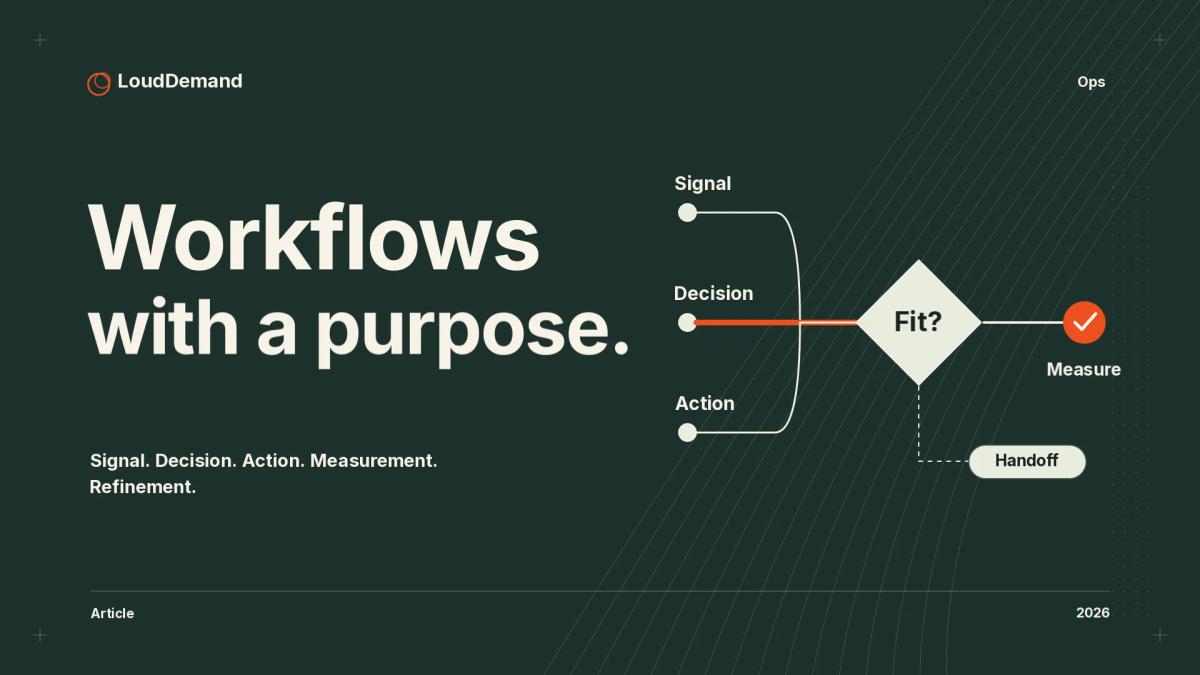
B2B marketing automation works when it operates as a decision system and fails when it operates as a drip scheduler. The clearest 2026 evidence is the gap in Gartner’s 2026 CMO Spend Survey, where 15.3% of marketing budgets now go to AI but only 30% of marketing organisations report mature or fully developed AI readiness: the tooling is ahead of the operating design that makes it pay. The architecture that holds up has five parts signal, decision, action, measurement, refinement and one rule underneath: automate the reversible steps, escalate the consequential ones.
Why workflow design matters more than platform choice in 2026
Seventy percent of CMOs say becoming an AI leader is a critical goal for 2026, and 70% also say their internal marketing processes are not mature enough to scale it. Gartner’s own read on that gap is that less mature organisations “may be over-indexing on short-term optimization and channels that are easiest to measure and automate.”
That is the whole argument. Automation concentrates budget on whatever is easiest to count, so a weak strategy gets executed at scale and faster. Gartner’s Ewan McIntyre put it plainly: “AI can help marketers optimize faster, but optimization is not the same as strategy.” And with marketing budgets flat at 7.8% of company revenue in 2026, spending on automation before you can measure what it changes is a gamble with someone else’s money.
Measurement discipline is the weak point. Content Marketing Institute and MarketingProfs surveyed 1,015 B2B marketers for their 2026 B2B Content and Marketing Trends report and found only 12% rate themselves highly effective, while 33% call measuring content effectiveness a top challenge. The top drivers of effectiveness were content relevance and quality at 65%, team skills at 53%, and alignment with sales at 45%.
The payoff data argues for measurement first. ICONIQ’s 2026 research across more than 150 B2B software GTM organisations found high AI adopters seeing roughly 10 percentage point higher New Lead-to-MQL conversion (38% versus 27%) and MQL-to-SQL conversion (37% versus 29%), and about $640K in net new ARR per GTM FTE against $370K for low adopters.
Only 30% of marketing organisations report mature or fully developed AI readiness, while 15.3% of marketing budgets already go to AI Gartner’s 2026 CMO Spend Survey, published May 11, 2026 (401 CMOs, fielded January–March 2026).
The architecture: signal, decision, action, measurement, refinement
A marketing automation workflow is a rule that connects an observable event to a decision, an action, and a number that tells you whether the rule still works. Every workflow needs all five parts; one missing the measurement part is a habit.
1. Signal
The event that fires the rule: a first-party behaviour (pricing page visit, content download, webinar registration), a third-party research signal (a buyer reading comparison pages on a review site), a score threshold, or a calendar event. Good signals are observable and dated; “interested” is not a signal.
2. Decision
The branch the signal produces, and it fits in one sentence: if [signal] crosses [threshold], then [action], within [time], unless [suppression]. Programmes fail here when they encode several mutually exclusive paths and no stated default.
3. Action
What happens: an email, a scored record, a routed task, a suppression entry, an alert to a named human. Every action needs a named owner, because unowned actions become orphan sends that live forever.
4. Measurement
Exactly one primary metric per workflow. Two metrics means nobody defends either, and the metric has to sit downstream of the action.
5. Refinement
The scheduled review where thresholds move. Most teams skip it, which is why their automation gets less relevant every quarter.
The workflow catalogue a B2B organisation actually runs
For a mid-market B2B team, start with lead routing and follow-up before adding more workflows. Routing mechanics sit in our marketing ops routing article and the lead routing SOP; this is the layer above them. Most lifecycle marketing B2B programmes live in the first two rows.
| Workflow | Trigger | Action | Owner | SLA | Primary metric |
|---|---|---|---|---|---|
| Lead routing and acceptance | Inbound form or lead above the fit threshold | Update CRM record, assign a rep, notify the channel | Marketing ops | First touch in 5 minutes; acceptance in 1 day | Lead acceptance rate |
| B2B lead nurture | Pricing-page visit plus download, or intent score crosses a band | Branch on role and stage, send next-best asset | Demand gen | Asset within 24 hours | MQL-to-SQL rate |
| Event and webinar follow-up | Registered, attended, or no-show | Split attended, no-show and replay paths; brief the rep | Events, demand gen | Follow-up within 2 hours | Attendee-to-meeting rate |
| Signal-triggered campaign | Third-party research signal on a named account | Suppress nurture, launch the account sequence | Marketing ops | Live within 1 hour | Pipeline per triggered account |
| SDR task handoff | Fit score crosses the sales-ready band | Create the SDR task, start the SLA clock | Sales ops | Task accepted within 4 hours | SLA breach rate, SQL rate |
| Scoring-threshold alerts | Fit score changes band, engagement spikes | Alert the account owner and demand gen lead | Marketing ops | Alert inside 15 minutes | Alert-to-action rate |
| Renewal and expansion | Renewal date, usage drop, new buying-group member | Route to customer success and the AE | Customer marketing | 90 days before renewal | Expansion ARR |
| Competitive displacement | Buyer visits a competitor comparison page | Serve the displacement asset, switch the track | Demand gen | Asset within 1 hour | Win rate on displaced accounts |
Every line has a name and a number, which separates a workflow from a campaign. Campaigns do not compound.
Designing triggers off buying signals, not elapsed time
Behavioral triggers are conditions the buyer meets; time triggers are conditions you meet. A day-seven email fires because a week passed; a pricing-page-visit trigger fires because something happened. The evidence favours the second approach: in a joint INFUSE and G2 study reported by Demand Gen Report, accounts surfaced by both G2 Buyer Intent data and demand activation produced 21% more leads per account, 93% higher multi-touch engagement, and were 1.6 times more likely to be at the decision stage than accounts reached by activation alone. It covered 243,000 intent accounts across 11 cybersecurity programmes, so read it as directional evidence for one vertical.
| Signal | Threshold | Action | Escalation | Suppression rule |
|---|---|---|---|---|
| Third-party research on a review site | 3+ comparison or rival-vendor page views in 7 days | Start the account sequence, brief the owner | Reminder if no meeting in 2 business days | Never fire when an accepted opportunity exists |
| Pricing-page intent | 2+ pricing visits in 10 days plus one download | Swap to commercial content, raise the fit score | Manager reviews if no reply in 7 days | Suppress once a demo is booked |
| Score band crossing | Fit times engagement crosses 60/60 | Alert the owner, arm the SDR task | Director if the task sits untouched 24 hours | Suppress while a rep-owned opportunity is open |
| Content engagement depth | 3+ content touches in 14 days | Deepen the track, change the asset tier | Alert if engagement stops after touch 3 | Cap at 2 touches per contact per week |
| Event attendance | Attended 30 minutes or more | Alert the rep with context, send the session asset | Manager if no task is accepted | No-show path runs separately, so nobody gets both |
| Email fatigue | 3 sends without an open in 14 days | Drop to monthly cadence | Marketing ops reviews the list weekly | Hold all other sends for 30 days |
| Account roll-up | 3+ contacts from one account engaged in 14 days | Move to account orchestration | Weekly owner and demand gen review | One owner and one sequence per account |
The suppression column is the one teams skip and the one that decides whether the programme survives. Without it, the same person receives nurture, the newsletter and retargeting, and registers only volume.
Why B2B needs account-level orchestration
Most B2B marketing automation is built on a contact record, and most B2B decisions are made by a group. Gartner’s current formulation is six to ten decision makers for a complex solution, with involvement spread across functions.
Treat this carefully, because the famous figures here have aged badly. Kevin Escoda’s 2026 audit for Demand Gen Report traced the “57% of the buying journey happens before sales gets a call” statistic to a 2011 CEB and Google study, and noted that Gartner’s 17% figure for supplier interaction time is shared across every supplier under consideration. His conclusion is the useful part: the direction of these statistics is real, the precision is mostly fiction.
So treat the committee as a shape, not a number, and design for it. Account based automation means the unit of orchestration is the account, with one owner, one sequence and one metric, while individual contacts enter and exit it based on their own behaviour. The overlap data from the INFUSE and G2 study supports the model: 42% of accounts appeared in both G2 Buyer Intent data and demand activation, and those accounts recorded 2.5 times more G2 pageviews, 3.0 times more competitor pageviews and up to 5.3 times more comparison pageviews.
CMI’s 2026 research found 65% of ABM users say their campaigns outperform traditional marketing, and the INFUSE and G2 work found accounts with competitor pageviews generated up to 41% more leads per company which is why competitive displacement belongs in the catalogue.
Automate the reversible, escalate the consequential
The practical rule I give teams: automate reversible steps, escalate consequential ones. A follow-up email is reversible. A pricing concession, a public statement about a competitor and a contract change are not.
The rule only works if you have governance to run automation at all. Vendor-sponsored 2026 research from Integrate and Demand Metric, reported by Demand Gen Report, found high-growth organisations nearly four times as likely to rate their marketing data governance maturity as advanced or leading, with 79% automating lead validation before CRM ingestion against 44% of lower-growth organisations. Gartner’s CMO survey points the same way: 70% of CMOs say their internal processes are not mature enough to scale AI, and lack of in-house AI expertise was the top barrier at 38%.
How to build b2b marketing automation workflows
Allow about a quarter to build and test these workflows.
- Name the outcome before the tool. Pick the one metric the workflow moves. If you cannot name it, the workflow does not exist yet.
- Inventory what you run today. List every recurring marketing action, then cut anything with no owner and no metric.
- Define the signal set. Decide which events and score bands can start a workflow and which can only inform one.
- Write each rule in one sentence. If [signal] crosses [threshold], then [action] within [time], unless [suppression]. Needs a semicolon? Split the workflow.
- Write the escalation path. Decide what happens when the action does not happen, who gets told, and how quickly.
- Assign one owner and one metric per workflow. Two owners means no owner, and two metrics means a reporting exercise nobody finishes.
- Draw the human boundary. List the steps a buyer would be embarrassed to receive without a human reviewing them.
- Run in shadow mode for two cycles. Log what the workflow would have sent, routed and suppressed, then compare against what your team did by hand.
- Review on a fixed cadence. A monthly thirty-minute pass over exceptions, suppression-list changes and threshold drift.
Steps three and four need a marketing ops owner rather than a platform admin, and they are where most programmes fail.
Choosing a marketing automation platform, and what it actually costs
Platform choice follows workflow design, never the reverse. If your workflows need account-level orchestration with custom suppression logic, a contact-centric drip tool will fight you the whole way. The automation tooling stack notes cover platform selection in more detail.
| Platform | Public pricing, as listed | Best fit | Watch-out |
|---|---|---|---|
| HubSpot Marketing Hub | Starter $7/mo, Professional $800/mo, Enterprise $3,600/mo | CRM and marketing in one system | Workflow volume capped by tier; a HubSpot Credits layer sits on top |
| Adobe Marketo Engage | Four packages, Growth (10 users) to Ultimate (25); 20K to 50K API calls a day. No public list price | Deep lead management, custom data objects | Long sales cycle, no published entry price |
| Salesforce Marketing Cloud | Next Growth $1,500 per organisation per month billed annually; Next Advanced $3,250; Account Engagement+ $1,250; Starter $25 per user per month | Teams standardising on Salesforce | Core editions priced per organisation, not per seat |
| Customer.io | Essentials from $100/mo monthly, Premium from $1,000/mo yearly, Enterprise by quote | Behavioural messaging for mid-market | Volume above published tiers is negotiated |
| ActiveCampaign | Starter $15/mo, Plus $49/mo, Pro $79/mo, Enterprise $145/mo, yearly at 1,000 contacts | A small team wanting a full suite cheaply | Starter caps automation at 5 actions |
| Klaviyo | Free to 250 profiles and 500 emails a month; paid tiers priced by profile count | Commerce-led teams | Flows assume ecommerce cycles, not committees |
| Braze | No public list price on its pricing page | High-volume, real-time cross-channel engagement | Price negotiated; Salesforce agreed to acquire it for $5.66B enterprise value on October 20, 2026, closing expected fiscal 2028 |
| Zapier | Free with 100 tasks a month, Professional from $19.99/mo, Team from $69/mo, Enterprise by quote | Connecting systems the platform cannot talk to | Task billing scales with volume, brittle under load |
| Make | Free 1,000 credits a month; credits became the billing unit on August 27, 2026 | Visual multi-step orchestration | Credit pricing rather than a flat seat price |
| n8n | Starter $20/mo for 2.5K executions, Pro $50/mo for 10K, Business $800/mo for 40K and self-hosted only, Enterprise by quote | Workflows you host and control | Business tier is self-serve, self-hosted only |
Failure modes that kill B2B automation programmes
| Anti-pattern | What it looks like | What it costs | The fix |
|---|---|---|---|
| Automating a strategy that was never right | You codify the current sequence, then run it harder | The bad strategy gets distributed faster, and the metric is activity volume | Name the decision each workflow makes and the outcome it moves |
| Contact-level drip on a committee deal | Five people at one account get the same sequence | The buying group sees uncoordinated contact | Orchestrate at account level: one owner, one sequence, per-contact suppression |
| Timer-triggered sends with no signal | A sequence fires because day seven arrived | Prospects hear from you for irrelevant reasons, reply rates decay | Require every send to name a signal and a threshold |
| Nurture outpacing sales | Fourteen touches in three weeks, reps looped in on day fifteen | Marketing speaks before sales, so reps treat the channel as noise | Cap volume, route on score bands, give reps a window to take over |
| Routing with no acceptance loop | Leads are assigned, the queue is never checked | Time-to-lead decays silently, acceptance collapses | Track acceptance rate per workflow; only 9% of lower-growth organisations in the Integrate study report acceptance above 80% |
| No suppression register | The same contact gets nurture, newsletter and retargeting | Unsubscribe rates and deliverability damage follow | One suppression list, checked by every send path |
| Automation that hides the market | Triggers fire only for in-market buyers | You talk to the five percent who are ready; the ninety-five stay invisible | Pair signal-triggered programs with always-on demand generation |
That last row deserves a pause. The Ehrenberg-Bass 95:5 rule, published by John Dawes in 2021 through LinkedIn’s B2B Institute, says up to 95% of potential buyers are not in market at any moment. Trigger-driven automation shrinks the market, because it can only see people already moving.
FAQ
What is B2B marketing automation?
It is the system that turns a buyer’s observable behaviour into a coordinated next action without a human touching every step. That spans trigger rules, scoring, routing, content, handoffs to sales and measurement that shows whether the rules work, which makes it much bigger than an email drip.
Which workflows should a B2B team automate first?
Lead routing and acceptance, because the output is a human behaviour you can measure and the feedback loop is hours rather than quarters. Then event and webinar follow-up, then nurture branching once routing is reliable.
How do you build a lead nurture workflow that actually converts?
Start from buying signals rather than elapsed time, because signal-aligned programs produced 21% more leads per account and 93% higher multi-touch engagement in the INFUSE and G2 study. Branch on role and buying stage rather than personalising copy, cap touches per week, and define what ends the sequence. Our guide to signal-based selling covers where the signals come from.
Which marketing automation platform should you choose?
Choose the one whose native workflow model matches the workflows you intend to run, then check the price against your list size and seat count. Contact-centric platforms fail once you move to account-level orchestration; enterprise platforms fail on time-to-value.
How do you automate without making everything generic?
Personalise the branch, not the copy. CMI’s 2026 research found 59% of B2B marketers describe their personalisation as basic, meaning one or two channels with minimal integration, so most programmes personalise tokens while sending everyone the same story. HubSpot’s 2026 State of Marketing reports 80% of marketers already using AI for content creation, which makes judgment the scarce input, not content volume.
How do you measure marketing automation ROI?
Give every workflow one downstream metric and report it monthly. In Demand Gen Report’s 2026 B2BMX Insights Benchmark, pipeline influenced became the top performance metric for B2B marketers at 44%, and 33.3% of teams now carry revenue-based quotas against 25.3% in 2025.
What mistakes kill most B2B automation programmes?
Automating a strategy that was never right, running contact-level drips on committee deals, letting nurture outpace the sales handoff, and shipping without a suppression register. Each has a fix in the table above.
What to do next
Pull your automation inventory and put an owner and one metric next to every line. Then rebuild the workflow with the shortest feedback loop, usually lead routing, using a written signal, threshold, owner and SLA. Our sales and marketing SLA setup playbook covers that SLA, and build the B2B demand generation engine covers the signals feeding those rules.
Sources & references
- Gartner 2026 CMO Spend Survey Finds CMOs Allocate 15.3% of Marketing Budgets to AI, but Only 30% Are Ready to Scale AI CapabilitiesGartner, Inc. (press release syndicated via Business Wire) · Accessed Oct 18, 2026Gartner, May 11, 2026 (n=401 CMOs, fielded Jan–Mar 2026)
- AI remains a top priority for CMOs, but spending lags: GartnerMarketing Dive · Accessed Oct 18, 2026Marketing Dive, May 11, 2026
- Awareness and Conversion Account for 62.6% of Total Media Spend, Gartner FindsDestination CRM · Accessed Oct 18, 2026Destination CRM, June 9, 2026
- 9 Takeaways and Insights From the 2026 B2B Content and Marketing Trends ReportContent Marketing Institute and MarketingProfs · Accessed Oct 18, 2026Content Marketing Institute and MarketingProfs (n=1,015 B2B marketers)
- Leaner, Smarter, Flatter: Inside the Modern GTM OrganizationICONIQ Venture & Growth · Accessed Oct 18, 2026ICONIQ Venture and Growth (150+ B2B software GTM organisations)
- Study Finds Demand Programs Aligned with Buyer Signals Deliver 93% More EngagementDemand Gen Report · Accessed Oct 18, 2026Demand Gen Report, July 16, 2026 (INFUSE and G2)
- The 2026 B2BMX Insights 2026 Benchmark Survey Results: B2B Marketing Enters the AI EraDemand Gen Report (B2BMX Insights) · Accessed Oct 18, 2026Demand Gen Report, October 2026
- AI Readiness Is Closely Linked to Marketing Data Governance, Revenue Growth: Integrate, Demand MetricDemand Gen Report · Accessed Oct 18, 2026Demand Gen Report, Sept 28, 2026 (Integrate and Demand Metric, vendor-sponsored)
- Check the Date on Your Buying Group StatsDemand Gen Report · Accessed Oct 18, 2026Kevin Escoda, Demand Gen Report, Oct 22, 2026
- Salesforce to Acquire Braze for $5.6BDemand Gen Report · Accessed Oct 18, 2026Demand Gen Report, Oct 21, 2026
- Marketing Software Pricing | HubSpotHubSpot · Accessed Oct 18, 2026
- Marketo Engage: Pricing and Packaging | Adobe for BusinessAdobe · Accessed Oct 18, 2026
- Marketing Cloud Software PricingSalesforce · Accessed Oct 18, 2026
- Pricing + Plans | Customer.ioCustomer.io · Accessed Oct 18, 2026
- Platform Pricing & FeaturesActiveCampaign · Accessed Oct 18, 2026