

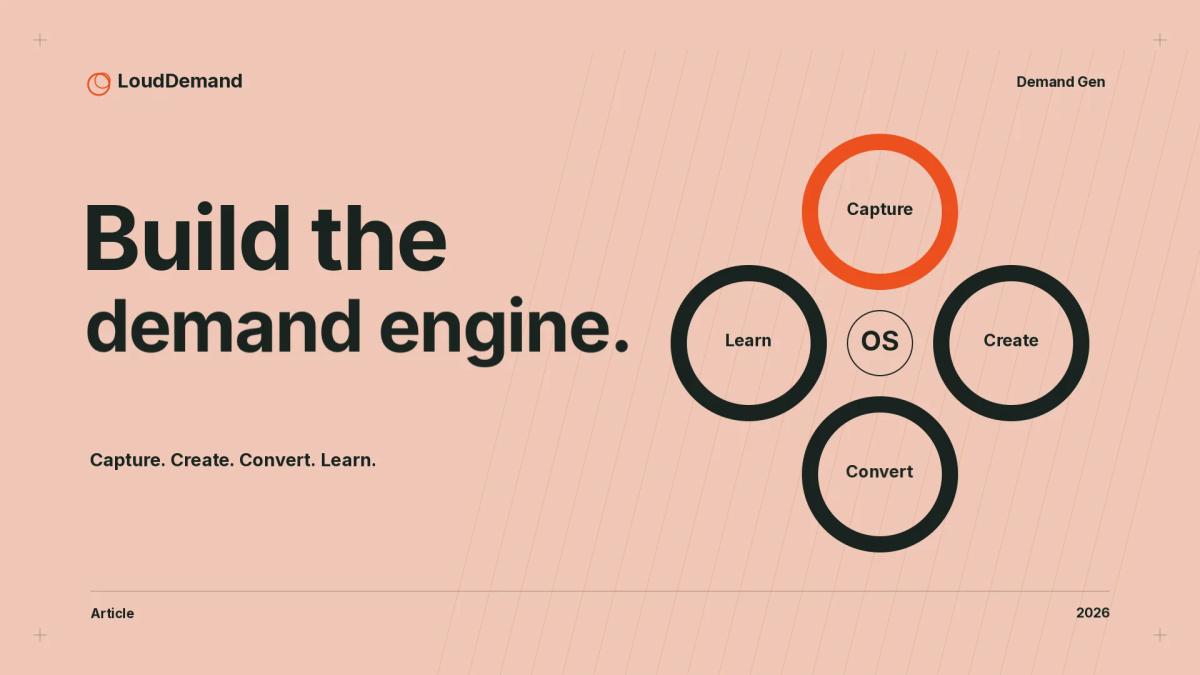
A b2b demand generation engine is a repeatable loop that turns a defined buyer into measurable pipeline, then feeds what it learns back into the next round. You build it from four sub-engines - capture, create, convert, learn - and you build the measurement spine before you buy the tooling. The case for that order is numeric: ICONIQ Growth’s 2026 research on 150+ B2B software GTM teams found that high AI adopters generate about $640K in net new ARR per GTM FTE versus $370K for low adopters, and convert roughly 10 percentage points better from lead to MQL and from MQL to SQL (ICONIQ Growth, 2026).
What changed in 2026: the money and the readiness gap
A build guide is urgent now: the budget stopped moving while the technology accelerated. Gartner’s 2026 CMO Spend Survey (401 CMOs, fielded January–March 2026) found marketing budgets flat at 7.8% of company revenue, with 15.3% of it going to AI and 56% of CMOs saying their organisation lacks the budget to deliver its 2026 strategy (Gartner, May 11, 2026).
On the same survey, only 30% of marketing organisations report mature or fully developed AI readiness, even though 70% of CMOs call becoming an AI leader a critical 2026 goal. My read: this is an operating-model gap, not a software gap.
CMI’s 2026 research (1,015 B2B marketers) shows the same shape: only 12% of B2B marketers rate themselves highly effective, while 95% of B2B marketers use AI-powered applications and just 39% say AI improved content performance. Output went up and impact did not, and an engine closes that gap by measuring the loop, not the pieces you shipped.
What a b2b demand generation engine actually is
A demand generation engine is a set of repeatable steps that turns a defined buyer into measurable pipeline and re-runs better every quarter. What most teams have is a calendar.
A demand generation engine is the closed loop where every quarter’s output becomes the next quarter’s input. Six links, in order:
- Input - the buyer you chose, the problem they have, the evidence.
- Asset - what that buyer sees: a page, post, deck, webinar, sequence.
- Signal - the trace that they engaged, captured where you can query it.
- Conversation - the human (or agent) response that turns attention into exchange.
- Pipeline - the outcome you can name in dollars.
- Learning - the decision about what to change next time.
Most teams build links one through three and then admire their calendar. The pipeline engine - routing, the conversation, the named outcome - is the part they skip, and without it link six cannot change link one.
HubSpot’s 2026 State of Marketing found 61% of marketers believe marketing is facing its biggest disruption in 20 years because of AI (HubSpot, 2026). An engine keeps a point of view alive while AI volume grows every week.
The four sub-engines
A demand generation system is only as good as the order you build its sub-engines in. Capture collects intent, create produces assets that earn attention, convert turns attention into pipeline, and learn decides what you do next.
| Sub-engine | Purpose | Inputs | Owner | Cadence | Key metric |
|---|---|---|---|---|---|
| Capture | Collect in-market account traces | ICP, first-party data, intent signals, outbound list | Demand gen lead | Daily | Signal-to-conversation rate |
| Create | Ship assets that earn attention | Buyer research, positioning, proof, distribution | Content lead | Weekly | Qualified engagement per asset |
| Convert | Move engaged buyers into pipeline | Signals, routing, landing page, nurture, SLA | Marketing ops + sales | Continuous | Lead-to-meeting rate |
| Learn | Decide what to change and kill | Stage conversion, call notes, pipeline, attribution | Demand gen lead + ops | Weekly review, monthly reallocation | Stage-to-stage conversion trend |
Capture comes first because it is the cheapest to fix. If you cannot say who contacted you and why, content quality will not save the quarter.
The 12-month build sequence
The sequence matters more than the stack. Most failures here come from buying tools in month one and asking them to produce pipeline in month three.
| Phase | Window | What you build | Exit test before you move on |
|---|---|---|---|
| 0. Instrument | Days 1–30 | ICP one-pager, one conversion path, tracking sheet | You can trace any lead back to a source and forward to an outcome |
| 1. Capture | Days 31–90 | Form, routing, one outbound sequence, one weekly content slot | Every inbound lead reaches a named human within one business day |
| 2. Create | Months 4–6 | Three repeatable assets (flagship, proof, distribution) and a plan | One asset has run in three channels without a rewrite |
| 3. Convert | Months 7–9 | Lifecycle nurture, landing page test, written sales SLA | You can name your lead-to-meeting rate and its eight-week trend |
| 4. Learn | Months 10–12 | Experiment log, one review cadence, a reallocation rule | You have scaled or killed one program on evidence rather than opinion |
Notice what is missing: no phase where you buy an intent-data platform or add a second channel. Both come later, and only if the prior exit test is passed.
How to build a b2b demand generation engine: the eight steps
A b2b demand generation engine from scratch comes down to eight ordered moves.
- Write the ICP on one page. Who they are, what problem they have, what they would search for, what disqualifies them. If it does not fit on one page, you have a hope, not an ICP.
- Pick one conversion path. One form, one offer, one meeting type. Three offers means three programs getting a third of the attention each.
- Build the sheet before the stack. Source, timestamp, segment, first touch, meeting, opportunity, outcome - one tab, one owner.
- Ship capture. Form, routing rules, and a written response SLA. A lead that sits unanswered for two days is money you paid for and threw in a bin.
- Write three assets, not thirty. One flagship, one proof asset, one short distribution piece. CMI’s 2026 research found the top content challenge for B2B marketers is content that prompts a desired action (40%), ahead of resource constraints (39%) and measuring effectiveness (33%).
- Start the learning loop in month one. Four questions at every review: which source produced meetings, which asset did the work, what did sales say no to, what are we stopping.
- Automate only what repeats. A rule that has fired ten times is a candidate for marketing automation. One you have seen once is a note in your head.
- Add a channel only after one channel has a baseline. No baseline, no comparison, no decision.
The demand gen audit worksheet runs steps one through six against your own numbers.
What a scalable B2B marketing system actually looks like
A scalable B2B marketing system is a demand gen operating model with named owners, a fixed weekly rhythm, and a measurement layer that survives staff changes. At full size that model has five jobs that can sit on three people:
- Demand gen lead - owns the loop and the reallocation decision.
- Content or creative lead - owns the asset pipeline and the point of view.
- Marketing ops - owns routing, the sheet, the SLA, and the reporting layer. Most teams leave this role out; the marketing ops routing guide covers the mechanics.
- Lifecycle and paid - owns nurture and the capture channels.
- Analyst or measurement owner - can start at half a day a week.
ICONIQ’s 2026 data on 150+ B2B software GTM teams says how this resizes: more than 65% of marketing teams and 71% of SDR teams now have a majority of FTEs using AI regularly, Marketing and RevOps headcount is largely flat while Sales and Post-Sales grow 10–20%, and AI-forward companies run GTM teams 20–30% leaner.
The labour market says the same: CMI’s 2026 Career and Salary Outlook (600+ marketers) found 76% of marketers are already doing the work of more than one job and 50% have taken on new responsibilities without a promotion or pay increase, while only 11% of organisations have replaced workers with AI (CMI, April 8, 2026). The AI argument for a lean team is real, but it is redistribution of work, not a headcount cut.
The hiring brief changes. The AMA’s 2026 State of Marketing Careers Report (1,412 marketing practitioners, margin of error 3% at 95% confidence) found content marketer roles fell 11% and SEO specialist roles fell 15% from 2024 to 2025, while GEO/AEO specialists and AI workflow designers rose (AMA, July 31, 2026). Hire for judgment, and use the demand generation strategy piece for the positioning work that feeds step one.
Lean demand generation: one marketer, no budget
Lean demand generation is not a compromise. It is the version most companies should ship first, because the tooling floor is close to zero and the failure mode is process, not software. These free plans cover the basics:
- Zapier Free - 100 automation tasks a month, unlimited zaps, tables and forms.
- Airtable Free - data tables, forms and automations that replace a pipeline database.
- Apollo Free - 900 credits per seat per year for prospecting, enrichment and sequences.
- Klaviyo free tier - up to 250 profiles and 500 email sends a month with reporting.
- Ahrefs Free - limited Site Explorer and Site Audit, enough to see where pages rank.
Paid search is the one place where “lean” still costs real money, and it should. WordStream and LocaliQ’s 2026 benchmarks, from 13,000+ search campaigns across 23 industries, put the average cost per lead across Google Ads and Microsoft Ads at $66.69, and Business Services at $93.69 with a 4.85% conversion rate and a $5.87 average click cost (WordStream/LocaliQ, updated September 16, 2026). Ten paid leads a month is roughly $940 at that benchmark - decide whether that is a test budget or a distraction before you launch.
What to skip with nothing: a demand-data contract, a second channel, a marketing automation platform, and any content calendar longer than six weeks. The 90-day demand gen audit is built for this starting point.
The tooling stack by budget band
The stack follows the engine, not the other way around. Each layer of the loop has a free option, a lean option, and a funded option.
| Engine layer | Free band ($0/mo) | Lean band ($50–$500/mo) | Funded band ($500+/mo) |
|---|---|---|---|
| Data and pipeline (capture) | Airtable Free | Airtable Team, $20/user/mo annually | Airtable Business, $45/user/mo; Enterprise quote |
| Enrichment and outbound (capture) | Apollo Free, 900 credits/seat/yr | Apollo Basic, $49/seat/mo annually | Apollo Professional, $79/seat/mo; custom for org |
| Signal-led prospecting (capture) | Clay Free, 500 actions/mo | Clay Launch, $167/mo | Clay Growth, $446/mo; Enterprise quote |
| Lifecycle and nurture (convert) | Klaviyo free, 250 profiles, 500 emails/mo | Customer.io Essentials, from $100/mo | Customer.io Premium, from $1,000/mo |
| Automation glue (learn) | Zapier Free, 100 tasks/mo | Zapier Professional $19.99/mo; Team $69/mo | Zapier Enterprise, quote |
| Search and AI visibility (create) | Ahrefs Free, limited tools | Semrush Starter tier; add-on seats from $45/mo | Ahrefs Enterprise $1,499/mo annual; Semrush quote |
Two caveats. Clay’s pricing page lists Launch at $167/month and Growth at $446/month in its plan table, while its FAQ quotes $185 and $495, so check the live page before you budget. And the funded column says “quote” because Marketo, Pardot, Salesforce Marketing Cloud, 6sense, Demandbase and ZoomInfo sell on contract.
Consider whether you need more software before adding to the stack. CMI’s 2026 research found 45% of B2B marketers plan to increase spend on AI-powered tools and 21% on tech infrastructure, but only 9% on human resources. Yet when effective teams are asked what moved the needle, content relevance and quality (65%) and team skills (53%) outrank technology and tools (43%).
A stack you assembled around your own spec, with a spreadsheet at the centre, beats a contract you signed to look credible. The automation tooling stack notes cover sequencing.
Where to automate, and where to keep a human
Automate the repeatable, keep the judgment calls human. That is not a slogan invented for the occasion; it is roughly where the 2026 evidence lands.
The AMA scored 35 marketing skills on Stanford’s Human Agency Scale, where H1 means an agent can do the task alone and H5 means it needs continuous human involvement. Lead generation, email marketing, SEO, paid media, performance analytics, copywriting, market research and graphic design sit in the H1–H2 band; marketing strategy, brand management, collaboration, creativity, critical thinking, leadership, ethical decision-making and adaptability sit in H4–H5.
The CMI numbers add the caution. Only 28% of B2B marketers say they experiment with AI agents and just 3% say agents are core to their strategy, which makes an agentic pipeline a 2027 project for most teams. The gap is wide: 87% report better productivity, 39% better content performance.
High AI adopters generate roughly $640K in net new ARR per GTM FTE, versus $370K for low adopters - ICONIQ Growth, “Leaner, Smarter, Flatter: Inside the Modern GTM Organization” (2026), based on 150+ B2B software GTM teams (ICONIQ Growth).
The practical read: the gap between those two groups is not an AI-tooling gap. ICONIQ attributes it to operating structure - flatter teams, owners who build rather than operate, and a measurement loop that tells you which you are.
Common failure modes
The failure modes I keep seeing, roughly in order of frequency:
- Buying the stack before writing the loop. Six tools and no definition of what a good week looks like.
- Optimising lead volume before you can trace a lead to a meeting. Volume without a destination is a vanity metric with a budget.
- Treating AI output as performance. More posts, more replies, more assets shipped, same pipeline.
- Ignoring the buying group. B2B buying groups now average nine members, so a program aimed at one contact is aimed at a fraction of the committee (INFUSE/G2 via Demand Gen Report, 2026). The B2B demand generation operating system covers how to widen the blast radius.
Frequently asked questions
What is a B2B demand generation engine?
A b2b demand generation engine is a closed loop that turns a defined buyer into measurable pipeline and improves each round: input, asset, signal, conversation, pipeline, learning. It is built from four sub-engines - capture, create, convert and learn - each with a named owner, a cadence, and one metric that shows whether it works. The difference from a campaign plan is that the learning step can change the plan.
How do you build a demand generation engine from scratch?
Start with the measurement spine, not the tooling: an ICP on one page, one conversion path, and a tracking sheet that traces source to lead to meeting to opportunity. Then build capture, then three repeatable assets, then conversion, and only then add automation and channels. Most teams lose the first 90 days by starting at step four.
What does a scalable B2B marketing system actually look like?
Five owned jobs - demand gen lead, content lead, marketing ops, lifecycle and paid, and a measurement owner - on a fixed weekly pipeline-review rhythm, with a reporting layer that survives staff changes. ICONIQ’s 2026 research found Marketing and RevOps headcount flat while AI-forward GTM teams run 20–30% leaner, so the system scales by breadth per person, not by adding seats.
How do you build demand generation with no budget and one marketer?
Use the free tiers: Airtable Free for the data, Zapier Free for 100 automation tasks a month, Apollo Free for 900 credits per seat per year, Klaviyo’s free tier for up to 250 profiles, and Ahrefs Free for search and site audits. Spend your time on the loop rather than the tools - one ICP, one offer, one weekly asset, one review - and only pay for a channel when you can name what a lead costs you. At the 2026 Business Services benchmark of $93.69 per lead, ten paid leads is about $940 a month.
What is the 90-day plan to fix a broken demand engine?
Start with three thirty-day blocks: days 1–30 rebuild the tracking sheet so every lead source, stage and outcome sits in it. Days 31–60 fix capture - routing, response SLA, one outbound sequence - and watch the lead-to-meeting rate daily. Days 61–90 run the first monthly review, kill the worst source, and fix the biggest drop-off between stages.
How much of a demand engine should you automate?
Automate the H1–H2 work first: data capture, routing, list hygiene, reporting, enrichment, and the repeatable parts of content production. The AMA’s 2026 scoring puts lead generation, email marketing, SEO, paid media and performance analytics firmly in that band. Before you automate a step, make sure you have seen the rule fire ten times, otherwise you are automating a guess.
Which parts of demand generation should never be automated?
Positioning, the point of view, account selection, and the judgment call about whether a deal is worth a senior person’s time. AMA’s 2026 research puts marketing strategy, brand management, creativity, critical thinking, leadership and ethical decision-making in the H4–H5 band, where AI cannot function without continuous human involvement. CMI’s finding that only 39% of marketers see AI improving content performance shows it in practice.
What to do next
If you are starting from nothing, do three things this week: write the one-page ICP, open a sheet with columns for source, lead, meeting, opportunity and outcome, then ship one buyer-facing asset within seven days instead of planning the next quarter.
If you already have demand activity but it does not compound, the problem is usually the loop, not the tactics, and the fastest diagnostic is the 90-day audit above.
Sources & references
- Gartner 2026 CMO Spend Survey Finds CMOs Allocate 15.3% of Marketing Budgets to AI, But Only 30% Are Ready to Scale AI CapabilitiesGartner · Accessed Oct 11, 2026Gartner, 2026
- Leaner, Smarter, Flatter: Inside the Modern GTM OrganizationICONIQ Growth · Accessed Oct 11, 2026ICONIQ Growth, 2026
- 9 Takeaways and Insights From the 2026 B2B Content and Marketing Trends ReportContent Marketing Institute / MarketingProfs · Accessed Oct 11, 2026CMI/MarketingProfs, 2026
- A Ghost Workforce Rises in the 2026 Marketing Job Market (and Other AI-Driven Shifts)Content Marketing Institute · Accessed Oct 11, 2026CMI, 2026
- 2026 State of Marketing Careers ReportAmerican Marketing Association · Accessed Oct 11, 2026AMA, 2026
- Google Ads Benchmarks 2026: Competitive Data & Insights for Every IndustryWordStream / LocaliQ · Accessed Oct 11, 2026WordStream/LocaliQ, 2026
- Apollo.io Pricing PlansApollo.io · Accessed Oct 11, 2026
- Pricing + PlansCustomer.io · Accessed Oct 11, 2026
- Study Finds Demand Programs Aligned with Buyer Signals Deliver 93% More EngagementDemand Gen Report · Accessed Oct 11, 2026Demand Gen Report, July 16, 2026 (INFUSE/G2 study, 243,000 intent accounts)