

Quick verdict
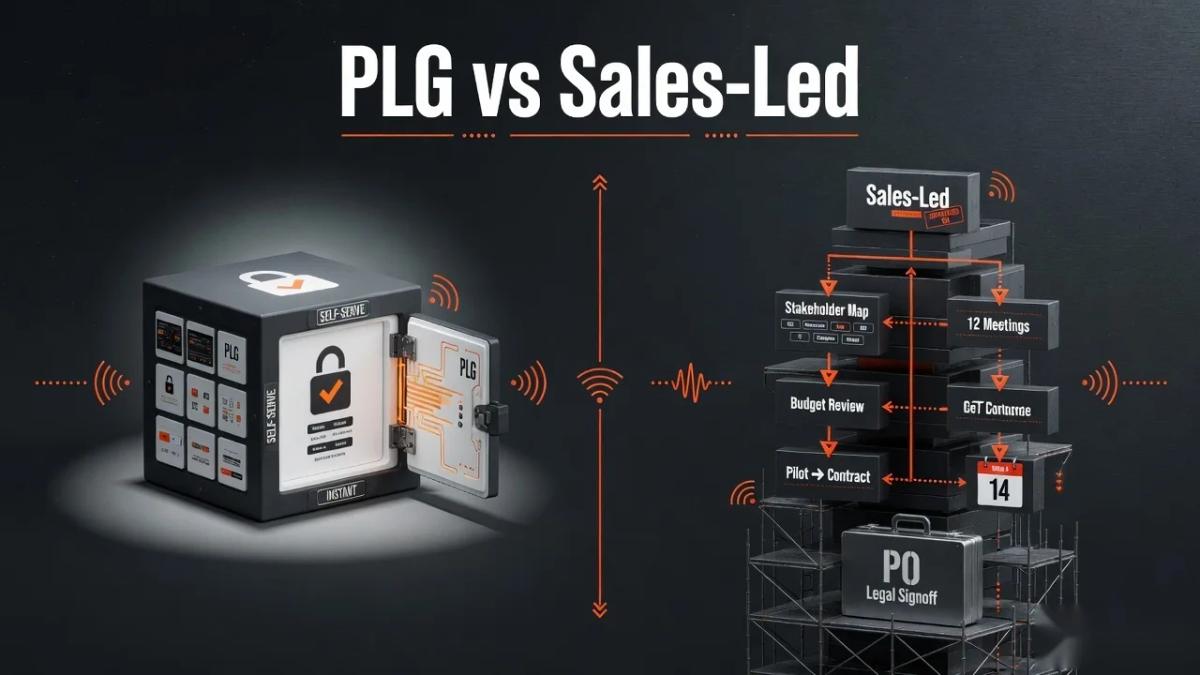
If your product delivers immediate, self-serve value to individual users — Slack, Notion, Figma, Calendly — product-led growth (PLG) is the rational starting motion. If you sell complex, high-ACV solutions into buying committees with security reviews and procurement — think enterprise data, ERP, or security platforms — sales-led growth (SLG) remains the default. Both pure versions are now the exception.
The real question in August 2026 is not “which one” but “where on the spectrum, and who owns the handoff.” The 2026 data is unambiguous: hybrid motions are the norm, self-serve is a serious revenue line, and AI is compressing time-to-value expectations on the product side while reshaping what sellers actually do on the sales side.
What each motion looks like in 2026
Product-led growth (PLG)
The product remains the acquisition, activation, and expansion engine — but the 2026 edition differs from the 2022 playbook in four verified ways.
Free tiers got tighter. Unlimited freemium is dying. Slack, Notion, HubSpot, and Calendly have all tightened free tiers in the past two years, per Mixpanel’s 2026 PLG guide. Slack and Notion reduced unlimited free features in mid-2025, adding message-history and block limits that create natural upgrade pressure. The replacement is “strategic freemium”: genuinely useful free tiers that build habit and invite teammates while making the paid jump obvious.
Conversion benchmarks are well-established now. ProductLed’s benchmark study of 600+ B2B SaaS companies (2025) remains the reference: about 58% of B2B SaaS companies run a PLG motion, 91% plan to increase PLG investment, and average free-to-paid conversion across all models is roughly 9%. Products with $1K–$5K ACV convert best at the median (10%), while sub-$1K products reach 24% at the top quartile. Freemium drives a 12% median visitor-to-signup rate, about 140% higher than free trial sign-up conversion.
Free-to-paid conversion varies by model, and the mechanism matters more than the sticker. In Lenny Rachitsky and Kyle Poyar’s benchmark survey of 1,000+ products, good freemium self-serve conversion is 3–5% (6–8% is great), while good free-trial conversion is 8–12% (15–25% great). Opt-out trials that collect a card upfront convert at 48.8% versus 18.2% for opt-in trials, and trials of seven days or fewer convert at 40.4% versus 30.6% for trials longer than 61 days, per First Page Sage data cited by Mixpanel. Shorter, higher-commitment trials win.
AI has redefined the funnel. Time-to-value expectations collapsed from “under ten minutes” to roughly 60 seconds for AI-era products — Wes Bush’s PLG 1.0/2.0/3.0 framing (user-led, agentic, headless) is the standard way operators talk about this. Netlify already reports about 80% of signups coming from AI agents, and it dropped seat-based pricing on its Pro plan because agents broke the model. Cursor hit $2B in three years and Lovable $200M in four months on the same insight: remove the work, not just the friction. Activation in 2026 means first successful output, and agents — not just humans — are the users being activated.
Sales-led growth (SLG)
Human sellers still close the complex stuff, but the 2026 sales-led motion is narrower and more strategic than it was five years ago.
Buyers have left the building. Gartner’s March 2026 survey of 646 B2B buyers found 67% prefer a rep-free experience, up from 61% in 2025, and 45% used AI during a recent purchase. At the May 2026 CSO conference, Gartner added that 70% of buyers prefer a completely digital, self-service buying experience. The days of sellers being the primary information source are over — buyers consult an average of seven information sources per purchase.
Sellers survive as validators, not sources. The same Gartner research found 69% of buyers prefer to validate AI-generated insights with a sales rep. Buyers distrust both channels roughly equally (51% say they are more likely to hit misleading information from GenAI, 49% from a rep), but reps remain the most important source when buyers research a problem, choose a supplier, secure internal support, and finalize. The seller’s job in 2026 is confidence and context at the decision moment — Gartner’s phrase is “value clarity,” and buyers who reach it are twice as likely to report a high-quality deal.
Sales cycles are shorter but deals are stickier to close. ICONIQ’s State of Go-to-Market 2026 (survey of 150+ B2B software GTM leaders) found median sales cycles fell to about 19 weeks in 2026 from a peak of 25 weeks in 2025 — roughly six weeks shorter — while deals above $100K ACV still run up to 24 weeks. The catch: contract durations are compressing too, with sub-one-year terms rising as buyers refuse multi-year commitments in a fast-moving AI market. Sales-led motions earn their keep on expansion — ICONIQ finds sales and channel-generated pipeline now accounts for 60–80% of total pipeline at high-growth companies, versus 15–20% from marketing.
AI is embedded in the motion. Gartner advises sales enablement leaders to operationalize buyer- and seller-facing AI agents and structure content as modular, agent-ready building blocks. ICONIQ reports AI-influenced pipeline generation lifts lead-to-MQL conversion by 11% and MQL-to-SQL by 8%, and high AI adopters run leaner GTM teams at every revenue band with better quota attainment. The leverage is real; the motion is still human.
How to decide: four fit tests
The motion should follow the product’s economics, not founder preference. Four tests, in order:
1. Time-to-value. If a new user can reach the core value in minutes — one session, no setup, no migration — PLG is viable. If meaningful value requires implementation, data migration, or configuration, self-serve will leak users. The 2026 expectation is brutal: with AI-native products delivering value in seconds, a product that takes 20 minutes to activate competes against a 60-second benchmark.
2. ACV. The cleanest cut in the data. PLG dominates below $5,000 ACV; hybrid product-led sales is the sweet spot from roughly $5K–$25K; above $25K, sales-led with a trial or proof-of-concept component is the realistic model. A rep closing $3K deals needs impossible volume; a self-serve layer at $50K ACV leaves money on the table.
3. Buyer structure. PLG wins when the initial buyer is the end user and adoption is bottom-up. Sales-led wins when the decision belongs to a committee — security, finance, IT, and business owners — even if the user loves the product. Product-qualified leads (PQLs) only solve this when usage maps to an actual buying process.
4. Product complexity and compliance. Intuitive, collaborative, category-understood products self-serve well. Products requiring certifications, vendor assessments, custom SLAs, or integration work need humans. Product complexity is the second most common barrier to adopting PLG (24% of companies cite it), per ProductLed.
The 2026 data that matters
| Benchmark | Number | Source |
|---|---|---|
| B2B buyers preferring rep-free experience | 67% (up from 61%) | Gartner, March 2026 |
| Buyers preferring fully digital self-service | 70% | Gartner, May 2026 |
| Buyers using AI in a recent purchase | 45% | Gartner, March 2026 |
| Buyers who validate AI insights with a rep | 69% | Gartner, May 2026 |
| Average free-to-paid conversion (all models) | ~9% | ProductLed, 2025 (600+ companies) |
| Good/great freemium conversion | 3–5% / 6–8% | Lenny’s Newsletter / Kyle Poyar, 1,000+ products |
| Good/great free-trial conversion | 8–12% / 15–25% | Lenny’s Newsletter / Kyle Poyar |
| PQL trial conversion vs 9% unqualified | ~25% (30% at $1K–$5K ACV, 39% at $5K–$10K) | ProductLed, 2025 |
| Companies tracking activation | only 34% | ProductLed, 2025 |
| Activation rate benchmarks | 20–40% normal, 40–60% good, 70%+ elite | SaaS Mag 2026 / Prospeo |
| Free trial/POC-to-paid conversion | ~50% in 2026 vs ~36% in 2025 | ICONIQ State of GTM 2026 |
| SQL/demo path conversion | 30–40% | ICONIQ State of GTM 2026 |
| AI-native trial/POC conversion ($100M+ ARR) | 56% vs 32% non-AI-native | ICONIQ State of GTM 2025 |
| Median B2B sales cycle | ~19 weeks (down from 25) | ICONIQ State of GTM 2026 |
| Median NRR, venture-backed SaaS | 106% | ChartMogul (via Shno 2026 roundup) |
| Best-in-class PLG NRR | 120%+ (premium 130–150%) | Kotzabasis (via Shno 2026 roundup) |
| Weekly retention, B2B products | 44.6%–77.9% | Mixpanel 2026 State of Digital Analytics |
Read the table with two caveats. First, benchmark sources disagree on ranges because they measure different populations — treat them as directional, not targets. Second, the highest-leverage number in the entire table is the one most teams don’t track: activation. Only 34% of PLG companies measure it, and it is the upstream driver of every conversion figure below it.
AI is the third variable in 2026
Every GTM discussion from 2023 forward has an AI section; in 2026 the difference is that AI stopped being a channel and became a buyer, a user, and a headcount decision. Three shifts are verified and measurable.
Agents are customers. Kyle Poyar’s Growth Unhinged newsletter asks directly whether “your next customer might be an AI agent”; Elena Verna asks whether MCP should be part of your ICP; and Salesforce co-founder Parker Harris has publicly wondered whether anyone should log into Salesforce again as the company pushes headless access. This is not speculation about the future — Netlify reports roughly 80% of its signups are agents, and Atlassian’s MCP server and Teamwork Graph CLI passed one million monthly active users in its Q4 FY2026 quarter. Agentic users change the mechanics: activation means first successful output, docs must be machine-readable, pricing must be parseable, and “seats” break as a value metric.
AI-native products convert better, and the gap is measurable. ICONIQ’s GTM research found AI-native companies at $100M+ ARR convert free trials and proof-of-concepts at 56% versus 32% for non-AI-native peers. The mechanism is time-to-value: AI products deliver output in seconds, so the evaluation window — the riskiest part of any funnel — nearly disappears.
AI restructures sales team economics. ICONIQ’s 2026 report finds high AI adopters run leaner GTM teams at every revenue band while posting stronger quota attainment across SMB, mid-market, enterprise, and strategic segments. AI-influenced pipeline generation lifts lead-to-MQL conversion 11% and MQL-to-SQL 8%. Gartner’s guidance to sales leaders is that enablement must shift from static content to operationalized buyer- and seller-facing AI agents with modular, agent-ready content. The SDR role that survives is the one that can work an AI-augmented, high-volume prospecting environment — and the AE role that thrives is the validator, not the presenter.
The practical takeaway: the PLG-vs-SLG question in August 2026 cannot be answered without a third axis — where AI sits in your product, your funnel, and your headcount plan. A sales-led motion with AI-assisted sellers and a product-led motion with agentic users are both converging on the same operating model: fewer humans, earlier value, validation at the end.
Hybrid is the 2026 default: product-led sales
ICONIQ’s 2026 report is explicit: hybrid is no longer a differentiator, it is the default. High-growth companies now project self-serve at roughly 20% of 2026 revenue versus about 10% for peers, and 48% of companies run hybrid pricing models with usage-based elements. Three hybrid patterns dominate.
Product-led sales (PLG + sales assist). Users self-serve to activation; product analytics identify PQLs; sales engages only at expansion, security review, or procurement moments. PQLs are the hinge: only about 24–25% of PLG companies use them, yet PQL-qualified free trials convert at roughly 25% on average — 30% at $1K–$5K ACV and 39% at $5K–$10K — versus 9% for unqualified free accounts. The reason adoption lags is not effectiveness; it is that PQL definitions take 6–12 months of behavioral data to build.
Sales-led with product trial (SLG + trial/POC). Enterprise sellers now run trials and proofs-of-concept as the core of the motion, not a favor to prospects. This is where the biggest 2026 conversion story lives: ICONIQ measured free trial/POC-to-paid conversion at roughly 50% in 2026, up from 36% in 2025, outperforming traditional SQL and demo paths (30–40%). Companies investing in structured POC support — dedicated solution architects, forward-deployed engineers — are capturing the gain.
Motion by segment. PLG for SMB and mid-market, full sales motion for enterprise, with explicit segmentation rules, separate packaging, and a defined handoff. This is the most operationally demanding pattern and the one most companies drift into accidentally. The org-design section below is where most hybrids fail.
Sequencing a hybrid motion
Most teams ask “which motion first” when the harder question is “in what order do we build the layers.” A widely used sequencing framework, popularized by Stage 2 Capital and summarized in Prospeo’s 2026 operator playbook, runs four stages, each with its own north-star metric:
- Flow of free users — new signups per day. Volume first, because you cannot experiment on an empty funnel.
- Prove retention — free-user-to-weekly-active conversion. If free users do not stick, nothing downstream matters.
- Prove scalable acquisition — cost per quality (ICP-fit, activated) user, not cost per signup.
- Prove monetization — quality-user-to-paid conversion and ACV, including which behaviors predict it (your future PQL definition).
The discipline that makes this work is segmentation: measure every stage for your ICP, not for all users. A 25% activation rate across all signups can hide 55% among the target persona and 5% everywhere else. Teams that skip stage two and hire sales against unretained free accounts build the most expensive mistake in this playbook — a sales team working a leaky product funnel.
Real-world examples, current as of mid-2026:
- Atlassian — the archetypal self-serve company — reported Q4 FY2026 revenue of $1.766B (up 28% YoY) and cloud revenue of $1.213B (up 31%) on August 6, 2026, with full-year revenue of $6.572B. The interesting part for GTM teams: its MCP server and Teamwork Graph CLI passed one million monthly active users, more than doubling in a single quarter — the agentic front door is now a real acquisition channel for a 20-year-old product-led business.
- Notion passed $600M in ARR in late 2025, per Forbes, and ran an employee tender at an $11B valuation in January 2026, with AI the stated growth accelerant — a freemium company monetizing AI and moving upmarket without abandoning self-serve.
- Calendly reached roughly 20 million users and a $3B valuation largely through its scheduling-link viral loop; Dropbox now generates about $2.3B in annual revenue across 700 million users.
- Figma grew via shareable design files and turned individual adoption into enterprise contracts — the standard land-and-expand story.
- HubSpot added usage-based pricing tiers alongside seat plans, and Calendly capped unlimited free meetings — both examples of hybrid monetization converging on the same pattern.
- The cautionary tale is SurveyMonkey vs Qualtrics: around Qualtrics’ SAP acquisition in 2018, Qualtrics commanded roughly $17.6B in value against SurveyMonkey’s $2.8B, despite the same category, because Qualtrics sold strategic outcomes to executives while SurveyMonkey sold features to practitioners. Product simplicity does not beat executive relevance; hybrid motions must include the strategic layer.
Team and org design: where hybrids break
The handoff between product and sales is where hybrid models fail, and the org data proves the fragmentation is structural. In ProductLed’s survey, Product leads PLG strategy 49% of the time, Marketing 42%, Sales owns free-to-paid conversion only 23% of the time, and Customer Success supports free users 26% of the time. Nobody owns the full journey, and activation — the metric that ties it together — is tracked by a third of companies.
Three decisions determine whether a hybrid works:
1. Who owns the PQL definition and the handoff trigger? Define thresholds from usage data (active users, feature depth, invite behavior, API usage) and validate them against conversion cohorts. Without validation, sales gets handed noise.
2. How is revenue attributed? Credit both product-generated and sales-generated revenue, and pay on the whole account. ICONIQ found AE compensation is shifting from gross new ARR and TCV toward net revenue and net dollar retention — a structural fix for the classic fight where sales ignores self-serve accounts that would have converted anyway.
3. Is there a rules-of-engagement SLA? Response time to PQLs, account ownership boundaries, and escalation paths. This is process work, not tooling work, and it is the least glamorous reason most hybrid motions underperform.
Team composition and tooling
The two motions pull different operating models, and hybrid teams need both — usually under a single revenue operations owner.
PLG-side roles and stack: product managers owning activation and conversion; growth engineers running experimentation infrastructure; lifecycle marketers; product analytics (Mixpanel, Amplitude, PostHog); feature flags and experimentation (LaunchDarkly, Statsig); in-app guidance (Pendo, Userpilot); lifecycle messaging; usage-based billing (Stripe, Orb, Chargebee). In 2026, add agent observability and MCP server tooling to the list — teams measure agent task success, not just human sessions.
SLG-side roles and stack: SDRs and AEs working AI-augmented prospecting; solution engineers running the trials and POCs that now convert at ~50%; sales operations; CRM and sales engagement (Salesforce, HubSpot, Outreach); conversation intelligence; intent data; revenue intelligence. The 2026 change is who works the top of funnel: AI agents absorb prospecting volume, so SDR headcount shifts toward qualification and account strategy while pipeline quality metrics (lead-to-MQL, MQL-to-SQL) become the reported numbers.
The structural fix that matters most: one person — often a head of growth or revenue operations — owns the activation metric and the handoff, with authority to pull resources from product, engineering, and marketing. Without a single owner, activation falls between the chairs because it sits at the intersection of every function; ProductLed’s data shows that is exactly where most companies sit.
Metrics that matter per motion
PLG motion: activation rate (the one metric everything else depends on), time-to-value, free-to-paid conversion by model, PQL conversion rate, expansion rate, NRR. For agentic-era products, add agent task-success rate and agent-initiated account share — Netlify’s 80%-agent-signup reality makes seat counts and human session metrics misleading.
Definitions worth getting precise, because teams argue about them endlessly:
- Activation rate — the share of new users who complete the behavior that predicts long-term retention (validated by cohort analysis, not guessed). Benchmarks: 20–40% is ordinary, 40–60% good, 70%+ elite. Improving activation from 20% to 30% has roughly the same top-line effect as a 50% increase in signup volume at a fraction of the cost.
- Free-to-paid conversion — share of new accounts paying within their first six months, measured by cohort (the definition from Lenny Rachitsky and Kyle Poyar’s benchmark). It ranges from ~3% for freemium to ~25% for great trials, so benchmark against your own model type, not the blended 9%.
- PQL conversion — share of users who hit a usage threshold and then pay. The threshold must be validated against conversion data; unvalidated thresholds just produce noise for sales.
- NRR — revenue from existing customers including expansion, minus churn and contraction. 106% is the median for venture-backed SaaS; 120%+ separates best-in-class PLG; premium PLG companies run 130–150%.
SLG motion: pipeline coverage, win rate, ACV, sales cycle length (benchmark: ~19 weeks median, up to 24 for $100K+), CAC payback, and — increasingly — AI-augmented productivity metrics: pipeline generated per rep, and conversion lift from AI-assisted outreach. The old SDR-to-AE ratio is being rewritten as AI absorbs prospecting; ICONIQ reports high AI adopters run leaner teams with better quota attainment.
Hybrid motions: PQL-to-opportunity rate, trial/POC-to-paid conversion (~50% benchmark), handoff speed, and per-segment NRR. Watch expansion share of ARR: expansion is the most capital-efficient lever in both motions, and companies in the $15M–$30M+ ARR band now get about 40% of growth from existing customers (ChartMogul, via Shno’s 2026 roundup). If expansion is below a third of growth, the motion is under-investing in the accounts it already won.
Mistakes
PLG failure modes:
- Premature sales overlay that cannibalizes self-serve conversion and confuses the upgrade path.
- Freemium designed as a permanent tier instead of a conversion mechanism — infinite free value with no natural upgrade trigger. This is exactly the mistake Slack and Notion spent 2025 unwinding.
- Activation blindness: optimizing signups and page views while 60–80% of users never reach the aha moment, and not tracking activation at all (66% of PLG companies).
- Ignoring agentic users: no MCP server or agent-readable API, seat-based pricing, docs written for humans only.
- Treating PLG as no-sales-at-all: skipping the expansion and procurement layer that converts the PQLs into seven-figure accounts.
SLG failure modes:
- Volume-over-fit pipeline: measuring activity instead of fit, and spending the AI productivity dividend on more bad outreach.
- Demo theater: generic pitches that ignore the buyer’s AI-shortlisted context. Buyers arrive pre-researched; a demo that repeats their research is a waste of the one moment a seller adds value.
- Comp misalignment: rewarding new logos over NRR and expansion, when the 2026 compensation shift is toward net revenue.
- Ignoring the self-serve layer: 67% of buyers prefer rep-free, and 70% prefer fully digital self-service. A sales-led motion with no trial, no pricing transparency, and no self-serve evaluation path is invisible to most of its own market.
- Misreading “rep-free preference” as “reps don’t matter”: 69% of buyers still want a rep to validate AI-generated insights. The motion needs fewer, better sellers at the validation moment — not zero sellers.
Decision framework
| Factor | PLG score (1–5) | SLG score (1–5) |
|---|---|---|
| ACV: under $5K = 5, $5K–$25K = 3, over $25K = 1 | ||
| Time-to-value: under 5 minutes = 5, over 30 minutes = 1 | ||
| Product complexity: intuitive = 5, implementation-heavy = 1 | ||
| Buyer: end user = 5, committee = 1 | ||
| Compliance/security load: minimal = 5, heavy = 1 | ||
| Market education: well-understood category = 5, novel = 1 | ||
| Expansion mechanics: built-in usage triggers = 5, none = 1 | ||
| Agent-readiness: API/MCP-first = 5, UI-only = 1 | ||
| Total |
Interpretation: 30+ leans pure PLG; 20–29 means hybrid product-led sales, which is where most companies land; 10–19 means sales-led with trial/POC; under 10 means pure sales-led. In practice, the hybrid band is the widest, and the scarce skill is the handoff, not the model choice.
Two worked examples, so the framework is not abstract:
- A $15K ACV developer tool with a free tier. Time-to-value in minutes (5), ACV in the hybrid band (3), intuitive product (5), end-user buyers (5), minimal compliance (5), well-understood category (4), natural usage-based expansion (5), agent-ready API (5) — roughly 37 points, but the ACV and the procurement layer argue against pure self-serve. The right motion is product-led sales: self-serve acquisition, PQL scoring (the $5K–$10K ACV bracket converts at 39% with PQLs), and a small sales layer for the accounts that hit security review. This is the Atlassian pattern at smaller scale.
- A $60K ACV security platform for regulated buyers. Time-to-value measured in weeks (1), ACV above $25K (1), complex (1), committee buyer (1), heavy compliance (1), novel category (2), weak expansion mechanics (2), UI-only product (1) — roughly 10 points. Pure sales-led with a structured proof-of-concept, which is exactly where ICONIQ’s 50% trial/POC conversion benchmark comes from: the POC is the product experience, executed by solution engineers, closing the deal.
The framework punishes companies that reverse the examples: a $60K product with no self-serve evaluation path is invisible to the 67% of buyers who prefer rep-free research, and a $15K product with a full sales team spends more on the motion than the deal returns.
What this means for demand generation teams
This comparison is a GTM-motion decision, but it has direct consequences for how demand generation is run in 2026.
The MQL is not the unit anymore. Product-qualified leads out-convert marketing-qualified leads by roughly 3x, yet only about a quarter of PLG companies use them. The demand team’s job shifts from manufacturing form-fill volume to instrumenting the product events that predict purchase: activation, feature depth, invite behavior, pricing-page visits, usage-limit hits. That means demand and product share a data layer — the same event definitions, the same account views — or the PQL handoff is noise.
Buyer research happens without you. Buyers consult an average of seven information sources per purchase, and 45% used GenAI in a recent purchase (Gartner, 2026). Two-thirds prefer rep-free experiences. Demand content must therefore be machine-readable and agent-ready — structured, modular, outcome-oriented — because a growing share of evaluation happens inside AI summaries your team never sees. Gartner’s framing is that confident buyers are twice as likely to report a high-quality deal; generating that confidence is now a content-and-product job, not a sales-call job.
Marketing’s share of pipeline is smaller than the hype suggests. At high-growth companies, ICONIQ finds sales and channel-generated pipeline accounts for 60–80% of the total versus 15–20% from marketing. That is not an argument to cut demand — it is an argument that demand’s highest-value output in hybrid motions is enabling self-serve evaluation and equipping sellers to close the confidence gap, rather than owning the pipeline number alone.
The 69% rule for sales support. Most buyers still want a rep to validate AI-generated insights. Demand teams that arm sellers with proof, benchmarks, and customer evidence tuned to the buyer’s AI-shortlisted context convert that validation moment into revenue. The worst position in 2026 is a buyer who has done all their research in AI, found your content confusing, and has no reason to take the call.
Limitations of this comparison
This article is a general framework, not a prescription. Benchmarks from different studies measure different populations and disagree at the edges; where they disagree, the differences are noted rather than reconciled. PLG and SLG are not static categories: every major PLG company adds sales as it moves upmarket, and every serious sales-led company has added self-serve since Gartner’s 2023 rep-free research. The 2026 addition is agentic buying — expect the conversion benchmarks in this article to shift again as AI agents become both users and evaluators.
Methodology and disclosure
No sponsorship on this page. This article synthesizes publicly available research fetched and verified in August 2026: Gartner press releases (March and May 2026), ICONIQ’s State of Go-to-Market 2026 and 2025 reports, ProductLed’s 2025 benchmark study of 600+ SaaS companies, Lenny Rachitsky and Kyle Poyar’s free-to-paid benchmark survey, Mixpanel’s 2026 PLG guide and State of Digital Analytics, Userpilot’s 2026 PLG strategy guide, and company financial disclosures (Atlassian Q4 FY2026 earnings, Forbes’ reporting on Notion). Figures are dated to their source; verify against your own data before setting targets. This comparison will be updated when material new research alters fit guidance.
Sources
- Gartner: 67% of B2B Buyers Prefer a Rep-Free Experience (March 9, 2026)
- Gartner: 69% of B2B Buyers Turn to Sales Reps to Validate AI-Generated Insights (May 20, 2026)
- ICONIQ Growth: State of Go-to-Market 2026
- ICONIQ Growth: State of Go-to-Market 2025
- ProductLed: Product-Led Growth Benchmarks — Key SaaS Findings (600+ companies)
- Lenny’s Newsletter / Kyle Poyar: What Is Good Free-to-Paid Conversion
- Mixpanel: Product-Led Growth in 2026 — A Complete Guide
- Userpilot: Product-Led Growth Strategy in 2026 — Transition into the Agentic AI Era
- Prospeo: Product-Led Growth — The Operator’s Playbook for 2026
- Shno: Product-Led Growth Statistics for 2026
- Atlassian: Fourth Quarter and Fiscal Year 2026 Results (Business Wire, August 6, 2026)
- Forbes: Notion Kicks Off Employee Share Sale at $11 Billion Valuation (December 15, 2025)