

Quick verdict
Apollo.io remains the better default for most outbound sales teams in 2026, especially teams under 50 reps that want data, sequences, and a dialer in one platform without a six-figure commitment. It publishes prices, ships AI that executes inside the product, and its credit model is generous on emails.
ZoomInfo still wins when you need the deepest enterprise data coverage, mature buyer intent signals, and a platform that can feed an entire GTM operation across sales, marketing, and ops. But in 2026 it is a company under stress: it cut full-year revenue guidance in May, announced roughly 20% workforce layoffs, and faces a new securities class action filed in June. That changes the evaluation calculus for procurement teams, not the data itself.
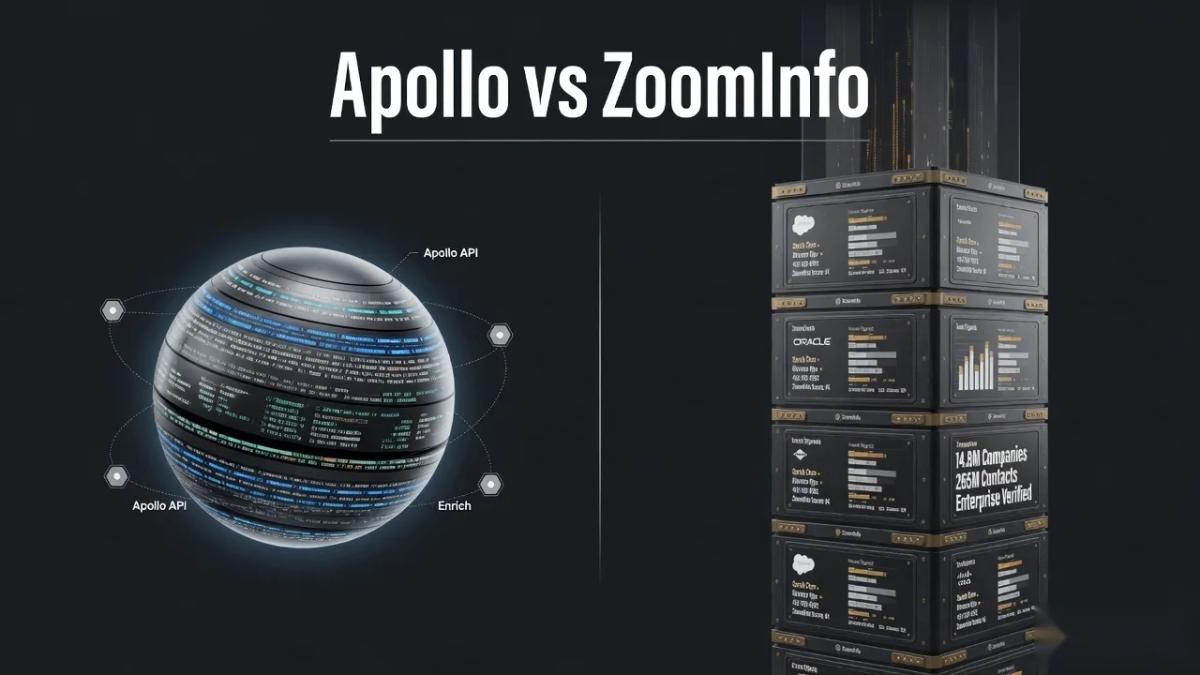
The operational difference hasn’t moved: Apollo treats data and engagement as one workflow. ZoomInfo treats data as the foundation and layers AI and engagement on top. The fit depends on whether you’re building a prospecting machine or a data-driven GTM engine.
What each platform is in 2026
Apollo.io
Apollo is a private company that last disclosed funding in August 2023 ($100M at a $1.6B valuation, per TechCrunch). It claims “millions of sellers at over 600,000 companies” and positions itself as an all-in-one sales intelligence and engagement platform: find prospects, enrich, sequence, call, and manage pipeline in one tool.
Core capabilities (as of August 2026):
- B2B database: Apollo claims the “largest global B2B database,” sourced from a network of 2 million contributors (connected inboxes, CRMs, CSV uploads), engagement signals, public web crawling, and vetted third-party providers processing 230M+ records monthly. It claims 98% email accuracy via a 7-step verification process, 72M emails verified monthly, 150M contacts refreshed monthly, and 5.3M new contacts added monthly. Apollo also claims less than 1% invalid direct phone numbers on requested numbers.
- Sequences: Multi-step email and phone sequences, A/B testing, task automation, email warm-up, and deliverability tooling. Included on all paid plans.
- Dialer: Click-to-call, parallel dialing, call recording on Professional and up; international dialing and local presence on Organization.
- AI Assistant: Free on Basic, Professional, and Organization plans (introductory offer); Free plans get 5 chats per month. It builds lists, generates sequences, enriches contacts, and runs research from natural-language prompts, grounded in your Context Center. Apollo reports that AI Assistant beta users were 36% more likely to book at least one meeting in their first 14 days and booked 2.3x more meetings in that window.
- Buying intent: Now a native, tiered feature (3 intent topics on Free, 6 on Basic, 9 on Professional, custom on Organization) — a meaningful 2025-2026 change.
- Chrome extension, workflow engine, lead scoring, conversation intelligence, deal management: all in-platform.
- Apollo MCP: connects Apollo data to external AI tools; API access on Custom plans.
What changed in 2026: The AI Assistant is workflow-native rather than a chatbot bolted on, and intent data was productized into plan tiers. Apollo’s 2026 event (Apollo Next) is its first flagship user conference. No new funding or IPO was announced as of August 2026.
ZoomInfo
ZoomInfo is the public incumbent (Nasdaq: GTM since May 2025, formerly ZI). Founded in 2007 as DiscoverOrg, it went public in 2020 and has been repositioning from data provider to “AI GTM platform” — Copilot is now the lead product, with GTM Studio, GTM Workspace, and MCP added since 2025.
Core capabilities (as of August 2026):
- B2B database: 600M+ professional profiles captured, 260M+ published; 1.3B+ company profiles analyzed, 100M+ published; 135M+ verified phone numbers; 1.5B+ data points processed daily. Outside North America: 200M+ professional profiles, 34M+ company profiles, 45M+ mobile numbers. ZoomInfo’s own FAQ says first-party data “can reach up to 95% accuracy.”
- Copilot: The AI sales agent product line — account prioritization, AI-generated account summaries, buying group identification, chat. Sales plans are now branded around it (Professional, Copilot Advanced, Copilot Enterprise).
- GTM Studio: Workflows triggered by buying signals (enrichment, segmentation, activation).
- GTM Workspace: An AI workspace for coordinating GTM strategy across teams.
- Buyer Intent: Real-time intent on Copilot Enterprise; Streaming Intent available as an add-on; marketing tiers include 25 to unlimited intent topics.
- Chorus: Conversation intelligence (acquired 2021, $575M).
- WebSights: Anonymous website visitor identification.
- Engage: Email cadences and dialer — competent but not the primary selling point; most teams pair ZoomInfo data with Outreach/Salesloft.
- ZoomInfo in ChatGPT, ZoomInfo MCP: data access for external AI tools.
- ZoomInfo Lite: free tier (formerly the “ZoomInfo Community”), available via self-serve signup.
The 2026 story is financial. ZoomInfo reported FY2025 revenue of $1.25B (up 2.9% year over year). On May 11, 2026 it reported Q1 results and cut its 2026 full-year revenue guidance to $1.185-1.205B, down from the $1.237-1.24B it had forecast for 2025 the prior November. The stock fell from $6.04 to $4.06 in a day, and CEO Henry Schuck announced layoffs of about 20% of the workforce with $45-60M in restructuring costs. A securities class action was filed June 26, 2026 alleging misleading statements between November 3, 2025 and May 11, 2026. None of this invalidates the data quality, but enterprise buyers doing vendor risk reviews should weigh it.
Verified pricing: Apollo publishes, ZoomInfo doesn’t
Apollo.io pricing (as of August 2026)
Apollo uses a credit system; prices are published on its pricing page and mirrored on G2:
| Plan | Price (per user/month) | Email credits | Mobile credits | Export credits |
|---|---|---|---|---|
| Free (Starter) | $0 | Unlimited | 5/month | 10/month |
| Basic | $49 | Unlimited | 75/month | 1,000/month |
| Professional | $79 | Unlimited | 100/month | 2,000/month |
| Organization | $119 (min 3 users) | Unlimited | 200/month | 4,000/month |
| Custom | Contact sales | API access, SSO/SCIM, dedicated support |
Credit mechanics (from Apollo’s own FAQ):
- Export credits are consumed when you push contacts outside Apollo (CSV, CRM sync, Person API enrichment).
- Trials include 50 credits and 5 mobile credits.
- On Unlimited plans, non-paying accounts are capped at 10,000 credits/month; paying accounts get the lesser of total paid / $0.025 or 1M credits per year, with add-ons purchasable.
- Sending email is free on every plan; only Gmail connections work on the free plan.
- Intent topics scale with plan: 3/6/9/custom.
Real cost modeling: a 10-person SDR team on Professional = $79 x 10 x 12 = $9,480/year before extras. Adding 50,000 export credits at $0.025 each is another $1,250. Roughly $10,700/year all-in for a full stack of data + sequencing + dialer + AI. That is still the single biggest structural advantage Apollo has over ZoomInfo.
ZoomInfo pricing (as of August 2026)
ZoomInfo’s pricing page still has no dollar figures — it requires a “Get Pricing” form. What the page does disclose:
- Sales tiers: Professional, Copilot Advanced, Copilot Enterprise (each a step up in intent depth, AI features, and support).
- Marketing tiers: Marketing Demand (75K included credits), ABM Lite (100 intent topics), ABM Enterprise (150K included credits, unlimited intent topics).
- Credits: every export of a contact or company profile costs one credit, whether from the platform, the Chrome extension, or an API call. Packages include a set number of monthly credits; you can buy more.
- Add-ons: Streaming Intent is priced on expected usage (keyword volume and account universe). Integrations have base costs plus minimum bulk credit purchases.
- Terms: annual contracts standard; annual, not monthly, pricing is the norm.
- Lite: free self-serve tier for individuals.
- The bottom line: ZoomInfo pricing is license count + credits + feature depth. No published per-seat prices, no published credit prices. Analyst and user estimates commonly put paid ZoomInfo plans in the tens of thousands of dollars per year, but in 2026 those are estimates, not vendor facts.
The gap is real and unchanged: Apollo’s entire Professional stack for a 10-person team costs less than most credible estimates of ZoomInfo’s entry paid plans. That is the reason Apollo’s growth has been so fast since 2022.
Data coverage and accuracy
This is the comparison that matters most, and vendor claims here are still the hardest to verify independently.
| Metric (2026 published claims) | Apollo.io | ZoomInfo |
|---|---|---|
| Published contacts/profiles | “Largest global B2B database” (no count) | 260M+ professional profiles (600M+ captured) |
| Published companies | Not stated | 100M+ (1.3B+ analyzed) |
| Verified phone numbers | <1% invalid on requested numbers (claim) | 135M+ |
| Monthly refresh | 150M contacts refreshed | 1.5B+ data points processed daily |
| New records monthly | 5.3M new contacts | Not disclosed |
| Data sources | 2M contributors + crawling + 230M records/mo from third parties | Web crawling, community contributors, third-party providers, 300+ human researchers |
| Accuracy claim | 98% email accuracy | “Up to 95%” for first-party data |
What to make of the numbers: ZoomInfo’s raw database is still larger, deeper on org charts and technographics, and stronger in North American mid-market and enterprise niches built up over 15+ years. Apollo’s data is sufficient for most outbound motions, and its pricing makes coverage mistakes cheap to fix. Neither vendor’s accuracy claims are independently audited; both recommend running a sample search against your own ICP, which is the right advice. User-reported bounce rates on cold lists still vary widely by vertical and region regardless of platform.
Coverage differences: ZoomInfo publishes explicit non-NA numbers (200M+ profiles, 34M+ companies outside North America) and is historically strongest in the US and Western Europe. Apollo positions itself as global-first. Both are thinner in niche verticals like government, healthcare, and specialized manufacturing — run your own counts before signing.
Engagement and sequencing capabilities
Apollo: full multi-channel sequencing (email, phone, tasks), A/B testing, warm-up and deliverability tools, parallel dialer, call recording, conversation intelligence, and deal management — all included in the seat price. The AI Assistant writes and executes sequences from prompts. This is the complete stack in one product.
ZoomInfo: Engage provides cadences and dialer, and Chorus handles conversation intelligence, but the typical deployment pairs ZoomInfo data with Outreach or Salesloft (or Apollo itself) for engagement. Copilot drafts outreach and account plays, and GTM Studio automates workflow triggers, but the sequencing muscle is not ZoomInfo’s primary value.
Edge: Apollo, clearly. If engagement is part of your stack, Apollo removes a tool; ZoomInfo usually requires you to keep one.
Feature deep-dive
| Capability | Apollo.io | ZoomInfo | Edge |
|---|---|---|---|
| Prospecting & list building | 65+ filters, Chrome extension, AI list building from prompts | 300+ attributes, org charts, technographics, WebSights visitor ID | ZoomInfo for depth; Apollo for speed |
| Intent data | Native, tiered (3/6/9/custom topics) | Mature: 25 to unlimited topics, streaming add-on, custom signals | ZoomInfo, significantly |
| AI | AI Assistant: executes lists/sequences/enrichment in-product, free on paid plans | Copilot: account prioritization, summaries, buying groups; chat grounded in data | Apollo for execution; ZoomInfo for account-level insight |
| Sequencing | Full multi-channel sequences, A/B, warm-up, parallel dialer, recording — included | Engage cadences + Chorus CI, but usually paired with a separate engagement tool | Apollo, clearly |
| Integrations | Salesforce, HubSpot, Outreach, SalesLoft, Marketo, API on Custom | Hundreds via marketplace, DaaS/API, Microsoft/Gemini/OpenAI connectors | ZoomInfo for breadth |
| Reporting | Sequence/call/pipeline analytics built in | Pipeline influence, intent-based reporting, advanced attribution | ZoomInfo for ops teams |
| Enterprise governance | SSO/SCIM on Custom, permission profiles on Org, ISO 27001, SOC 2 | ISO 27001 + 27701, SOC 2, TRUSTe, white-glove onboarding, DaaS | ZoomInfo |
What reviewers say (2026): Apollo carries a 4.7/5 rating on G2 from 9,246 reviews (9,015 per Apollo’s own site); ZoomInfo Sales sits at 4.5/5 on G2 with roughly 8,700-8,900 reviews, while ZoomInfo’s site cites 9,384 G2 reviews. On G2, Apollo reviewers consistently credit the breadth-per-dollar and the Chrome extension; the recurring complaints are the lack of phone support and credit math surprises. ZoomInfo reviewers typically praise data depth and intent while flagging price and contract lock-in. Both rating pools skew toward users with strong experiences either way.
Compliance and legal exposure
This section matters more in 2026 than it did in 2024, and the two vendors are not in the same position.
ZoomInfo’s litigation history is substantial:
- Paid $30M in 2024 to settle Ramos v. ZoomInfo (California, Illinois, Indiana, Nevada plaintiffs) over data collection practices; a September 2024 class action over use of personal information under the Washington Personality Rights Act followed (Bloomberg Law).
- An earlier securities class action (alleging inflated SMB-customer health disclosures in 2020-2024) survived dismissal in part on October 28, 2025, when Judge Tiffany M. Cartwright allowed key claims to proceed; investor firms also opened 2026 investigations.
- A new securities class action was filed June 26, 2026 (Tejada v. ZoomInfo Technologies Inc., W.D. Wash.), covering November 3, 2025 - May 11, 2026, tied to the guidance cut and stock drop (KOIN, July 2026).
- ZoomInfo is a registered data broker in California (DOJ registry) and offers opt-out via its privacy portal.
Apollo: no comparable active litigation found in research for this article. Its notable historical incident is a 2018 breach in which a contacts database was stolen (TechCrunch). It advertises GDPR compliance (as both processor and controller), ISO 27001, and SOC 2.
The legal climate around scraping and cold outreach tightened in 2025-2026:
- The scraping precedent remains hiQ v. LinkedIn: the Ninth Circuit twice held that scraping public data doesn’t violate the CFAA (2019, reaffirmed 2022), but hiQ ultimately settled after a court found it breached LinkedIn’s terms (November 2022). Public-data scraping is lawful in most circuits; scraping behind auth or against terms still carries risk.
- Platforms are suing scrapers directly: Google sued SerpApi in federal court in December 2025 over circumventing security measures to harvest and resell search content, following Reddit’s October 2024 suit against the same company.
- The FTC’s Telemarketing Sales Rule (16 CFR 310) remains the operational constraint on cold calling: required disclosures, Do-Not-Call compliance, and calling-time limits. The FTC’s March 2024 TSR amendments added protections against telemarketing fraud and affirmed protections against AI-enabled scam calls; the National Do Not Call Registry fees rose again in 2025. No new TSR final rule had been published as of August 2026.
Practical takeaway for buyers: cold email is largely unregulated at the federal level in the US (CAN-SPAM requires opt-outs), cold calls are regulated (TSR), and B2B contact data itself is under steady legal attack. ZoomInfo carries more demonstrated legal risk to date; Apollo carries the older breach history. Both offer opt-out mechanisms (Apollo: “Don’t Sell My Info” removal; ZoomInfo: verify/remove portal). GDPR and CCPA diligence on the data you export — not just the vendor’s certifications — remains your responsibility.
Enterprise fit: admin, governance, security
ZoomInfo is the enterprise product: ISO 27001, ISO 27701, SOC 2, TRUSTe GDPR validation, dedicated customer success managers on higher tiers, white-glove onboarding, custom integrations, DaaS/API data delivery, and a marketplace of integrations. If your org needs procurement-grade security documentation and data piped into a complex stack, ZoomInfo is built for that.
Apollo covers the basics well — ISO 27001, SOC 2, GDPR compliance, SSO/SCIM on Custom plans, permission profiles on Organization — and counts large customers including Fortune 500s. But its governance story (role-based permissions, audit controls, custom data agreements) is thinner than ZoomInfo’s and lives mostly on the Organization/Custom tier.
Edge: ZoomInfo for scale and formal governance; Apollo for teams that need to move without an IT project.
Best for specific scenarios
Choose Apollo.io when:
- You’re a startup or mid-market team (1-50 reps). The cost gap versus ZoomInfo is verified, not vibes: roughly $10,700/year for a 10-person full stack.
- You want one platform for data + engagement. Sequences, dialer, and AI are in the seat price.
- You want transparent pricing. No sales call required to learn what you’ll pay.
- You need a working AI assistant now. Apollo’s executes in-product and is free on paid plans.
- Your ICP is global or SMB/mid-market at high volume. Apollo’s data is sufficient at a fraction of the cost.
- Vendor stability matters. Apollo is private with no disclosed distress; ZoomInfo’s 2026 guidance cut and litigation are visible risks.
Choose ZoomInfo when:
- You’re an enterprise (50+ reps) with complex GTM needs. Depth of company/contact data, org charts, and technographics justify the price.
- Buyer intent is core to your strategy. ZoomInfo’s intent (25 to unlimited topics, streaming add-on) is more mature than Apollo’s 3-9 topic tiers.
- You’re running ABM at scale. GTM Studio, WebSights, ad audiences, and intent form a full ABM platform.
- You need procurement-grade security and data contracts. ISO 27701, SOC 2, DaaS, and custom agreements.
- Your ICP is US mid-market to enterprise. That’s where the deepest coverage lives.
- You can absorb vendor risk. Model what happens if the platform’s commercial trajectory keeps deteriorating.
Consider both when:
- You’re growing past 20 reps. Start with Apollo; re-evaluate ZoomInfo as GTM complexity grows.
- You have budget for two tools. ZoomInfo for data/intent plus Apollo (or Outreach) for engagement is a common 2026 architecture.
How to evaluate before you buy
Both vendors will sell you on their own benchmarks. Run the same five tests on each platform before deciding:
- Coverage audit. Run 5-10 sample searches for your exact ICP (title, industry, geography, company size) and compare match counts and freshness. Both vendors tell you to do this; few buyers actually do.
- Deliverability test. Export 500-1,000 contacts from each platform and send a test sequence. Measure bounce rates yourself rather than trusting the 98% vs “up to 95%” claims, which measure different things.
- Credit modeling. For Apollo, project export and mobile credit burn against your actual outbound volume for 12 months, including CRM syncs and enrichment. For ZoomInfo, get the contract’s license and credit terms in writing before negotiation starts.
- Compliance review. Have counsel check the vendor’s opt-out mechanisms, your export-to-CRM data flows, and TSR requirements (Do-Not-Call scrubbing for phone work) before you push any list through a dialer.
- Reference calls. Ask each vendor for a reference in your segment — not their biggest logo. Apollo references are cheap to get; ZoomInfo’s should include a negotiation-story customer so you understand the real price trajectory after year one.
Limitations of this comparison
- Pricing accuracy. Apollo’s figures are published on its site and G2; ZoomInfo’s are not published — the paid-plan numbers in this article are structural facts (licenses + credits + tiers), not dollars, because no verified public price list exists. Get quotes from both.
- Data claims are vendor-reported. Neither Apollo’s 98% nor ZoomInfo’s “up to 95%” accuracy claims are independently audited. Run your own verification against your ICP.
- Product changes are fast. AI features, credit systems, and tiers changed materially between 2025 and 2026; verify again before you buy.
- Financial facts are as of August 2026. ZoomInfo’s guidance cut, layoffs, and litigation status are reported facts, not predictions; Apollo has no public financial disclosures.
- This is not a sponsored comparison. Neither vendor paid for or reviewed this content. We have no affiliate relationship with either platform.
Methodology and disclosure
Researched in August 2026 from vendor websites (apollo.io, zoominfo.com, including archived captures), G2 pricing/review pages, SEC-filed figures via stockanalysis.com, Wikipedia’s litigation citations, KOIN’s reporting on the June 2026 class action, TechCrunch’s Apollo funding coverage, the FTC’s TSR page, and the Times of India’s report on Google v. SerpApi. Where sources disagree or figures could not be verified, this article says so rather than guessing.
No sponsorship, affiliate links, or paid placement is involved.
Sources
- Apollo.io Pricing — https://www.apollo.io/pricing
- Apollo.io Data Network — https://www.apollo.io/product/b2b-data
- Apollo.io AI Assistant — https://www.apollo.io/ai/assistant
- Apollo.io Pricing on G2 (archived, Nov 2025) — https://www.g2.com/products/apollo-io/pricing
- Apollo.io pricing FAQ via Wayback Machine (Aug 2026) — https://web.archive.org/web/20260804171803/https://www.apollo.io/pricing/
- TechCrunch: Apollo.io raises $100M at $1.6B valuation — https://techcrunch.com/2023/08/29/apollo-io-a-full-stack-sales-tech-platform-bags-100m-at-a-1-6b-valuation/
- TechCrunch: Apollo 2018 data breach — https://techcrunch.com/2018/10/01/apollo-contacts-data-breach/
- ZoomInfo Pricing (archived, Aug 2026) — https://web.archive.org/web/20260811214131/https://www.zoominfo.com/pricing
- ZoomInfo Our Data (archived, Mar 2026) — https://web.archive.org/web/20260311140645/https://www.zoominfo.com/data
- ZoomInfo Lite signup — https://signup.zoominfo.com
- ZoomInfo on Wikipedia — https://en.wikipedia.org/wiki/ZoomInfo
- ZoomInfo financials — https://stockanalysis.com/stocks/gtm/financials/
- KOIN: ZoomInfo faces class action suit from investors (July 7, 2026) — https://www.koin.com/news/washington/the-truth-emerges-vancouver-based-zoominfo-faces-class-action-suit-from-investors/
- hiQ Labs v. LinkedIn on Wikipedia — https://en.wikipedia.org/wiki/HiQ_Labs_v._LinkedIn
- FTC Telemarketing Sales Rule — https://www.ftc.gov/legal-library/browse/rules/telemarketing-sales-rule
- Times of India: Google sues SerpApi (Dec 2025) — https://timesofindia.indiatimes.com/technology/tech-news/google-sues-data-scraping-company-serpapi-for-stealing-web-content-texas-based-tech-firm-responds/articleshow/126092684.cms