

Quick verdict
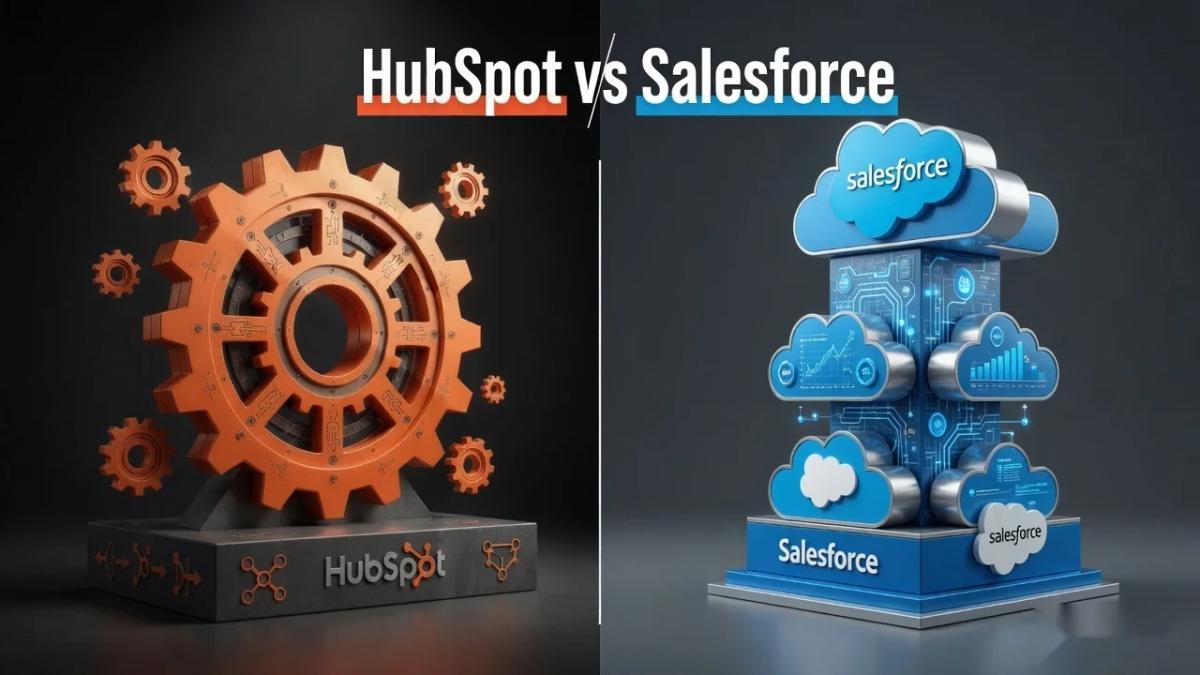
If you’re a B2B demand team with a marketing-led growth motion and no dedicated CRM admin, HubSpot is still the faster path to value — and in 2026 the pricing argument got simpler, because HubSpot killed the old $1,500/month platform fee and now sells Sales Hub straight per seat. A 10-seat Professional deployment lists at $100/seat plus a one-time $1,500 onboarding fee: roughly $13,500 in year one. No platform fee, no contact-count surprises on the sales side.
If you’re an enterprise sales org with 50+ reps, multi-stage deal cycles, territory management, or CPQ requirements, Salesforce Sales Cloud remains the deeper platform. It can model almost any process, and in 2026 it’s an agentic platform first: Agentforce is bundled into Enterprise ($175/seat) and has crossed $1.2 billion in ARR — but you pay for what agents actually do on top of your seats, and you still need a certified admin (or a very good consultant) to run the thing.
The real question hasn’t changed: which one can your team actually operate and afford to run — including the AI?
What each platform is in 2026
HubSpot: the agentic all-in-one
HubSpot is now formally an “agentic customer platform,” and its numbers support the claim: 306,446 customers as of June 30, 2026 (up 14% year over year) and $911.7 million in Q2 2026 revenue, up 20% (Q2 2026 results, reported August 5, 2026).
The architecture is a family of hubs — Marketing, Sales, Service, Content, Data, Revenue — sitting on one Smart CRM database, plus Agent Hub, the AEO (answer engine optimization) beta, and a Small Business Bundle. Every hub reads and writes the same contact, company, and deal records. No middleware, no sync delays.
The 2026 story is Agent Hub (formerly Breeze Agents): a library of ready-made agents included with Professional and Enterprise subscriptions, with usage metered through HubSpot Credits. Published per-work rates: Customer Agent at $0.50 per resolution, Prospecting Agent at $1.00 per lead, Data Agent at $0.10 per answer. Custom agents built in Agent Builder consume credits too, at $0.010 per credit; credits reset monthly and don’t roll over. That’s a fundamentally different AI pricing philosophy from Salesforce: you pay for outcomes, not for seats of AI.
Sales Hub itself covers deal pipelines, sequences, meeting scheduling, forecasting, conversation intelligence (Enterprise), AI-guided selling, smart deal progression (beta), and CPQ/payments via Revenue Hub ($95–$140/seat). The free tier remains genuinely useful: contacts, one deal pipeline, live chat, meeting scheduling, and forms — it doesn’t expire.
What demand teams actually use day to day:
- Marketing Hub for campaigns, email automation, landing pages, forms, and multi-touch attribution — same database as sales, no syncing
- Sales Hub for pipelines, sequences, meeting scheduling, playbooks, and forecasting
- Agent Hub for the prospecting agent (research + outreach), data agent (record enrichment and answers), and custom agents
- Revenue Hub for CPQ, e-signatures, and payments when the deal closes inside the platform
- AEO (beta) to see whether your brand surfaces in ChatGPT, Gemini, and Perplexity answers — an increasingly direct demand-gen lever in 2026
The catch with the bundled-credit model: the customer and prospecting agents are included only with Professional and Enterprise, and heavy use burns credits fast. A prospecting agent that drafts outreach for 500 leads a month is $500 on top of your seats at the published $1.00/lead rate. Budget the credit line explicitly.
One caveat from the market: HubSpot’s Q2 print triggered a sharp stock drop. News coverage in the days after August 5 cited a reduced customer-growth forecast and scrutiny of the company’s 2026 pricing and packaging changes; Morgan Stanley analysts pointed to “changes in pricing” as a growth headwind. The pricing changes are real — Starter now lists at $20/seat with a limited-time $10 promo for new customers — and buyers should expect more packaging churn, not less.
Salesforce: the enterprise agentic operating system
Salesforce’s Q1 FY27 (ended April 30, 2026) was a record: $11.1 billion revenue, up 13%, with cRPO of $33.6 billion, up 14%. The AI story is the headline: Agentforce ARR hit $1.2 billion, up 205% year over year, combined AI + data ARR is roughly $3.4 billion, and the company says 3.8 billion “Agentic Work Units” have been delivered to date. The Agentforce page claims 18,000+ companies run on it, from OpenTable to Heathrow to Honda (which adopted it for sales operations in Japan in June 2026). Salesforce also acquired the AI assistant company Fin in June 2026.
Sales Cloud in 2026 is best understood as: classic CRM depth (custom objects, flows, Apex, territories, forecasting) plus Agentforce — the agent platform with SDR agents that qualify leads and book meetings around the clock, Sales Coach for role-play, Service agents, Agentforce Voice, multi-agent orchestration, and MCP support for external tools. Agents run on the Atlas Reasoning Engine and draw on Data 360 (the renamed data cloud). Gartner named Salesforce a Leader in the 2026 Magic Quadrant for Conversational AI Platforms (a claim Salesforce prominently cites).
Agentforce is bundled into the Enterprise edition, but real deployment means Data 360, flows, and typically a partner — the “digital labor force” framing from earnings is accurate, but it’s labor you have to build and supervise.
What demand teams actually use day to day:
- Lead and opportunity management with custom sales processes, validation rules, and approval chains
- Advanced forecasting with territory roll-ups, manager adjustments, and collaborative submissions
- Pipeline Inspection and Deal Insights for AI-flagged risks and next-best actions
- Campaign Influence for multi-touch attribution (3–5 campaigns per opportunity depending on edition)
- Sales Engagement for cadences and call logging, plus Einstein Conversation Intelligence at Enterprise+
- Agentforce SDR agents and Sales Coach when the data foundation is ready
The important nuance: Agentforce is not a switch you flip. Its SDR agent needs your sales process, knowledge base, and CRM hygiene in order; its reasoning stack runs on Data 360, which is a separate purchase at scale. In the Q1 FY27 report, more than half of Agentforce and Data 360 bookings came from existing customers — this is expansion revenue on an installed base, not a quick-start tool.
Verified pricing, August 2026
HubSpot Sales Hub
| Plan | Per seat/month | Billing | Onboarding |
|---|---|---|---|
| Free | $0 | — | — |
| Starter | $20 ($10 promo for new customers, limited time) | — | — |
| Professional | $100 | — | $1,500 one-time |
| Enterprise | $150 | Annually | $3,500 one-time |
Important correction to what’s widely written about HubSpot: the old $1,500/month platform fee on Professional and Enterprise no longer exists. Since March 2024, Sales Hub has been priced per seat with no seat minimums, and HubSpot’s current product catalog lists only the one-time onboarding fees above. Anyone budgeting HubSpot in 2026 should use this model, not the pre-2024 one.
Demand teams usually add Marketing Hub: Starter is $20/seat; Professional starts at $890/month with 3 seats included ($50 per extra seat, $3,000 onboarding); Enterprise starts at $3,600/month with 5 seats included ($75 per extra seat, $7,000 onboarding). Marketing Hub pricing still varies with your marketing contact count — that’s the cost line that grows as your database grows.
Salesforce Sales Cloud
| Plan | Per user/month | Billing | Notes |
|---|---|---|---|
| Free Suite | $0 | — | Basic lead/account/contact/opportunity management |
| Starter Suite | $25 | Monthly or annually | Sales Flows, lead routing, AI email sync |
| Pro Suite | $100 | Annually | Quoting, forecasting, AgentExchange access |
| Enterprise | $175 | Annually | Pipeline management, deal insights, conversation intelligence, Agentforce |
| Unlimited | $350 | Annually | Predictive AI, sales engagement, full sandbox, Premier Success Plan |
| Agentforce 1 Sales | $550 | Annually | Unmetered employee Agentforce, Spiff, Sales Planning, Tableau Next, Slack Enterprise+, 1M Flex + 2.5M Data Cloud credits/org/yr |
Agentforce consumption is priced separately for anything beyond what’s bundled: Flex Credits at $500 per 100,000 credits (each agent “action” costs 20 credits; voice actions cost 30), or Conversations at $2 per conversation (you can’t mix both in one org). Employee-facing agents run $125/user/month on the add-on; a barebones Agentforce User License is $5/user/month but still requires Flex Credits. Salesforce Foundations gives you the agent builder free to experiment. For a sense of scale: Salesforce’s own example puts a 100-user service team at roughly $1,800/month in Flex Credits if every user runs three case-management actions a day.
Seat math at 10 / 50 / 200 seats (list prices, billed annually)
| Scenario | HubSpot Sales Hub Professional | Salesforce Pro Suite | Salesforce Enterprise |
|---|---|---|---|
| 10 seats, year 1 | $12,000 + $1,500 onboarding = $13,500 | $12,000 | $21,000 |
| 50 seats, year 1 | $60,000 + $1,500 onboarding = $61,500 | $60,000 | $105,000 |
| 200 seats, year 1 | $240,000 + $1,500 onboarding = $241,500 | $240,000 | $420,000 |
At 200 seats, HubSpot Enterprise ($150/seat, billed annually) lists at $360,000 plus $3,500 onboarding — still below Salesforce Enterprise, and Salesforce’s Unlimited and Agentforce 1 Sales tiers ($350/$550 per user) are in a different price league entirely. Note these are list prices: HubSpot runs promos, Salesforce discounts on committed multi-year deals, and neither vendor publishes enterprise contract math. Get quotes.
Pricing gotchas on both sides
- HubSpot credit meters. The published per-work rates ($1.00/lead, $0.50/resolution, $0.10/answer) add up on top of seats. Credits reset monthly and don’t roll over; overages bill at $0.010/credit on pay-as-you-go. Monitor the Agent Hub dashboard before your first renewal.
- HubSpot marketing contacts. Sales Hub is seat-priced, but bundling Marketing Hub means paying per marketing contact as your database grows. Model the contact curve, not just the seat count.
- HubSpot annual terms. Enterprise is billed annually; Pro onboarding is a one-time $1,500 fee (Enterprise $3,500). Promos like the $10 Starter rate are new-customer-only and limited-time.
- Salesforce add-ons. Data 360, the Premier Success Plan, Tableau Next, and Slack Enterprise+ are separate purchases, or come only with the $550 Agentforce 1 Sales tier (which bundles Slack Enterprise+ and Tableau Next). Quote them explicitly — they’re rarely in the headline number.
- Salesforce agent consumption. Enterprise seats include Agentforce, but agent actions consume Flex Credits ($500 per 100k; 20 credits per action) or $2 per conversation — and you must pick one billing model per org. Usage is tracked in Digital Wallet; budget a run-rate review quarterly.
- Both vendors’ AI pricing is young. Neither rate card is more than a year or two old, and both have changed materially already. Re-verify before signing.
Capability deep-dive
| Capability | HubSpot Sales Hub | Salesforce Sales Cloud |
|---|---|---|
| Data model | One shared database across hubs; custom objects at Enterprise (20 object definitions, 1.5M records) | Metadata-driven multi-tenant platform; unlimited custom objects, fields, relationships |
| Customization | Configuration only (properties, workflows, pipelines, permissions) | Configuration + Apex code, Lightning Web Components, custom apps |
| Automation | Workflows, sequences, meeting scheduling, AI-guided selling | Flows, Apex, Process Builder lineage, MuleSoft connectors |
| Reporting | Custom reports, attribution, AI forecasting at Professional+ | Cross-object reports, summary formulas, territories, Tableau Next (Agentforce 1 Sales) |
| AI agents | Agent Hub: customer/prospecting/data agents + custom builder; per-work credits | Agentforce: SDR, Sales Coach, Service, Voice; Flex Credits or $2/conversation |
| Integrations | HubSpot Marketplace, 2,000+ apps | AppExchange (largest CRM ecosystem) + AgentExchange + MCP |
| Marketing | Native Marketing Hub on the same database | Marketing Cloud as a separate license; Campaign Influence (3–5 campaigns/opportunity) |
| Free tier | Genuinely usable CRM (contacts, pipeline, chat, meetings) | Free Suite with basic lead/account/contact/opportunity management |
Data model
HubSpot runs on a single shared database. Every hub writes to the same contact, company, and deal records, which is precisely what marketing-led teams want: one source of truth with zero integration seams. Custom objects exist but are an Enterprise-tier capability, with limits of 20 object definitions and 1.5 million custom object records per the product catalog. That’s fine for subscriptions, implementations, and product lines; it will cramp genuinely exotic data models.
Salesforce is a metadata-driven multi-tenant platform. Custom objects, custom fields, validation rules, and relationships are first-class citizens from Enterprise up, and Apex/Lightning Web Components let you build applications that barely look like a CRM. The power is real; the cost is that every org’s data model is bespoke, and everything downstream — reports, flows, integrations — inherits that bespoke-ness.
Bottom line: HubSpot gives you a standard data model that works out of the box. Salesforce gives you a data model you design, for better and worse.
Customization and automation
HubSpot customization is configuration, not code: properties, pipelines, workflows, sequences, permissions, and role-based views. The HubSpot Marketplace has 2,000+ integrations for the long tail. You can’t write code against the core, and you don’t need to.
Salesforce automation runs the gamut from declarative Flows to Apex triggers to MuleSoft API connectors — and Agentforce agents are built on exactly those primitives (Agent Builder, Prompt Builder, flows, Apex, MCP servers). Every customization is technical debt that needs a governance process; the AppExchange ecosystem is the largest in CRM.
Bottom line: HubSpot is “enough for 90% of teams” and stays maintainable. Salesforce is “build whatever you need” with a matching support burden.
Reporting and forecasting
HubSpot reporting is visual and self-service, with custom report builder and attribution at Professional+. Forecasting is AI-assisted at Professional+. It’s not the deepest analytics in the market, but a marketing ops person can own it.
Salesforce reporting is deeper — cross-object joins, summary formulas, historical trending, row-level sharing — and forecasting with territories and collaborative roll-ups is genuinely superior for complex sales orgs. Tableau Next only comes with Agentforce 1 Sales (or as a separate Tableau+ purchase). The learning curve is real: useful reports require understanding your data model first.
Bottom line: HubSpot reports are fast to build; Salesforce reports are powerful once someone with platform knowledge builds them.
AI agents (the 2026 difference)
HubSpot (Agent Hub): bundled with Professional and Enterprise; pay per work delivered. Published rates: Customer Agent $0.50/resolution, Prospecting Agent $1.00/lead, Data Agent $0.10/answer, custom agents at $0.010/credit. HubSpot’s own reported outcomes (marketing claims, not independent): 65% more sales leads created per month and a 26% higher deal win rate with the prospecting agent; 77% more tickets closed and 39% faster resolution with the customer agent. Agents act on live CRM data, and there’s an AEO beta for showing up in AI answers — a genuinely demand-gen-native feature that Salesforce doesn’t have an equivalent for.
Salesforce (Agentforce): enterprise-grade agent platform with 18,000+ customers, SDR/Sales Coach/Service agents, Voice, multi-agent orchestration, observability, and MCP support. Included with Enterprise seats but metered on top: Flex Credits at $500/100k (20 credits per action) or $2/conversation. Agentforce 1 Sales ($550/seat) is the “unmetered for employees” answer, plus 1M Flex Credits per year. The maturity and ecosystem are ahead; the setup, data foundation (Data 360), and budget discipline required are also ahead.
Bottom line: HubSpot AI is easier to switch on and priced per outcome. Salesforce AI is more powerful and more expensive to operate — you need data plumbing and governance before agents can run.
Marketing integration
HubSpot is the only one of the two where marketing and sales share a native database, automation engine, and attribution. A demand team can run the whole funnel in one platform. Salesforce splits marketing into Marketing Cloud (a separate license and UI), with Campaign Influence in Sales Cloud attributing 3–5 campaigns per opportunity depending on edition. Most Salesforce shops run a separate marketing automation stack.
Implementation and time to value
HubSpot publishes its onboarding economics and positions setup in days or weeks, not months — its own FAQ says teams get up and running in “days or weeks,” and the platform is designed for a marketing ops generalist to own. Professional onboarding is a one-time $1,500 fee; Enterprise is $3,500. Data migration is the main project risk.
Salesforce implementation is a project with a capital P: data migration, permission model, flows, integration, training — typically measured in months for Enterprise, and agent deployments add their own phase (data hygiene, action design, testing, guardrails). The Salesforce admin skill set is a recognized specialty, and orgs without a certified admin tend to accumulate half-configured flows and unreliable data. Plan for a dedicated admin or a retained partner from day one.
Total cost of ownership
| 50-seat scenario, year 1 | HubSpot (Sales Hub Pro + Marketing Hub) | Salesforce Enterprise |
|---|---|---|
| Subscription (list) | $60,000 (Sales Hub) + $18,000 (Marketing Hub Pro base w/ seats) = $78,000 | $105,000 |
| Onboarding / implementation | $1,500 (published) + partner work if needed | Quote-based; typically a five- to six-figure project |
| AI | Credits included in Pro/Ent; add $0.010/credit for overage | Flex Credits / add-ons / Data 360 on top |
| Ongoing operation | Part-time ops generalist | Dedicated admin or managed service |
The structural gap is the admin line. HubSpot is designed to be operated by the marketing ops person who already owns campaigns. Salesforce almost always requires someone whose full-time job is the CRM — which, over a three-year horizon, usually costs more than the licenses. Model that line before you model the seat count.
Admin, talent, and ongoing ops
HubSpot administration is a part-time role. Adding a property, editing a workflow, or building a report doesn’t require platform training. HubSpot Academy certifications are free, and the consultant ecosystem is broad and comparatively inexpensive — but rates vary widely, so price that work by proposal rather than by any single quoted figure. The risk profile is the mirror image of Salesforce: the platform is easy to run, so governance discipline tends to be the failure mode.
Salesforce administration is a specialty. Profiles and permission sets, Flow debugging, sandbox refreshes, release management (three major releases a year), and data quality are a full-time job at any serious scale. The Certified Administrator credential is one of the most recognized in enterprise software, and the consulting ecosystem is deep but variable in quality — vet partners on references, not logos. The governance failure mode here is customization sprawl: orgs accumulate Apex, flows, and validation rules until change costs real money.
Neither vendor’s AI changes this asymmetry. HubSpot agents run on your existing CRM data with no code. Agentforce agents are built with flows, prompts, and data foundations that require the admin capability Salesforce already demands — the AI layer inherits the platform’s operations burden.
Common pitfalls
HubSpot pitfalls
- Treating the credit meter as free. The agents are included; the work they do is not. 1,000 leads a month of prospecting-agent outreach is $1,000 at list rates.
- Ignoring Marketing Hub contact pricing. The sales side is seat-based; the marketing side still scales with contacts. A database that doubles can meaningfully move your bill.
- Custom object ceiling. Twenty object definitions and 1.5M custom-object records is generous for most B2B teams and genuinely limiting for platform-style businesses.
- Promo-price whiplash. New-customer promos (like the current $10 Starter) create renewal sticker shock when the list price reasserts itself. Confirm what the renewal rate actually is before signing.
- Outgrowing the platform. If you need Apex-level logic, true territory hierarchies, or CPQ with hundreds of SKUs, you’ll hit the ceiling — and migrating out of any CRM is expensive.
Salesforce pitfalls
- Underestimating the project. The $175/seat Enterprise license is the floor. Implementation, Data 360, agent design, and admin time routinely double or triple the real cost.
- Buying the headline AI before the data. Agentforce is only as good as your data hygiene, and half-configured agents quietly burn Flex Credits while producing nothing useful. Start with one narrow agent and measure.
- Skipping the admin. Without dedicated ownership, Salesforce becomes half-configured flows, inconsistent picklists, and frustrated reps. Budget for the role from day one.
- Customization sprawl. Every Apex class and flow is technical debt. Without governance, the platform gets slower to change and more expensive to maintain each year.
- Edition gymnastics. Conversation Intelligence, predictive scoring, and full Agentforce capabilities live at Enterprise+; a Pro Suite purchase looks cheap until you discover the gating.
Best for specific scenarios
Choose HubSpot when:
- Marketing leads the revenue motion and sales follows up on marketing-sourced pipeline.
- You’re a team of roughly 5–200 and want one database across marketing, sales, and service.
- You need to be live in weeks and can’t justify a dedicated CRM admin.
- You want agents you can switch on without a data-engineering project, priced per outcome.
- Predictable per-seat pricing (no platform fee, no sales-side contact surcharges) matters to your CFO.
- You care about showing up in AI answers (AEO) as part of demand generation.
Choose Salesforce when:
- You have complex multi-stage sales processes, territories, deal desk approvals, or CPQ requirements.
- You need custom objects, validation rules, Apex, and a data model shaped to your exact business.
- You’re an enterprise with 50+ reps and the scale that implies for forecasting and reporting.
- Agentic AI is strategic: you have (or will hire) the flow-builders, data hygiene, and governance to run Agentforce properly.
- You already employ Salesforce-certified talent or a consulting relationship that lowers the incremental cost.
- You need the AppExchange ecosystem — whatever you need, someone has built it.
The 2026 buying decision, in brief
Both vendors have pivoted to the same agentic narrative, but they are selling different operating models. HubSpot is selling an agentic CRM your existing marketing ops person can run, with AI priced per outcome and packaging simplified to per-seat rates. Salesforce is selling an agentic enterprise platform — more powerful, more configurable, and metered for AI in ways that demand data discipline and a dedicated operator.
The financial signals in 2026 reinforce the strategic split. Salesforce is monetizing AI aggressively: Agentforce passed $1.2 billion in ARR and is growing faster than the core. HubSpot is absorbing the friction of repackaging: its Q2 print showed strong revenue growth (20%) but triggered guidance and pricing scrutiny from the street. Neither trajectory tells you which platform fits your team — but both tell you that AI cost lines and packaging changes are now a permanent part of CRM budgeting.
If you’re still deciding: run a scoped proof on both. Thirty days with HubSpot’s free tier or Salesforce Foundations (which includes the Agentforce builder at $0) is cheaper than any migration you’ll regret later.
Limitations of this comparison
Pricing is list pricing verified against vendor pages and HubSpot’s official product catalog as of August 12, 2026. Enterprise deals, volume discounts, and promos (HubSpot’s current $10 Starter offer, for example) change the math; always get a written quote.
Two data classes were deliberately excluded. G2 and TrustRadius page-level review counts and ratings could not be verified in this pass (both sites blocked automated access), so no review-volume or star figures are cited — the G2 badges each vendor displays on its own pages are vendor-claimed and not treated as independent evidence. Similarly, IDC/Gartner CRM market-share percentages for 2026 were not independently verified, so the article uses audited company figures (revenue, customer counts, ARR) as scale proxies instead.
Vendor-reported agent performance statistics (HubSpot’s 65% more leads and 77% more tickets closed; Salesforce’s 18,000+ Agentforce customers) are marketing claims from the vendors’ own pages, reproduced as such.
This comparison focuses on Sales Cloud and Sales Hub. Marketing Cloud, Service Cloud, Data Hub, and the rest of both portfolios introduce additional pricing dimensions not covered here. Both vendors ship major updates multiple times a year; verify current limits during your evaluation.
Method and disclosure
All pricing, seat math, agent rates, and financial figures in this piece were verified against the vendor pages and filings listed below on August 12, 2026 — including HubSpot’s official product and services catalog, which is the authoritative source for the current per-seat pricing and onboarding fees. Where vendor-reported statistics are used (HubSpot’s agent outcome claims, Salesforce’s 18,000+ Agentforce customers), they are labeled as the vendors’ own claims. Where a figure could not be verified — G2 and TrustRadius review counts, IDC/Gartner market-share percentages, “Agentforce 3” version naming, and common consultant rate-card figures — it was omitted or explicitly qualified rather than reproduced. This is an independent editorial comparison; no vendor reviewed or approved this content.
Sources
- Salesforce Sales Cloud pricing — edition tiers and feature gating, verified August 2026.
- Salesforce Agentforce pricing — Flex Credits ($500/100k), Conversations ($2), add-ons, buying models, usage examples.
- Salesforce Agentforce product page — agent types, Atlas Reasoning Engine, 18K+ customers, Gartner MQ claim.
- Salesforce Q1 FY27 earnings release (May 27, 2026) — revenue, Agentforce ARR, AWU counts, guidance.
- Salesforce press release archive — 2026 items: VA/Missionforce contract, Fin acquisition, FIFA World Cup 2026, Honda Agentforce, U.S. Army HRC.
- HubSpot Sales software product page — Sales Hub tiers, Starter promo pricing, agent features, Marketplace count.
- HubSpot Agent Hub — agent catalog, per-work pricing, HubSpot Credits, vendor-reported outcomes.
- HubSpot Product & Services Catalog — per-seat pricing, onboarding fees, seat types, credits rate sheet, technical limits.
- HubSpot Q2 2026 results (August 5, 2026) — revenue, customers, guidance, pricing-change commentary.
- HubSpot investor relations overview — customer count, TTM revenue, Q2 2026 event listing.
- HubSpot pricing page — tier anchors used for cross-checking.
- Yahoo Finance — HubSpot growth reacceleration note (August 2026) — analyst coverage of the Q2 2026 report and pricing changes.
- Bing News search — HubSpot pricing 2026 coverage — surfaced the Seeking Alpha and Motley Fool headlines on the August 2026 guidance change used for context.