

Quick verdict
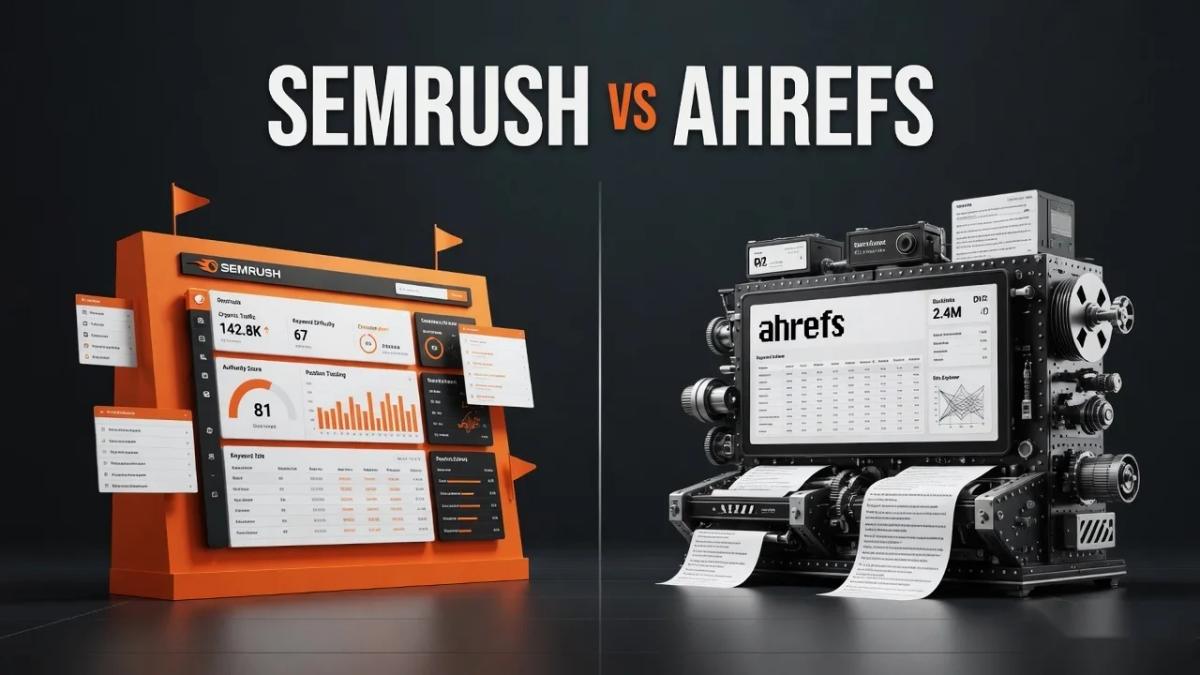
Pick Semrush if you want one platform for SEO, AI visibility, paid ads, social, local, and reporting. Since Adobe completed its $1.9 billion acquisition on April 28, 2026, Semrush has been repositioned as the brand-visibility layer of Adobe’s CX stack — and the integrations with Adobe Experience Manager, Commerce, and Experience Platform are the real 2026 story for enterprise buyers.
Pick Ahrefs if you care most about backlink data depth, keyword research rigor, and technical SEO auditing. The crawler infrastructure is unmatched in the category (674K CPU cores, 3 PB RAM, 502 PB SSD, and the Yep1 supercomputer), the backlink index updates every 15–30 minutes, and 2026 added real-time monitoring (Firehose) and an agent workspace (Letaido) on top of the core suite.
Pick both if your budget allows. The overlap is real, but the workflows aren’t: teams that run both typically use Semrush for reporting and AI sentiment, Ahrefs for link research and content discovery.
Everything below was verified against vendor pages and primary sources in August 2026. Figures are labeled where they are vendor-reported rather than independently tested.
What each tool does in 2026
Semrush: now an Adobe company
Semrush reorganized its line-up in 2026. The old Pro/Guru/Business tiers are gone; the current plans are SEO, Starter, Pro+, and Advanced, sold as “SEO + AI Search” plans. The flagship packaging is Semrush One, which merges the SEO toolkit and AI Visibility toolkit into one plan with prompt-level AI tracking, and Semrush MCP ships on Starter and above so you can query Semrush data from ChatGPT or Claude.
The Adobe deal matters more than any feature release:
- November 19, 2025 — Adobe announced the $1.9 billion acquisition (TechCrunch, The Verge).
- April 28, 2026 — the deal closed. Adobe’s press release says AI traffic to U.S. retail sites grew 269% year over year as of March 2026, and frames Semrush as its SEO/GEO/agentic-search offering inside Adobe CX Enterprise.
- June 17, 2026 — Adobe Brand Visibility launched, combining Semrush AI-visibility intelligence with Adobe’s agentic content optimization across AEM, Adobe Commerce, Experience Platform, and Brand Concierge.
- July 7, 2026 — Semrush, “an Adobe Company,” was named a Representative Vendor in the Gartner Market Guide for Answer Engine Visibility Tools (vendor announcement).
- The site now footers as ”© 2026 Semrush Holdings” with links to business.adobe.com, and Semrush no longer trades as a public company.
Platform coverage beyond SEO: ad research and PPC tools, content marketing (SEO Writing Assistant, topic research, content audit), social media management, local SEO, digital PR with an AI PR Toolkit, media monitoring, and AI-Cited Media (which shows which outlets LLMs cite for a topic). In June 2026, Semrush also shipped Traffic Insights, AI-powered explanations of competitor traffic swings.
Ahrefs: infrastructure first, products on top
Ahrefs stayed independent and kept building on its own crawler — the pricing page describes it as “the world’s second-most active crawler.” The core suite (Site Explorer, Keywords Explorer, Site Audit, Rank Tracker, Content Explorer, Web Analytics, GSC Insights) is unchanged in shape, with four notable 2026 additions:
- Bot Analytics (new): shows which good and bad bots are crawling your site.
- GBP Monitor (new, beta): Google Business Profile management at scale.
- Firehose (firehose.com, free to start): real-time brand-mention and competitor-change monitoring powered by the Ahrefs crawler, with an API and an AI-agent skill.
- Letaido (letaido.com, $99/mo): an agent-powered marketing workspace built by the Ahrefs team — reports, apps, and automations on an always-on server with a native Ahrefs integration at no extra API cost. Dmytro Gerasymenko, Ahrefs’ founder and CEO, says Ahrefs runs its own workflows on it.
Social Media Manager remains free while in beta. Brand Radar and AI Content Helper are separate purchases (pricing below).
Platform breadth at a glance
| Capability | Semrush | Ahrefs |
|---|---|---|
| Keyword research | Yes (28B+ keywords, 142 geo databases) | Yes (28.7B keywords, 217 locations) |
| Backlink analysis | Yes (43T+ backlinks, daily updates) | Yes (35T, updates every 15–30 min) |
| Site audit | Yes (included; AI crawler checks) | Yes (credit-based; boosts for always-on) |
| Rank tracking | Yes | Yes |
| AI visibility | Yes (AI Visibility + sentiment, in plan) | Yes (Brand Radar — plan limits or standalone) |
| Content AI tools | Bundled (writing assistant, topic research) | Add-on (AI Content Helper, Content Kit) |
| First-party web analytics | No (integrations with GA4/Search Console) | Yes (Web Analytics) |
| Social media management | Yes (social toolkit) | Yes (Social Media Manager, free in beta) |
| Local SEO | Yes (listings, review tracking) | Yes (GBP Monitor, beta) |
| MCP access | Yes (Starter+) | Yes (included) |
| Real-time web monitoring | Media monitoring app | Firehose (free to start) |
| AI agent workspace | No | Letaido ($99/mo) |
Verified pricing (as of August 2026)
Semrush plans
All four plans include position tracking, Site Audit, AI search performance tracking, and AI sentiment monitoring. Annual billing saves roughly 17%.
| Plan | Monthly | Annual (per mo) | Websites | Keywords tracked | AI prompts tracked/day |
|---|---|---|---|---|---|
| SEO | $139 | $117.33 | 5 | 500 | Included (basic) |
| Starter | $199 | $165.17 | 5 | 500 | 50 |
| Pro+ | $299 | $248.17 | 15 | 1,500 | 100 |
| Advanced | $549 | $455.67 | 40 | 5,000 | 200 |
| Enterprise | Custom | Custom | Unlimited | Unlimited | Custom |
Plan notes: Starter adds MCP access, 1 domain for AI brand performance, and 300 AI visibility reports per day. Pro+ adds historical data, content optimization, and cannibalization analysis. Advanced adds API access and SEO share of voice. Enterprise includes custom AI prompt tracking, multi-million-page crawling, SSO, audit logs, and a dedicated account manager.
Add-ons: additional users from $45/mo, Lead Generation $90/mo, Base Report $10/mo, Pro Report $20/mo (white-labeling, AI summaries, 20+ integrations). There’s also a free tier: 1 demo project, 10 reports per day.
Ahrefs plans
| Plan | Monthly | Projects | Keywords tracked | AI prompts | Crawl credits/mo | History |
|---|---|---|---|---|---|---|
| Starter | $29 | 1 | Limited | — | Limited | Limited |
| Lite | $129 | 5 | 750 | 5 | 100,000 | 6 months |
| Standard | $249 | 20 | 2,000 | 10 | 500,000 | 2 years |
| Advanced | $449 | 50 | 5,000 | 20 | 1,500,000 | 5 years |
| Enterprise | $1,499 | 100 | From 10,000 | From 83 | From 5M | Unlimited |
Annual billing saves up to 17% (Ahrefs does not run promotional discounts). Additional users: $40/mo on Lite (up to 2), $60/mo on Standard (up to 5), $80/mo on Advanced (up to 10), $100/mo on Enterprise. Ahrefs Free gives limited Site Explorer and Site Audit access.
Ahrefs add-ons
- Brand Radar: $398/mo for selected platforms, $699/mo for all platforms (the pricing page currently advertises entry “from $199/mo”). All-platform includes 2,500 custom-prompt checks per month. YouTube, TikTok, and Reddit visibility are free while in beta.
- Custom prompt packages: $50/mo (2,500 checks), $100/mo (7,000 checks), $250/mo (25,000 checks); overage billed at $0.02, $0.015, and $0.01 per check respectively. One check = one prompt on one platform in one location.
- AI Content Helper: $99/mo for 50 documents/month.
- Content Kit: $299/mo — AI Content Helper at 250 documents/month, AI Content Grader, and AI Content Inventory (coming soon).
- Report Builder: $99/mo for 50 reports, 500 widgets, with scheduling.
- Project Boost Pro: $20/mo per project — always-on audit at 10 pages/min, AI detection (1,000 URLs/crawl), instant recrawl, IndexNow auto-submit.
- Project Boost Max: $200/mo per project — 30 pages/min, unlimited batch AI detection, patches.
Free tiers and trials
Semrush runs a 7-day free trial on paid plans and a permanent free tier ($0): one demo project, 10 reports per day across vital tools, with AI visibility features included. Ahrefs has no trial on paid plans (its FAQ is explicit: no discounts, no trials), but Ahrefs Free gives limited Site Explorer and Site Audit access, and the $29 Starter plan is the cheapest paid entry to keyword and competitor data. Both approaches work for a first look; only Semrush’s gives you a timed full-feature window.
Where the money goes differently
Semrush bundles: one subscription covers SEO, AI visibility, social, local, and reporting, with add-ons only for users, reports, and lead generation. Ahrefs unbundles: a full stack (Standard + all-platform Brand Radar + Content Kit + Report Builder) runs about $1,346/mo — or roughly $1,045/mo with the $398 select-platform Brand Radar tier — before boosts. Modular, but the total climbs fast when you actually want the AI features both tools now treat as core.
Feature deep-dive
Keyword research
Semrush runs the Keyword Magic tool against 28B+ keywords across 142 regional databases, with search volume, trends, difficulty, SERP features, and competitive density. The 2026 version is AI-assisted: keyword clustering and topic suggestions come from prompts, not just seed terms.
Ahrefs Keywords Explorer covers 28.7B keywords (filtered from 110B discovered) across 217 locations, including 2.6B in the U.S. alone. The differentiators are real: traffic potential (estimated clicks to the #1 page), parent-topic grouping, AI search-intent analysis, SERP comparison, and historical ranking data. Keyword Difficulty is computed from the backlink strength of the top-ranking pages.
Verdict: Ahrefs has the richer per-keyword analysis and cleaner clustering. Semrush has more geo databases and ties into content and PPC workflows that Ahrefs doesn’t attempt.
Backlink analysis
Semrush tracks 43T+ backlinks across 808M domain profiles, with roughly 10 billion pages crawled daily and daily index updates. The workflow side is the selling point: Backlink Audit with disavow-file generation, Backlink Gap, an AI PR Toolkit that finds journalists and sends pitches, and AI-Cited Media for prioritizing outlets LLMs actually cite.
Ahrefs maintains 35T external backlinks (35.0T records, 28.7T internal) across 493.9B pages and 210.7M post-vetting domains, updating every 15–30 minutes from a 5M pages-per-minute crawl. The tools are DR/UR, referring domains, anchor distribution, broken-link finding, and Link Intersect, plus Content Explorer (21.1B content pages) for prospect discovery.
Verdict: Ahrefs wins on index breadth, freshness, and crawl transparency. Semrush wins when the job includes the outreach pipeline — link building, PR, and citation targeting in one flow.
Site audit
Semrush Site Audit produces a 0–100 health score, severity-ranked issue lists, thematic reports, and real-time alerts. It checks AI crawler accessibility for ChatGPT-User, OAI-SearchBot, Googlebot, Google-Extended, Perplexity-User, PerplexityBot, Claude-User, and Claude-SearchBot — so you can find pages that block LLMs. Enterprise Site Intelligence extends to multi-million-page crawls with JavaScript rendering.
Ahrefs Site Audit is credit-based (100K–1.5M crawl credits/month on standard plans). Always-on auditing and AI detection require Project Boost Pro ($20/mo per project) or Max ($200/mo per project), which push crawl speed to 10 and 30 pages per minute respectively. Ask AI in Site Audit lets you interrogate crawl results conversationally.
Verdict: Semrush is more accessible out of the box and its AI-crawler checks are a genuine 2026 differentiator. Ahrefs is more powerful per crawl at the high end, but only with boosts.
Content tools
Semrush bundles content into the subscription: SEO Writing Assistant, topic research, content audit, and the AI PR Toolkit. AI-Cited Media is the standout — it maps which outlets and authors LLMs cite so content teams can target coverage that converts into AI mentions.
Ahrefs sells content capability separately: AI Content Helper ($99/mo) grades drafts against top-ranking pages, detects search intent, and supports 173+ languages; Content Kit ($299/mo) adds the grader and an inventory tool. Content Explorer remains the best way to find content gaps and link prospects.
Verdict: Semrush’s bundled approach is cheaper for teams that want everything; Ahrefs’ grader is deeper per document and its content index is bigger. For content-heavy demand teams, Semrush wins on total cost, Ahrefs on research quality.
Reporting
Semrush includes My Reports with Base Report ($10/mo) and Pro Report ($20/mo, white-label, AI summaries, 20+ integrations) add-ons. Reports pull from 20+ Semrush tools plus GA4 and Search Console.
Ahrefs bundles a Dashboard and Portfolios; Report Builder is $99/mo for 50 reports and 500 widgets with scheduling, and Looker Studio integration sits on Advanced and above. Basic Report Builder capacity (5–25 reports) is included in plans, but the useful tier is the paid one.
Verdict: Semrush’s report stack is better for agencies. Ahrefs’ dashboard is fine for internal monitoring, but client-grade reporting means an add-on.
AI visibility features
This is the 2026 battleground, and the two vendors measure different things.
Semrush AI Visibility tracks brand appearance across ChatGPT, Gemini, Perplexity, and Google’s AI surfaces, backed by 289M+ AI prompts, 42 geographic AI prompt databases, 68,000 sentiment-tracking locations, and 36M+ unique brands analyzed, with weekly and monthly refreshes. The AI Brand Sentiment layer classifies LLM mentions as positive or general, tracks share of voice over time, and returns prioritized strategy recommendations. In June 2026, Semrush’s AI Visibility Index study scaled to 126 million U.S. AI search prompts (vendor study). Plan limits: 50–200 custom prompts tracked daily.
Ahrefs Brand Radar tracks 470M+ monthly prompts across seven indexes: AI Overviews (312.5M), Gemini (31.3M), Perplexity (31.3M), ChatGPT (31.2M), Copilot (30.8M), AI Mode (29.1M), and Grok (4.6M). It supports unlimited projects — you can analyze any domain, not just your own — plus AI citation discovery, search-demand and web-visibility overlays, and YouTube/TikTok/Reddit visibility while in beta. Ahrefs says 3,000+ companies use it (vendor-reported). Plan limits: 5–20 tracked prompts, from 83 on Enterprise.
Verdict: Semrush integrates AI visibility with sentiment and the rest of the marketing stack — better for brand teams and agencies reporting to stakeholders. Ahrefs covers more AI surfaces and offers a standalone option at $398/$699/mo, which suits SEO teams that already have a stack. Both track AI prompts as a first-class metric now; neither publishes independent accuracy benchmarks.
Data accuracy and freshness
Crawl infrastructure
Semrush: 808M domain profiles, 43T+ backlinks, ~10B pages crawled daily, backlink index updated daily, weekly/monthly data refreshes. Semrush does not publish its full datacenter footprint.
Ahrefs publishes the most transparent infrastructure disclosure in the category: 674K CPU cores, 3 PB RAM, 502 PB SSD across three datacenter locations, 5M pages crawled per minute, backlink index updated every 15–30 minutes, 16 years of historical data, and the Yep1 supercomputer (23.32 PFlops, ranked in the Top 50 worldwide — data supplied as of May 2024 per its Top500 entry). All vendor-reported, but verifiable.
Index sizes (August 2026, vendor-reported)
| Metric | Semrush | Ahrefs |
|---|---|---|
| Keywords in index | 28B+ (142 geo databases) | 28.7B filtered from 110B (217 locations) |
| Backlinks tracked | 43T+ | 35T external history |
| Pages in index | Not disclosed | 493.9B |
| Domains | 808M profiles | 210.7M post-vetting |
| Content pages | Not disclosed | 21.1B |
| AI prompts tracked | 289M+ | 470M+ monthly (7 indexes) |
| Crawl rate | ~10B pages/day | 5M pages/minute |
Accuracy considerations
- Fresh backlinks: Ahrefs’ 15–30-minute updates beat Semrush’s daily updates for spotting new links.
- Long-tail keywords: Ahrefs’ deeper crawl frequency tends to surface more long-tail variants.
- Traffic estimates: both are extrapolations. Ahrefs publishes click-based traffic potential; Semrush integrates with GA4 and Search Console for first-party validation.
- AI prompt data: Ahrefs tracks more platforms (7 vs. roughly 4), while Semrush adds sentiment classification Ahrefs doesn’t have.
For B2B demand teams the practical difference is smaller than the marketing would suggest. Both are accurate enough for competitive analysis and prioritization; the fit decision is about workflow, not precision.
Best for specific scenarios
Pick Semrush when:
- You want SEO, AI visibility, paid, social, local, PR, and reporting under one login.
- You’re an agency: white-label reports, client management, and multi-project structures are built in.
- You need AI sentiment for brand teams — seeing how LLMs frame you, not just whether you appear.
- Your enterprise stack already includes Adobe Experience Manager, Commerce, or Experience Platform, and you want the native integration story.
- You’d rather pay one predictable bill than compose a stack of add-ons.
Pick Ahrefs when:
- You’re an SEO specialist who lives in backlink and keyword data daily.
- You need the freshest link data (15–30-minute updates) and the most transparent crawl infrastructure.
- You want modular pricing and per-project boosts instead of bundled tiers.
- You want AI visibility without buying a full suite — Brand Radar standalone, or a check-based custom prompt package.
- You want the emerging agent ecosystem (Letaido) or real-time web monitoring (Firehose) attached to your research tool.
Pick both when:
- Budget allows and the team has distinct roles: content and reporting in Semrush, research in Ahrefs.
- You want redundancy on link and keyword data for high-stakes decisions.
- You’re an agency that needs white-label reporting plus best-in-class research depth.
Limitations of this comparison
- Pricing changes frequently. Both vendors adjust plans and limits; the tables above were verified August 2026.
- Enterprise pricing is opaque. Semrush Enterprise and Ahrefs Enterprise ($1,499/mo starting) are negotiated; published rates understate the real contract.
- Vendor-reported figures. Index sizes, AI prompt counts, and ratings come from vendor pages and press releases. Neither vendor publishes independent accuracy benchmarks, and we did not run controlled side-by-side tests.
- Review ratings are dated. Semrush’s pages show G2 4.5, Capterra 4.7, Gartner 4.4; Ahrefs’ reviews page shows G2 4.5, Capterra 4.7, TrustRadius 9.2/10, Crozdesk 4.6/5 — with data as of April 2025 on Ahrefs’ page. Review counts on G2/Capterra could not be independently verified at time of writing.
- AI visibility methodology is young. “470M prompts” and “289M prompts” measure different things (Ahrefs counts monthly prompts across seven indexes; Semrush counts total prompts in its database), and both methodologies will shift with the products.
- Adobe integration is still unfolding. Adobe Brand Visibility launched June 2026; enterprise roadmaps are forward-looking.
Methodology and disclosure
- No sponsorship. This comparison is editorially independent. Neither Semrush nor Adobe nor Ahrefs has reviewed, approved, or funded this content.
- Sources. Pricing, index sizes, and features were gathered directly from vendor pricing, product, and news pages on August 5, 2026, plus the Adobe press release announcing deal completion and Wikipedia for transaction history. Where a figure comes from a vendor’s own page, it’s labeled as vendor-reported.
- AI-assisted research. This article was researched and drafted with AI assistance. Every claim was checked against the fetched sources; unverifiable figures were removed or qualified.
- Update policy. We’ll update this article when material changes occur — pricing tier changes, major feature launches, or shifts in the Adobe-Ahrefs competitive dynamic.
Sources
- Semrush pricing: https://www.semrush.com/pricing/
- Semrush One: https://www.semrush.com/one/
- Semrush stats and facts: https://www.semrush.com/stats/
- Semrush backlink analysis features: https://www.semrush.com/features/backlink-analysis/
- Semrush AI brand sentiment: https://www.semrush.com/features/brand-sentiment/
- Semrush Site Audit: https://www.semrush.com/features/site-audit/
- Semrush newsroom (acquisition, Adobe Brand Visibility, Gartner guide): https://www.semrush.com/news/
- Adobe press release, “Adobe Completes Semrush Acquisition”: https://news.adobe.com/news/2026/04/adobe-completes-semrush-acquisition
- Wikipedia, “Semrush” (transaction history): https://en.wikipedia.org/wiki/Semrush
- Ahrefs pricing: https://ahrefs.com/pricing
- Ahrefs big data: https://ahrefs.com/big-data
- Ahrefs Brand Radar: https://ahrefs.com/brand-radar
- Ahrefs Keywords Explorer: https://ahrefs.com/keywords-explorer
- Ahrefs AI Content Helper: https://ahrefs.com/ai-content-helper
- Ahrefs reviews/ratings: https://ahrefs.com/reviews
- Firehose: https://firehose.com
- Letaido: https://letaido.com